

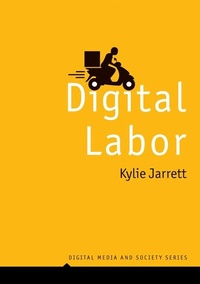
Digital Labor
Description

While the working lives of tech entrepreneurs and delivery platform workers seem far removed, both are engaged in digital labor. What unites their experience and allows us to speak of their work under the same umbrella? Is it even possible to talk about digital labor as if it were a single form of work?
Digital Labor explores these questions and critically examines the economics, politics, and experiences of workers in these new modes of employment. Using a novel definition of the term ''digital labor,'' Kylie Jarrett explores unpaid user activity, platform-mediated gig work, and formal employment within the digital media industries, mapping the common features of these varied practices. Applying a critical Marxian lens, the book interrogates the structures of exploitation in this sector, the organisation of the labor process, the dynamics of alienation associated with this work, and the commodification of workers' lives. It also documents the struggle of digital laborers to resist the iniquities and inequalities of their working environments. Ultimately, the book identifies what is specific about this form of labor and, in doing so, offers insight into the nature of work as it is being reconstituted in digital capitalism.
Synthesising an extensive range of studies and sources, Digital Labor offers a comprehensive overview - and a rich critical appraisal - of work in the high-tech economy. It is suitable for students and scholars of media and communication, sociology, labour studies, and anyone interested in emerging forms of work.
Kylie Jarrett is Associate Professor in the Department of Media Studies at the National University of Ireland, Maynooth.
More details
Other editions
Additional editions
Person
Content
1 Defining Digital Labor
2 Exploitation: Digital Deeds Done Dirt Cheap
3 Process: Of Autonomy and Algorithms
4 Alienation: The Romance of Entrepreneurialism
5 Commodification: Affective Attachment and Inalienable Assets
6 Struggle: The Workers United(ish)
7 Conclusion: Digital Labor on the Edge
Bibliography
Index
2
Exploitation: Digital Deeds Done Dirt Cheap
It is very tempting to make a chapter titled "exploitation" a list of examples of profiteering or wage theft by digital media companies. Such stories are, unfortunately, plentiful. Outsourced contract warehouse workers at Amazon receive fewer benefits than full-time, permanent employees doing the same work (Jamieson 2015). Dynamic pricing systems leave Australian food delivery cyclists underpaid by up to AU$322 per week (Karp 2019). The Huffington Post was bought out by AOL for US$315 million but failed to distribute any of this money to its unpaid contributors (Kirchner 2011). Google has systematically been underpaying temporary workers in Europe, Asia, and the United Kingdom (Wong 2021). However, from a strict Marxist perspective, it would be the height of banality to offer these examples and conclude that digital labor is exploitative. To make this chapter about that conclusion would not actually advance our thinking beyond pointing out that digital labor occurs in a capitalist context.
According to Marx's labor theory of value, exploitation occurs whenever a worker produces more value than they receive as compensation for their labor whenever a capitalist employer generates surplus from a worker's activity. This is the basic relationship of capitalism. The logic goes as follows: a widget maker is hired for an eight-hour day at a rate of ?10/hour. They are able to create 10 widgets in the course of the average day which are then sold by their employer for ?12 each, generating a total revenue of ?120. The worker, though, is only being compensated ?80 of that revenue, meaning that the remaining ?40 is surplus value retained by the employer. This can also be presented in terms of labor-time. To produce value to the equivalent of their salary, the widget maker only needs to work for just over 6.5 hours a day. However, they work for eight hours, meaning there is an hour and a half of work each day for which they are not compensated; work undertaken during this time is, effectively, unpaid labor. The existence of such unpaid work is what constitutes an exploitative labor relationship. Exploitation of workers is thus one of the foundations of value creation in the regime of accumulation that is capitalism - see Grundrisse (Marx 1993 [1939]) for more explanation of this economic concept. Consequently, it would not be surprising to document the economic relations of the digital media industries and find that digital labor is exploitative because all waged labor under capitalism is exploited.
However, there are important questions about whether the framework of exploitation as understood via this labor theory of value applies to all forms of work under consideration here. Not all digital laborers are, formally, waged workers, and so their labor is not able to be interpreted this way. As we will discuss further in the next chapter, there are three main forms of contractual relation between digital laborer and employer across the forms of work under consideration in this book. The first takes the base form of traditional waged labor, which may be linked to an hourly rate or annual salary. This form is commonly experienced by elite, full-time industry professionals as well as some lower-status formal workers. Yet these contracts sometimes reflect non-standard labor relations such as the offsetting of salary into share options. This practice also makes these workers investors in a firm, rather than merely employees, complicating their relationship to value creation. The second form of labor contract in fact has no contract and is the unpaid work associated with users which is typically undertaken during leisure time. While I argue this is exploited labor, this status is contentious because of its uncontracted and uncoerced nature - something we will discuss further below. The third form is self-employment, such as that associated with freelance creative workers, startup entrepreneurs, or platform workers where they are not hired as employees despite experiencing many aspects of a standard employment relationship (see chapter 6). In all three instances, we are looking at some level of self-employment or self-exploitation - where the extraction of surplus is not undertaken directly by an employer - which means that the strict application of the labor theory of value becomes complicated.
Also, the term "exploitation" is often used beyond the formal, structural definition associated with this theory. It is regularly invoked normatively to describe the degree to which surplus value is extracted and/or the cruel, coercive, or cynical conditions through which this extraction occurs. Analyses of exploitation are often focused on describing unfairness and brutality in the work regime under question and speak to the suffering of workers. A useful illustration is in the long-running debate about whether user activity on social media platforms can be understood as exploited labor. In querying this association, Hesmondhalgh (2010: 271) asks "are we really meant to see people who sit at their computers modifying code or typing out responses to TV shows as 'exploited' in the same way as those who endure appalling conditions and pay in Indonesian sweatshops?" Here he equates exploitation with degradation within the workplace, rather than referring to a structural relationship to surplus value creation. This discursive slippage of the term complicates whether it is feasible to describe all the work we are examining as exploitative. While Deliveroo riders like Thiago Cortes, whose untimely death at work begins this book, most certainly qualify to be described as exploited workers, it is less easy to reconcile other digital labors - such as Silicon Valley's young programmers playing foosball in their hip open-plan office and the unpaid users of QQ chatting with each other from their sofas - with this understanding of exploitation.
However, if we shift the central framework of this exploration of digital media labor economics from questions of exploitation to questions of income instability and the precarious labor position that creates, it is possible to combine these two perspectives and develop a more meaningful understanding of what digital labor looks like. Labor insecurity is related to the structural economic relations of work but also to degraded material and psychic conditions for workers; it reflects both the formal and normative definitions of exploitation. I suggest that, rather than trying to understand whether digital labor is exploitative, it is more valuable to consider the various mechanisms through which incomes are made unstable and uncertain by the systems of value generation in the sector. This brings attention to where and how digital labor is made precarious as both cause and effect of the exploitative machinery of the digital media industries. By moving us away from the fiscal accounting of the labor theory of value, this perspective allows us to develop a richer understanding of the qualities of exploitation, even in the contexts of self-employment.
This chapter will thus consider the relationship between precarity and digital labor in more detail before mapping the chronic under-compensation that manifests within the kinds of work under consideration here. It will also consider how this income insecurity is entangled with job insecurity and how these dynamics feature in digital labor. Through this, the chapter will map an exploitative regime that, using a framework from Minh-Ha Pham (2015), imagines digital labor as "cheap." In approaching the topic through the lens of precarity, this chapter does begin on the side of criticism, failing to adequately explore those instances where digital labor - particularly in the form of platform labor - offers opportunities and raises incomes for workers. It also doesn't adequately engage with the high salaries of some formal workers in the tech sector, although as we will see high or better incomes do not insulate workers from the dynamics of instability associated with precarious labor. Some of the desirable aspects of this work are discussed later in the book - particularly in chapter 4 - but for now the focus is on those mechanisms through which surplus value is generated, bringing attention to the tendency toward under-compensation and precarious conditions.
Precarity and digital labor
Central to the changes wrought by post-Fordist and neoliberal economic policies for workers is increased precarity or the condition where instability is so normalized it becomes the basic state: the condition of "stable instability" (Heidelkamp and Kergel 2017). The demand for flexibility in the organization of work, the decline of unions, and the collapse of the industrial compact that promised secure, full-time employment over the latter half of the twentieth century have eroded security for workers. The condition of precarity thus relates to wages that are not secure but also to work contracts and conditions that are moveable and uncertain. Guy Standing (2016; Kalleberg and Vallas 2018; Lorey 2015) takes this further, drawing on the increasing insecurity of social welfare and a generalized pervasive sense of insecurity that typifies neoliberal societies to describe instability as a broadly experienced social malaise. He contends that this experience of precarity is so widespread that it is the foundation of a new class formation: the "precariat." As the exemplary form of labor in the...
