

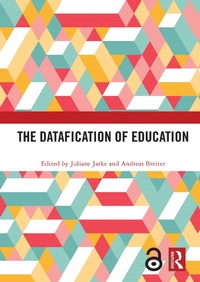
The Datafication of Education
1st Edition
Published on 21. May 2020
130 pages
978-1-000-68260-1 (ISBN)
Description

This book attends to the transformation of processes and practices in education, relating to its increasing digitisation and datafication. The introduction of new means to measure, capture, describe and represent social life in numbers has not only transformed the ways in which teaching and learning are organised, but also the ways in which future generations (will) construct reality with and through data.
Contributions consider data practices that span across different countries, educational fields and governance levels, ranging from early childhood education, to schools, universities, educational technology providers, to educational policy making and governance. The book demonstrates how digital data not only support decision making, but also fundamentally change the organisation of learning and teaching, and how these transformation processes can have partly ambivalent consequences, such as new possibilities for participation, but also the monitoring and emergence/manifestation of inequalities.
Focusing on how data can drive decision making in education and learning, this book will be of interest to those studying both educational technology and educational policy making. The chapters in this book were originally published in Learning, Media and Technology.
Chapter 4 of this book is freely available as a downloadable Open Access PDF at http://www.taylorfrancis.com under a Creative Commons Attribution-Non Commercial-No Derivatives (CC-BY-NC-ND) 4.0 license.
Contributions consider data practices that span across different countries, educational fields and governance levels, ranging from early childhood education, to schools, universities, educational technology providers, to educational policy making and governance. The book demonstrates how digital data not only support decision making, but also fundamentally change the organisation of learning and teaching, and how these transformation processes can have partly ambivalent consequences, such as new possibilities for participation, but also the monitoring and emergence/manifestation of inequalities.
Focusing on how data can drive decision making in education and learning, this book will be of interest to those studying both educational technology and educational policy making. The chapters in this book were originally published in Learning, Media and Technology.
Chapter 4 of this book is freely available as a downloadable Open Access PDF at http://www.taylorfrancis.com under a Creative Commons Attribution-Non Commercial-No Derivatives (CC-BY-NC-ND) 4.0 license.
More details
Edition
1. Auflage
Language
English
Place of publication
London
United Kingdom
Publishing group
Taylor & Francis Ltd
Target group
College/higher education
File size
5,20 MB
ISBN-13
978-1-000-68260-1 (9781000682601)
Copyright in bibliographic data and cover images is held by Nielsen Book Services Limited or by the publishers or by their respective licensors: all rights reserved.
Schweitzer Classification
Other editions
Additional editions
Juliane Jarke | Andreas Breiter
The Datafication of Education
Book
06/2021
1st Edition
Routledge
€62.50
Shipment within 10-20 days
Juliane Jarke | Andreas Breiter
The Datafication of Education
Book
10/2019
1st Edition
Routledge
€179.51
Shipment within 15-20 days
Persons
Juliane Jarke is a Senior Researcher at the University of Bremen, Germany. Her research focuses on public sector innovation, digital (in-)equalities and participatory design.
Andreas Breiter is a Professor at the University of Bremen, Germany, and Scientific Director of the Institute for Information Management Bremen (ifib), working on information management, educational technologies and media/data literacies.
Andreas Breiter is a Professor at the University of Bremen, Germany, and Scientific Director of the Institute for Information Management Bremen (ifib), working on information management, educational technologies and media/data literacies.
Content
Introduction: the data?cation of education 1. Datafied at four: the role of data in the 'schoolification' of early childhood education in England 2. Configuring the teacher as data user: public-private sector mediations of national test data 3. The datafication of discipline: ClassDojo, surveillance and a performative classroom culture 4. The social value of anonymity on campus: a study of the decline of Yik Yak 5. Reconsidering data in learning analytics: opportunities for critical research using a documentation studies framework 6. Objectivity as standardization in data-scientific education policy, technology and governance 7. Datafication, testing events and the outside of thought 8. Cruel optimism in edtech: when the digital data practices of educational technology providers inadvertently hinder educational equity
