

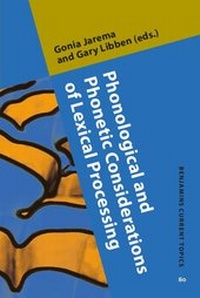
Phonological and Phonetic Considerations of Lexical Processing
1st Edition
Published on 1. October 2015
IX, 233 pages
978-90-272-6792-4 (ISBN)
Description

The human ability to understand and produce spoken words is fascinating in its complexity. People often vary in how they pronounce a word. They may need to recognize words spoken with an accent quite different from their own. And, in order to understand a word of a second or foreign language, they may need to identify words on the basis of sounds that are difficult to differentiate. This book brings together psycholinguistic research that addresses these topics and highlights how the study of spoken word processing can shed light on fundamental dynamics of language processing. It demonstrates how spoken word processing is affected by the specific characteristics of individual languages and their writing systems and how it grows and changes across the lifespan. The book offers new cutting-edge research on spoken word processing. It will benefit researchers and students interested in language processing as well as readers who wish to broaden their understanding of language in the mind. In particular, this book underlines the value of conducting psycholinguistic research across languages and across the lifespan. Originally published in The Mental Lexicon Vol. 8:3 (2013).
More details
Other editions
Additional editions
Gonia Jarema | Gary Libben
Phonological and Phonetic Considerations of Lexical Processing
Book
10/2015
John Benjamins Publishing Co
€95.40
Shipment within 10-15 days
Persons
Content
- Phonological and Phonetic Considerations of Lexical Processing
- Editorial page
- Title page
- LCC data
- Table of contents
- About the contributors
- The integration of phonological and phonetic processing: A matter of sound judgment
- The dynamic nature of the mental lexicon
- Phonological and phonetic processing as a window to dynamic lexical knowledge and processing
- Considering Second Language and bilingual processing as core phenomena
- How do speech and writing influence each other?
- The dynamics of dialect changes over time: Exemplar theory as capturing the interplay
- Morphology, phonology, and phonetics
- Toward a modality-integrated science of lexical processing
- Conclusion: The shape of the future
- References
- How robust are exemplar effects in word comprehension?
- Experiment 1
- Method
- Participants
- Materials
- Procedure
- Analyses
- Results and Discussion
- Experiment 2
- Method
- Participants
- Materials
- Procedure
- Results and Discussion
- Experiment 3
- Method
- Participants
- Materials and Procedure
- Analyses
- Results and Discussion
- Experiment 4
- Method
- Participants
- Materials and Procedure
- Results and Discussion
- Additional Analysis of All Experimental Data
- General Discussion
- Acknowledgments
- Notes
- References
- Appendix
- Stimuli in All Experiments
- Targets
- Repeated Pseudo-Word Foils
- Additional Foils in Experiments 1 and 3
- Pseudo-Words
- Additional Foils in Experiments 2 and 4
- Pseudo-Words
- Repeated Existing Words
- Repeated Pseudo-Words
- Additional Foils in Experiment 4
- Repeated Existing Words
- Repeated Pseudo-Words
- Production and accent affect memory
- The Present Study
- Experiments 1a and 1b
- Method
- Design
- Materials and Counterbalancing
- Participants
- Procedure
- Results and Discussion
- Experiment 1a
- Experiment 1b
- Combined Analyses
- Experiment 2
- Method
- Design
- Materials and Counterbalancing
- Procedure
- Results and Discussion
- General Discussion
- Conclusions
- Acknowledgements
- Notes
- References
- Appendix
- Phonological reduction in the first part of noun compounds: A case study of early child language
- Method
- Results
- Discussion and Conclusion
- References
- Appendix
- The locus of the masked onset priming effect: Evidence from Korean
- Method
- Participants
- Materials and Design
- Procedure
- Results
- Discussion
- Notes
- References
- Appendix
- The reversal of the Bären/Beeren merger in Austrian Standard German
- Reversal of a Merger
- From Distinction to Merger
- The Polycentric Character of German
- Procedure
- The Data
- Measuring the Bären and the Beeren Vowel
- Vowel Normalization
- Pillai-Scores as a Degree of Mergers
- Results
- General Discussion and Conclusions
- Acknowledgements
- Notes
- References
- Appendix
- Corresponding Address
- Asymmetric lexical access and fuzzy lexical representations in second language learners
- Background
- Preliminary Experimental Considerations
- The Current Study
- Experiments 1 and 2: Japanese
- Experiment 1: Categorical Discrimination with ABX
- Methods and Procedure
- Participants
- Results
- Experiment 2: Lexical Decision
- Method and Procedure
- Participants
- Results
- Discussion: Experiments 1 and 2
- Experiments 3 and 4: German
- Experiment 3: Categorical Discrimination with ABX
- Methods and Procedure
- Participants
- Results
- Experiment 4: Lexical Decision
- Method and Procedure
- Participants
- Results
- Discussion: Experiments 3 and 4
- General Discussion
- Acknowledgements
- Notes
- References
- Testing the viability of webDMDX for masked priming experiments
- Experiment 1 - LabDMDX
- Method
- Participants
- Materials and Design
- Procedure
- Results
- Discussion
- Experiment 2 - WebDMDX with "Known" Hardware
- Method
- Participants
- Materials and Design
- Procedure
- Results
- Discussion
- Experiment 3 - WebDMDX with "Unknown" Hardware
- Method
- Participants
- Materials and Design
- Procedure
- Results
- Discussion
- General Discussion and Conclusion
- Notes
- Learning is not decline: The mental lexicon as a window into cognition across the lifespan
- Learning is not decline: The mental lexicon as a window into cognition across the lifespan
- The nature of lexical learning across the lifespan
- Why decline appears to be in the eye of the beholder. And why a cognitive account of lifelong cognit
- Why better functional models of behavior across the lifespan are necessary to understanding the agin
- Understanding lexical processing and understanding lexical learning
- Conclusion: Learning is not decline
- Authors' Note
- References
- Appendix
- Index
