

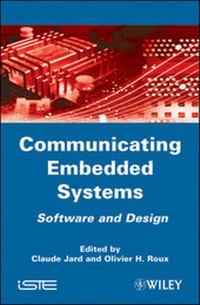
Communicating Embedded Systems
Software and Design
Published on 4. February 2013
288 pages
978-1-118-60012-2 (ISBN)
Description

The increased complexity of embedded systems coupled with quickdesign cycles to accommodate faster time-to-market requiresincreased system design productivity that involves both model-baseddesign and tool-supported methodologies.
Formal methods are mathematically-based techniques and provide aclean framework in which to express requirements and models of thesystems, taking into account discrete, stochastic and continuous(timed or hybrid) parameters with increasingly efficient tools.
This book deals with these formal methods applied tocommunicating embedded systems by presenting the related industrialchallenges and the issues of modeling, model-checking, diagnosisand control synthesis, and by describing the main associatedautomated tools.
Formal methods are mathematically-based techniques and provide aclean framework in which to express requirements and models of thesystems, taking into account discrete, stochastic and continuous(timed or hybrid) parameters with increasingly efficient tools.
This book deals with these formal methods applied tocommunicating embedded systems by presenting the related industrialchallenges and the issues of modeling, model-checking, diagnosisand control synthesis, and by describing the main associatedautomated tools.
More details
Other editions
Additional editions
Software
02/2013
Wiley
€208.18
Shipment within 15-20 days
Book
11/2009
Wiley-ISTE
€164.50
Article not available at the moment
Persons
Claude Jard is full professor at ENS Cachan Campus of Ker-Lann. His research works relate to the formal analysis of asynchronous parallel systems.
Olivier H. Roux is an Assistant Professor at Nantes University and his research focusses on validation and verification of embedded systems, real-time and hybrid systems.
Content
Preface xi
Claude JARD and Olivier H. ROUX
Chapter 1. Models for Real-Time Embedded Systems 1
Didier LIME, Olivier H. ROUX and Ji¡ri SRBA
1.1. Introduction 1
1.2. Notations, languages and timed transition systems 5
1.3. Timed models 8
1.4. Models with stopwatches 23
1.5. Conclusion 31
1.6. Bibliography 31
Chapter 2. Timed Model-Checking 39
Beatrice BERARD
2.1. Introduction 39
2.2. Timed models 40
2.3. Timed logics 46
2.4. Timed model-checking 51
2.5. Conclusion 61
2.6. Bibliography 61
Chapter 3. Control of Timed Systems 67
Franck CASSEZ and Nicolas MARKEY
3.1. Introduction 67
3.2. Timed games 72
3.3. Computation of winning states and strategies 76
3.4. Zeno strategies 82
3.5. Implementability 82
3.6. Specification of control objectives 85
3.7. Optimal control 87
3.8. Efficient algorithms for controller synthesis 92
3.9. Partial observation 96
3.10. Changing game rules 97
3.11. Bibliography 98
Chapter 4. Fault Diagnosis of Timed Systems 107
Franck CASSEZ and Stavros TRIPAKIS
4.1. Introduction 107
4.2. Notations 109
4.3. Fault diagnosis problems 113
4.4. Fault diagnosis for discrete event systems 115
4.5. Fault diagnosis for timed systems 122
4.6. Other results and open problems 136
4.7. Bibliography 136
Chapter 5. Quantitative Verification of Markov Chains139
Susanna DONATELLI and Serge HADDAD
5.1. Introduction 139
5.2. Performance evaluation of Markov models 140
5.3. Verification of discrete time Markov chain 148
5.4. Verification of continuous time Markov chain 157
5.5. State of the art in the quantitative evaluation of Markovchains 160
5.6. Bibliography 162
Chapter 6. Tools for Model-Checking Timed Systems165
Alexandre DAVID, Gerd BEHRMANN, Peter BULYCHEV, Joakim BYG, ThomasCHATAIN, Kim G. LARSEN, Paul PETTERSSON, Jacob Illum RASMUSSEN,Ji¡ri SRBA,Wang YI, Kenneth Y. JOERGENSEN, DidierLIME,MorganMAGNIN, Olivier H. ROUX and Louis-Marie TRAONOUEZ
6.1. Introduction 165
6.2. UPPAAL 166
6.3. UPPAAL-CORA 182
6.4. UPPAAL-TIGA 185
6.5. TAPAAL 199
6.6. ROMEO: a tool for the analysis of timed extensions of Petrinets 205
6.7. Bibliography 217
Chapter 7. Tools for the Analysis of Hybrid Models227
Thao DANG, Goran FREHSE, Antoine GIRARD and Colas LE GUERNIC
7.1. Introduction 227
7.2. Hybrid automata and reachability 228
7.3. Linear hybrid automata 232
7.4. Piecewise affine hybrid systems 234
7.5. Hybridization techniques for reachability computations241
7.6. Bibliography 249
List of Authors 253
Index 259
Claude JARD and Olivier H. ROUX
Chapter 1. Models for Real-Time Embedded Systems 1
Didier LIME, Olivier H. ROUX and Ji¡ri SRBA
1.1. Introduction 1
1.2. Notations, languages and timed transition systems 5
1.3. Timed models 8
1.4. Models with stopwatches 23
1.5. Conclusion 31
1.6. Bibliography 31
Chapter 2. Timed Model-Checking 39
Beatrice BERARD
2.1. Introduction 39
2.2. Timed models 40
2.3. Timed logics 46
2.4. Timed model-checking 51
2.5. Conclusion 61
2.6. Bibliography 61
Chapter 3. Control of Timed Systems 67
Franck CASSEZ and Nicolas MARKEY
3.1. Introduction 67
3.2. Timed games 72
3.3. Computation of winning states and strategies 76
3.4. Zeno strategies 82
3.5. Implementability 82
3.6. Specification of control objectives 85
3.7. Optimal control 87
3.8. Efficient algorithms for controller synthesis 92
3.9. Partial observation 96
3.10. Changing game rules 97
3.11. Bibliography 98
Chapter 4. Fault Diagnosis of Timed Systems 107
Franck CASSEZ and Stavros TRIPAKIS
4.1. Introduction 107
4.2. Notations 109
4.3. Fault diagnosis problems 113
4.4. Fault diagnosis for discrete event systems 115
4.5. Fault diagnosis for timed systems 122
4.6. Other results and open problems 136
4.7. Bibliography 136
Chapter 5. Quantitative Verification of Markov Chains139
Susanna DONATELLI and Serge HADDAD
5.1. Introduction 139
5.2. Performance evaluation of Markov models 140
5.3. Verification of discrete time Markov chain 148
5.4. Verification of continuous time Markov chain 157
5.5. State of the art in the quantitative evaluation of Markovchains 160
5.6. Bibliography 162
Chapter 6. Tools for Model-Checking Timed Systems165
Alexandre DAVID, Gerd BEHRMANN, Peter BULYCHEV, Joakim BYG, ThomasCHATAIN, Kim G. LARSEN, Paul PETTERSSON, Jacob Illum RASMUSSEN,Ji¡ri SRBA,Wang YI, Kenneth Y. JOERGENSEN, DidierLIME,MorganMAGNIN, Olivier H. ROUX and Louis-Marie TRAONOUEZ
6.1. Introduction 165
6.2. UPPAAL 166
6.3. UPPAAL-CORA 182
6.4. UPPAAL-TIGA 185
6.5. TAPAAL 199
6.6. ROMEO: a tool for the analysis of timed extensions of Petrinets 205
6.7. Bibliography 217
Chapter 7. Tools for the Analysis of Hybrid Models227
Thao DANG, Goran FREHSE, Antoine GIRARD and Colas LE GUERNIC
7.1. Introduction 227
7.2. Hybrid automata and reachability 228
7.3. Linear hybrid automata 232
7.4. Piecewise affine hybrid systems 234
7.5. Hybridization techniques for reachability computations241
7.6. Bibliography 249
List of Authors 253
Index 259
