

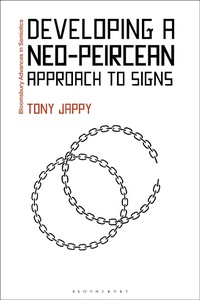
Developing a Neo-Peircean Approach to Signs
1st Edition
Published on 14. December 2023
216 pages
978-1-350-28883-6 (ISBN)
Description

This book takes up a number of Charles Sanders Peirce's undeveloped semiotic concepts and highlights their theoretical interest for a general semiotics.
Peirce's career as a logician spanned almost half a century, during which time he produced several increasingly complex sign systems. The best-known, from 1903, defined amongst other things a signifying process involving sign, object and interpretant, the universally-known icon-index-symbol division and a set of 10 distinct classes of signs. Peirce subsequently expanded this process to include 2 objects, the sign and 3 interpretants. Uncoincidentally, in the 5 years between 1903 and the final system of 1908, he introduced a number of highly innovative semiotic concepts which he never developed.
One such concept is hypoiconicity, which comprises 3 levels of isomorphism holding between sign and object and, in spite of the mutations these varieties of icon subsequently underwent, offers qualitative analysis as a complement to the traditional literal-figurative binarism in the discussion of verbal and nonverbal signs. Another is semiosis, which Peirce introduced and defined in 1907 but only rarely illustrated. Involving a complex combination of object, perception, interpretation and a medium, this is shown to be a far more complex signifying process than the one implicit in the three-correlate definition of the sign of 1903. Exploring the evolving theoretical background to the emergence of these new concepts and showing how they differ from certain contemporary conceptions of sign, mind and signification, the book proposes an introduction to, and explanations and illustrations of, these important developments.
Peirce's career as a logician spanned almost half a century, during which time he produced several increasingly complex sign systems. The best-known, from 1903, defined amongst other things a signifying process involving sign, object and interpretant, the universally-known icon-index-symbol division and a set of 10 distinct classes of signs. Peirce subsequently expanded this process to include 2 objects, the sign and 3 interpretants. Uncoincidentally, in the 5 years between 1903 and the final system of 1908, he introduced a number of highly innovative semiotic concepts which he never developed.
One such concept is hypoiconicity, which comprises 3 levels of isomorphism holding between sign and object and, in spite of the mutations these varieties of icon subsequently underwent, offers qualitative analysis as a complement to the traditional literal-figurative binarism in the discussion of verbal and nonverbal signs. Another is semiosis, which Peirce introduced and defined in 1907 but only rarely illustrated. Involving a complex combination of object, perception, interpretation and a medium, this is shown to be a far more complex signifying process than the one implicit in the three-correlate definition of the sign of 1903. Exploring the evolving theoretical background to the emergence of these new concepts and showing how they differ from certain contemporary conceptions of sign, mind and signification, the book proposes an introduction to, and explanations and illustrations of, these important developments.
More details
Series
Edition
1. Auflage
Language
English
Place of publication
London
United Kingdom
Publishing group
Bloomsbury Publishing PLC
Target group
Professional and scholarly
Illustrations
40 bw illus
ISBN-13
978-1-350-28883-6 (9781350288836)
Copyright in bibliographic data and cover images is held by Nielsen Book Services Limited or by the publishers or by their respective licensors: all rights reserved.
Schweitzer Classification
Other editions
Additional editions
Tony Jappy
Developing a Neo-Peircean Approach to Signs
Book
08/2025
Bloomsbury Academic
€44.20
Shipment within 15-20 days
Tony Jappy
Developing a Neo-Peircean Approach to Signs
Book
01/2024
Bloomsbury Academic
€141.13
Shipment within 15-20 days
Person
Tony Jappy is Honorary Professor of English Linguistics and Semiotics at the University of Perpignan Via Domitia, France.
Content
List of Figures
List of Tables
Acknowledgements
Primary Sources and Abbreviations
Introduction
1. The Problem of Relevance
2. The System of 1903
3. The Transition
4. The System of 1908
5. Approaches to Semiosis
6. Perspectives
Conclusion
Notes
References
Index
List of Tables
Acknowledgements
Primary Sources and Abbreviations
Introduction
1. The Problem of Relevance
2. The System of 1903
3. The Transition
4. The System of 1908
5. Approaches to Semiosis
6. Perspectives
Conclusion
Notes
References
Index
