

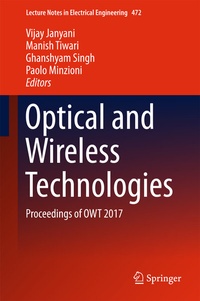
Optical and Wireless Technologies
Description

This book presents selected papers from 1st International Conference on Optical and Wireless Technologies, providing insights into the analytical, experimental, and developmental aspects of systems, techniques, and devices in these spheres. It explores the combined use of various optical and wireless technologies in next-generation networking applications, and discusses the latest developments in applications such as photonics, high-speed communication systems and networks, visible light communication, nanophotonics, and wireless and multiple-input-multiple-output (MIMO) systems. The book will serve as a valuable reference resource for academics and researchers across the globe.
More details
Other editions
Additional editions
Persons
Dr. Vijay Janyani obtained his Bachelors and Masters degrees in Electronics and Communication Engineering (ECE) from Malaviya Regional Engineering College, Jaipur (now MNIT, Jaipur) and his PhD from the George Green Institute for Electromagnetics Research in Nottingham (U.K.). He has received various awards and honours, such as the University of Nottingham's Derrick Kirk Prize, the Commonwealth Scholarship UK, and the All India Council for Technical Education Career Award. He has completed various national and international government-funded research projects, and was a member of the visiting faculty at the AIT Bangkok and UoTEM Tunisia. His current research interests include optical communication, optoelectronics and photonics, numerical modelling, nonlinear optics, radio frequency (RF) and microwaves, optical networks, and solar energy.
Dr. Ghanshyam Singh received his Masters and PhD degrees in ECE from Malaviya National Institute of Technology(MNIT), Jaipur. He has been a visiting scholar/visiting professor at various universities and research centres, in the UK, Finland and Japan. Dr. Singh is engaged in joint research projects with partner researchers from Keio University (Japan), the University of Vienna (Austria), Cairo University (Egypt) and Lviv Polytechnic National University (LNPU) (Ukraine). His current research interests include antenna engineering, micro and nano-structured photonic devices, and networks and non-linear characteristics of photonic crystal fibers.
Dr. Paolo Minzioni completed his PhD studies in 2006 and currently works at the Department of Electrical, Computer and Biomedical Engineering, University of Pavia. He is co-investigator of the European FABULOUS and NISTAS projects. Dr. Minzioni has authored more than 50 research articles in international peer-reviewed journals and he is co-inventor of 6 international patent applications.
Dr. Manish Tiwari received his Ph.D. in Electronics and Communication Engineering (ECE) in the field of Photonics from Malaviya National Institute of Technology (MNIT), Jaipur. He is currently a professor at Manipal University, Jaipur. He was a visiting researcher at City University, London in 2010 and 2011 and Tsinghua University, Beijing, China in 2016. Dr. Tiwari has presented talks at a number of universities in Hong Kong, Bangkok, and London. He has also served on the panel of experts at various workshops. His current research interests include micro/nano-structured photonic devices, nonlinear optics and photonic crystal fibers.
