

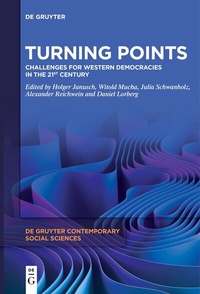
Turning Points
Challenges for Western Democracies in the 21st Century
1st Edition
Published on 18. December 2023
XI, 410 pages
978-3-11-127290-0 (ISBN)
Description

Turning Points: Challenges for Western Democracies in the 21st Century centers around the strikingly under-researched concept of turning points and its application in political science, including various theories, fields, and sub-disciplines. The chapters provide theoretical discussion and conceptual clarity by distinguishing a set of turning points at different analytical levels. Based on a wide range of case studies, the authors illustrate where, when and how different types of turning points occur (or not) against the backdrop of current challenges in and for Western democracies. The conceptual and empirical variety of the volume allows scholars and practitioners in policymaking to develop and apply their own frameworks when dealing with turning point dynamics.
More details
Other editions
Additional editions
Holger Janusch | Witold Mucha | Julia Schwanholz
Turning Points
Challenges for Western Democracies in the 21st Century
Book
11/2024
1st Edition
De Gruyter
€24.95
Shipment within 7-9 days
Holger Janusch | Witold Mucha | Julia Schwanholz
Turning Points
Challenges for Western Democracies in the 21st Century
Book
07/2024
1st Edition
De Gruyter
€99.95
Shipment within 7-9 days
Holger Janusch | Witold Mucha | Julia Schwanholz
Turning Points
Challenges for Western Democracies in the 21st Century
E-Book
12/2023
1st Edition
De Gruyter
€94.95
Available for download
Persons
Holger Janusch is a Professor of International Relations with a special focus on US foreign and security policy at the Department of the Intelligence Services at the Federal University of Applied Sciences for Public Administration in Berlin, Germany. Previously, he worked as an Associate Professor at the Rheinische Friedrich Wilhelms University in Bonn, Germany and as a guest professor at the Andrassy University in Budapest, Hungary. He also was a visiting scholar at the Johns Hopkins University in Washington, DC. His research focus is on power in IR theory, international negotiations, and US foreign and trade policy.
Witold Mucha is an interim Professor of Political Economy with a special focus on the international political economy of the Global South at the Institute of Social Sciences at the Heinrich-Heine University in Duesseldorf, Germany. Previously, he worked as researcher at the Institute for Advanced Studies in the Humanities (KWI) and the Institute for Development and Peace (INEF) at the University of Duisburg-Essen, Germany. He also was a visiting scholar at the Centre for Advanced Internet Studies (CAIS) at the Ruhr University in Bochum, Germany, and the School of Political Science and International Studies (POLSIS) at the University of Queensland in Brisbane, Australia. Before joining academia he has been engaged in development cooperation in Latin America and Sub-Saharan Africa. His research focus is on international relations and peace and conflict studies.
Julia Schwanholz is a political scientist and Senior Lecturer at the University of Duisburg-Essen, Germany. Her expertise lies in parliaments, democracy, and public policy research with an emphasis on digital transformation. She represented interim professorships for democracy research as well as comparative politics and ethics in politics at several German Universities. She has held research assignments in Australia (University of Melbourne; Monash University, Melbourne; Queensland University of Technology, Brisbane), in France (Sciences Po, Paris), in the Netherlands (University of Groningen), in Sweden (Lund University), and in Germany at the Alexander von Humboldt Institute for Internet and Society (HIIG, Berlin).
Alexander Reichwein is a Senior Lecturer in International Relations and PostDoc Researcher at the Department of Political Science at the Justus-Liebig-University Giessen, Germany. He is also a co-speaker of the research section Norms and Changes in Global Politics at the Giessen Graduate Centre for Social Sciences, Business, Economics and Law (GGS). Amongst others, he was a Guest Lecturer and Research Fellow at the University of Copenhagen, Denmark. Alex is doing research on the Intellectual History of the Discipline (I)nternational (R)elations (in particular the European 20th Century theoretical traditions in IR), on the Varieties of Realism in IR and in Foreign Policy Analysis, and on Humanitarian Interventions and the Responsibility to Protect (in particular the misuse of norms by states). Alex holds a PhD in Political Science from the Goethe University Frankfurt with a thesis on Hans J. Morgenthau's liberal and normative Realism (2014).
Daniel Lorberg is science manager, consultant and political economist. Currently he is advisor to the presidency of the University of Fine Arts Essen. Among other positions, he was a Professor of Economics and Business Administration at the Federal University of Applied Administrative Sciences Berlin, general director and director of economics and social sciences at Solar Decathlon Europe, the largest international sustainability competition, lecturer and management director at the Institute of Political Science at the University of Wuppertal, Germany, and founding manager of the IST University of Management. He is an author and editor of various publications in the field of economics and politics and has been a lecturer and visiting scholar at universities in Germany and around the world, including the United States, China, South Africa, and Hungary. His research focuses on change and stability in the relationships between business, government, and society.
Witold Mucha is an interim Professor of Political Economy with a special focus on the international political economy of the Global South at the Institute of Social Sciences at the Heinrich-Heine University in Duesseldorf, Germany. Previously, he worked as researcher at the Institute for Advanced Studies in the Humanities (KWI) and the Institute for Development and Peace (INEF) at the University of Duisburg-Essen, Germany. He also was a visiting scholar at the Centre for Advanced Internet Studies (CAIS) at the Ruhr University in Bochum, Germany, and the School of Political Science and International Studies (POLSIS) at the University of Queensland in Brisbane, Australia. Before joining academia he has been engaged in development cooperation in Latin America and Sub-Saharan Africa. His research focus is on international relations and peace and conflict studies.
Julia Schwanholz is a political scientist and Senior Lecturer at the University of Duisburg-Essen, Germany. Her expertise lies in parliaments, democracy, and public policy research with an emphasis on digital transformation. She represented interim professorships for democracy research as well as comparative politics and ethics in politics at several German Universities. She has held research assignments in Australia (University of Melbourne; Monash University, Melbourne; Queensland University of Technology, Brisbane), in France (Sciences Po, Paris), in the Netherlands (University of Groningen), in Sweden (Lund University), and in Germany at the Alexander von Humboldt Institute for Internet and Society (HIIG, Berlin).
Alexander Reichwein is a Senior Lecturer in International Relations and PostDoc Researcher at the Department of Political Science at the Justus-Liebig-University Giessen, Germany. He is also a co-speaker of the research section Norms and Changes in Global Politics at the Giessen Graduate Centre for Social Sciences, Business, Economics and Law (GGS). Amongst others, he was a Guest Lecturer and Research Fellow at the University of Copenhagen, Denmark. Alex is doing research on the Intellectual History of the Discipline (I)nternational (R)elations (in particular the European 20th Century theoretical traditions in IR), on the Varieties of Realism in IR and in Foreign Policy Analysis, and on Humanitarian Interventions and the Responsibility to Protect (in particular the misuse of norms by states). Alex holds a PhD in Political Science from the Goethe University Frankfurt with a thesis on Hans J. Morgenthau's liberal and normative Realism (2014).
Daniel Lorberg is science manager, consultant and political economist. Currently he is advisor to the presidency of the University of Fine Arts Essen. Among other positions, he was a Professor of Economics and Business Administration at the Federal University of Applied Administrative Sciences Berlin, general director and director of economics and social sciences at Solar Decathlon Europe, the largest international sustainability competition, lecturer and management director at the Institute of Political Science at the University of Wuppertal, Germany, and founding manager of the IST University of Management. He is an author and editor of various publications in the field of economics and politics and has been a lecturer and visiting scholar at universities in Germany and around the world, including the United States, China, South Africa, and Hungary. His research focuses on change and stability in the relationships between business, government, and society.
Content
- Intro
- Preface
- About the Editors
- Contents
- Introduction: Turning Points, Typology, and Puzzles
- I Pushing Back Globalisation? Brexit and Trump
- The impact of globalization and Europeanization on the societal foundations of Brexit
- Brexit: From ever closer union to differentiated integration?
- The American public and Trump's trade war with China
- Digitalization, Trumpismo, and the end of the liberal world order?
- II Challenging the World Order? China, Russia, and Ukraine
- The end of the age of military intervention: Liberal interventionism and global order since the end of the Cold War
- Crowding out the West? China's Belt and Road Initiative and the Asian infrastructure investment bank
- American renewal or decline? The Biden administration, Europe, and the invasion of Ukraine
- III Calling for Social Change? Norms and Practices
- A tipping point in feminist foreign policy in Europe? A constructivist analysis based on the norm life cycle model
- The turning point that was not: The Arab Spring, realism, and the circularity of Western policies toward the Arab world
- Emerging and fading practices in the era of the internet: A reflexive approach to analysing intelligence professionals' changing practices of data collection
- IV Changing Frozen Policies? Migration, Health, and Lobbying
- The 2015 refugee situation as a turning point? Migration- and integration-related debates in the German Bundestag
- COVID-19 as a potential turning point in German health policy
- Obstacles on the path to lobbying transparency in Europe: Assessing the German turning point at the end of the Merkel era
- V Dealing with Crises? Leadership and Market
- Re-regulating the European high-tech capitalism? The EU's digitalization strategy at a turning point after the COVID-19 pandemic
- The Social Market Economy and institutional development: Change in times of crisis
- VI Reflecting on Uncertainty? Epistemics and Critique
- The emergent discourse on global threats and risks: An analysis of the contemporary empirical evidence extant in scientific journals
- On the precipice of the unknown: Discussing the paradigm of uncertainty as a political challenge to Western democracies
- Index
