

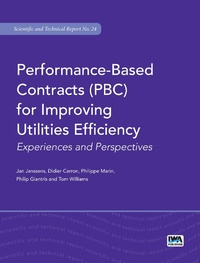
Performance-Based Contracts (PBC) for Improving Utilities Efficiency
Published on 15. August 2018
200 pages
978-1-78040-596-4 (ISBN)
Description

Scientific and Technical Report No. 24
Performance-Based Contracts (PBC) for Improving Utilities Efficiency: Experiences and Perspectives is a compendium of articles written by members of the PBC taskforce. It focuses on new approaches without delegated management to private operator i.e. service contracts, consulting contracts, Alliance approach, public-public partnership. It also mentions new design and generation of more traditional PPPs, (MC, lease, concession), where a larger proportion of performance-based design is being applied.
List of Contents:
Performance Based Contracts - Setting the scene; PBC and Results Based Financing: the inverse approach; PBC and Energy Efficiency; Internal Performance Contracts: A Case of the National Water and Sewerage Corporation in Uganda; Performance-Based Service Contracts in Navi Mumbai; Financial Comparison of PBCs and Conventional Approach; Tegucigalpa PBC Case Study; Performance Based Contracts - Key Design Issues; NRW Reduction Optimization Framework; How to improve water services performance? Performance Based Contracts (PBC) and Regulatory issues; Peer-to-Peer Partnerships Operational for sustainable water services; Performance Based Contracts in Malawi: Teamwork Works; Performance based affermage contracts; Performance based Contracts, The Aroona Integrated Alliance Experience; Experience from Eastern Europe; NRW Performance Contract - Kingdom of Bahrain; The way forward and perspectives/trends
Performance-Based Contracts (PBC) for Improving Utilities Efficiency: Experiences and Perspectives is a compendium of articles written by members of the PBC taskforce. It focuses on new approaches without delegated management to private operator i.e. service contracts, consulting contracts, Alliance approach, public-public partnership. It also mentions new design and generation of more traditional PPPs, (MC, lease, concession), where a larger proportion of performance-based design is being applied.
List of Contents:
Performance Based Contracts - Setting the scene; PBC and Results Based Financing: the inverse approach; PBC and Energy Efficiency; Internal Performance Contracts: A Case of the National Water and Sewerage Corporation in Uganda; Performance-Based Service Contracts in Navi Mumbai; Financial Comparison of PBCs and Conventional Approach; Tegucigalpa PBC Case Study; Performance Based Contracts - Key Design Issues; NRW Reduction Optimization Framework; How to improve water services performance? Performance Based Contracts (PBC) and Regulatory issues; Peer-to-Peer Partnerships Operational for sustainable water services; Performance Based Contracts in Malawi: Teamwork Works; Performance based affermage contracts; Performance based Contracts, The Aroona Integrated Alliance Experience; Experience from Eastern Europe; NRW Performance Contract - Kingdom of Bahrain; The way forward and perspectives/trends
More details
Series
Language
English
Place of publication
London
United Kingdom
Target group
College/higher education
Professional and scholarly
File size
5,79 MB
ISBN-13
978-1-78040-596-4 (9781780405964)
Copyright in bibliographic data and cover images is held by Nielsen Book Services Limited or by the publishers or by their respective licensors: all rights reserved.
Schweitzer Classification
Other editions
Additional editions
Jan Janssens | Didier Carron | Philippe Marin
Performance-Based Contracts (PBC) for Improving Utilities Efficiency
Book
08/2018
IWA Publishing
€160.50
Shipment within 3-4 weeks
Content
- Cover
- Copyright
- Contents
- Principal Authors
- Contributing Authors
- Preface
- Chapter 1: Performance-based contracts - setting the scene
- 1.1 Introduction - PBCs and PPPs
- 1.1.1 Specificity of PBCs
- 1.1.2 Legal framework
- 1.1.3 Designing a PBC
- 1.2 References
- Chapter 2: PBC and results-based financing: The inverse approach
- 2.1 Introduction
- 2.2 The Direct Problem
- 2.3 The Inverse Problem
- 2.4 Case Study
- 2.5 Conclusion
- 2.6 References
- Chapter 3: PBC and energy efficiency
- 3.1 Introduction
- 3.2 Energy Savings from Pumping
- 3.3 Other Energy Efficiency (EE) Possibilities
- 3.4 Performance-Based Contracts For Energy Efficiency
- 3.5 Designing and Implementing an EE Performance-Based Contract
- 3.6 Case Studies
- 3.6.1 Yerevan (Armenia)
- 3.6.2 Emfuleni (South Africa)
- 3.6.3 Larger contracts including an EE performance based component
- 3.6.4 Milwaukee
- 3.6.5 Lynn
- 3.7 References
- Chapter 4: Internal performance contracts: A case of the National Water and Sewerage Corporation in Uganda
- 4.1 Introduction: Why this Chapter?
- 4.2 IPCs at NWSC: Identity Card
- 4.3 Prerequisites for IPC Successful Implementation: Strong Foundations and Competition with the Private Sector
- 4.4 IPCs: An Integral Part of an Organisational Structure, A Management Style and an Organisational Culture
- 4.4.1 Key 1: Making managers accountable
- 4.4.2 Key 2: Motivate the staff
- 4.4.3 Key 3: Monitor and evaluate performance
- 4.4.4 Key 4: Manage resistance to change
- 4.5 IPCs: Only Constant is Change
- 4.5.1 Find the right balance between individual and collective incentive mechanism
- 4.5.2 Adjust the definition of performance over time
- 4.5.3 Find the right balance between control and confidence
- 4.5.4 Keep motivation high
- 4.6 Conclusion
- 4.7 Note
- 4.8 References
- Chapter 5: Performance-based service contracts in Navi Mumbai
- 5.1 Overview
- 5.1.1 Context
- 5.1.2 Current service delivery
- 5.1.3 Water supply management
- 5.2 The Performance-Based Contract Design
- 5.2.1 Overall nature of the PBC
- 5.2.2 Analysis of the contract structure
- 5.2.3 The procurement process
- 5.2.4 Performance monitoring
- 5.3 Implementation and Results Achieved
- 5.3.1 Results achieved
- 5.3.2 Sustainability
- 5.4 Lessons Drawn
- 5.5 References
- Chapter 6: Financial comparison of NRW PBCs and conventional NRW projects
- 6.1 Introduction
- 6.2 Methodology
- 6.3 Results
- 6.3.1 Project effectiveness
- 6.3.2 Project cost efficiency
- 6.3.3 Financial comparison
- 6.4 Conclusions
- Chapter 7: Tegucigalpa PBC case study
- 7.1 Context: How The PBC Came About
- 7.2 The Design of The PBC
- 7.2.1 Overall nature of the PBC
- 7.2.2 Analysis of the contract structure
- 7.2.3 The procurement/tender process
- 7.3 Implementation and Results Achieved
- 7.4 Lessons Drawn
- 7.5 References
- Chapter 8: Performance-based contracts - key design Issues
- 8.1 Introduction
- 8.2 Activities where PBCs are Typically Used
- 8.3 External Factors that can Influence Design of the Contract
- 8.4 Parties to the Contract
- 8.5 Scope of the Contract and PBC Contractor Obligations
- 8.6 Obligations of the Contracting Authority
- 8.6.1 Monitoring and supervision
- 8.6.2 Duration and sustainability of contract
- 8.6.3 Fees and incentives
- 8.6.4 Dispute resolution
- 8.6.5 Early termination
- 8.6.6 Procurement
- 8.7 Acknowledgements
- 8.8 Other Resources
- Chapter 9: NRW reduction optimization framework
- 9.1 Introduction
- 9.2 Optimizing Physical Losses
- 9.2.1 The point at which physical losses are optimized
- 9.2.2 Deriving the supply curve for physical loss reduction
- 9.2.3 The various benefits of physical loss reduction
- 9.2.4 Estimating the value of deferred capital costs
- 9.3 Optimizing for Service
- 9.3.1 The interaction between physical losses and hours of supply
- 9.3.2 Valuing benefits from increased duration of supply and increased access
- 9.4 Optimizing Commercial Losses
- 9.5 A General Optimization Framework
- 9.6 Conclusions
- 9.7 Note
- 9.8 References
- Chapter 10: How to improve water services performance
- 10.1 Introduction
- 10.2 A Strong Water and Sanitation Governance
- 10.3 A Smart PBC Design
- 10.3.1 Baselines, targets and incentives
- 10.3.2 Ensure mitigation of risks and leave room for flexibility
- 10.3.3 Develop an integrated approach
- 10.4 A Resilient Economic Model
- 10.4.1 Enhanced financial sustainability
- 10.4.2 A sustainable territorial anchorage
- 10.5 Conclusion
- 10.6 References
- Chapter 11: Performance-based contracts (PBC) and regulatory issues
- 11.1 Background
- 11.2 Monitoring and Evaluating Utilities
- 11.2.1 Building information systems with key performance indicators (KPIs) that enable regulators to monitor, and evaluate operators
- 11.2.2 Setting performance targets and monitoring performance with limited data
- 11.2.3 Developing incentives for quality improvements, cost containment and network/service expansion
- Chapter 12: Peer-to-peer partnerships operational for sustainable water services
- 12.1 Introduction
- 12.2 The Water Operator Partnership
- 12.3 Components of an Operational Partnership
- 12.3.1 Preparing a WOP
- 12.3.2 Incentives: yes or no?
- 12.3.3 Priority setting in performance improvement
- 12.3.4 Conditional factors for WOP success
- 12.4 Summary and Recommendations
- 12.5 References
- Chapter 13: Performance-based contracts in Malawi: Teamwork works
- 13.1 The Context: How the PBC Came About
- 13.2 The Design of the PBC
- 13.2.1 Overall nature of the PBC
- 13.2.2 What is the PBC about?
- 13.3 Performance Contract Design
- 13.3.1 Services to be provided
- 13.3.2 The remuneration structure
- 13.3.3 Performance regime: a "stick and carrot" approach
- 13.4 The Procurement/Tender Process
- 13.4.1 The pre-qualification stage
- 13.4.2 The proposal stage
- 13.5 Implementation and Results Achieved
- 13.5.1 The "office" phase
- 13.5.2 The "operations" phase
- 13.5.3 The extension phase
- 13.5.4 Remuneration
- 13.6 Did the Contract Achieve and Sustain Results?
- 13.6.1 Internalities
- 13.6.2 Externalities
- 13.7 Reflections on Performance-Based Service Contracting
- 13.8 Acknowledgements
- 13.9 References
- Chapter 14: Performance-based affermage contracts
- 14.1 The Basics of the Affermage Contract
- 14.2 Differences and Similarities Between the Affermage and Other Operations Contracts
- 14.3 Affermage Contracts from the 19th Century Until Today In France
- 14.4 The Way to a Second Generation of Affermage Contracts
- 14.5 The Performance-Based Affermage (PBA) Model
- 14.6 The Earning Logic
- 14.7 Technical Performance Indicators
- 14.8 Financial Performance Indicators
- 14.9 Case Study: The Sedif
- 14.10 Sedif: Return of Experience 2011-2013
- 14.11 Conclusion
- 14.12 References
- Chapter 15: Performance-based contracts, the Aroona Integrated Alliance experience
- 15.1 Case Study Detail
- 15.1.1 The Aroona Integrated Alliance to deliver improvements in water and wastewater services
- 15.1.2 A commercial framework set up to generate the right behaviour
- 15.1.3 Alliance governance
- 15.1.4 The "good to great" strategy to deliver a step change
- 15.1.5 A governance model is in place to ensure business improvements are sustainable
- 15.1.6 A Business improvement program designed to deliver sustainable cost efficiencies
- 15.1.7 The cultural and the change management challenge
- 15.1.8 Main achievements two years after the Good to Great strategy inception
- 15.2 Conclusion
- Chapter 16: Experience from Eastern Europe
- Chapter 17: Performance-based contracts (PBCs) for improving utilities efficiency: Experiences and perspectives: The way forward and perspectives/trends
- 17.1 Summary of Discussions of 31 October 2016
- Index
