

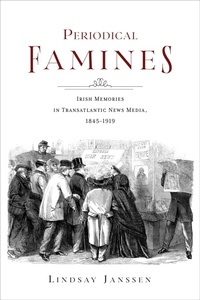
Periodical Famines
Description

Long recognized as Ireland's greatest demographic disaster in recent memory, the Great Famine of 1845-1851 has shaped Irish identities around the world. From the monuments erected to commemorate its victims to the political rhetoric involving it to the novels, poems, songs, and films that it continues to inspire, the Famine remains a crucial part of Irish memory. Famine memories have also reached across history and national borders to affect cultural groups who were not directly connected to the Irish diaspora.
Periodical Famines reveals how, within the transatlantic Irish periodical market between 1845 and 1910, Irish, Irish American, and Irish Canadian newspapers and magazines acted as carriers and shapers of cultural identities. Lindsay Janssen argues that Famine memory was deployed transhistorically to help represent other crucial events in the Irish past, and periodicals used Famine recollections transculturally to give new meaning to events outside of Ireland, such as the Second Boer War and labor issues in the United States. Moving beyond individual writings to interrogate how different texts printed within a periodical issue influenced each other and affected audiences' attitudes to Irish hunger and distress, Janssen's co-textual approach reveals the intricate and sometimes divergent paths that Famine memory traveled through in the decades during and after its onset.
Drawing upon more than 500 creative and nonfiction periodical publications, Periodical Famines is a thorough analysis of transatlantic Irish periodical culture during and after the Great Famine, demonstrating how periodicals' transmission of Famine memories shaped global cultures.
More details
Other editions
Additional editions
Person
Lindsay Janssen is Assistant Professor at the Department of Modern Languages and Cultures at Radboud University. She is editor (with Marguérite Corporaal, Christopher Cusack, and Ruud van den Beuken) of Global Legacies of the Great Irish Famine: Transnational and Interdisciplinary Perspectives; (with Christian Noack and Vincent Comerford) of Holodomor and Gorta Mór: Histories, Memories and Representations of Famine in Ukraine and Ireland; and (with Marguérite Corporaal and Christopher Cusack) of Recollecting Hunger: An Anthology.
Content
Acknowledgments
Introduction
Section I: Transhistorical Connections
1. Famine Print Patterns
2. Famine and Temporal Stasis in a Story Paper: Young Ireland Magazine, 1875-88
3. Special Correspondence on Ireland in the Early 1880s: Current and Past Famines in Margaret Dixon McDougall's "A Tour through Ireland"
4. Famine, Fiction, and Historicity in The Irish Packet during the First Years of the Twentieth Century
Section II: Diasporic and Transnational Connections
5. "Famine, or Farms": McGee's Illustrated Weekly and the Betterment of the Poor Laborer's Lot, 1876-82
6. Humiliating the Nation: Imperial Oppression, Gender, and Hunger in Maud Gonne's Periodical Writings on Ireland and South Africa, 1898-1904
7. Imperialism versus Economic Progress: The Irish World and American Industrial Liberator and Robert Ellis Thompson on Famines in Ireland and India at the Turn of the Twentieth Century
Conclusion: Travelling Irish Famine Memories in Transatlantic Periodical Culture
Appendix 1: Margaret Dixon McDougall, "A Tour Through Ireland," Daily Witness, April 16, 1881
Appendix 2: Margaret Dixon McDougall, "A Tour Through Ireland," Daily Witness, July 27, 1881
Appendix 3: Robert Ellis Thompson, "Free Trade Slays Millions," Irish World, February 20, 1897
Appendix 4: Chronological List of Creative Works which Contain Famine
Bibliography
Index
