

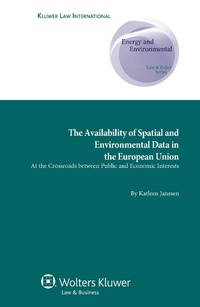
The Availability of Spatial and Environmental Data in the European Union
At the Crossroads between Public and Economic Interests
Published on 7. September 2010
652 pages
978-90-411-4887-2 (ISBN)
Description

Because the original and essential value of spatial data ' data that refer to specific geographical locations or areas ' lies in environmental decision-making, such data mostly originate in the public sector and are made available to people,
More details
Other editions
Additional editions
Katleen Janssen
Availability of Spatial and Environmental Data in the European Union
At the Crossroads between Public and Economic Interests
Book
07/2010
1st Edition
Kluwer Law International
€180.50
Shipment within 10-20 days
Content
- Cover
- Half Title Page
- Editorial Board
- Title Page
- Copyright Page
- Author Information
- Summary of Contents
- Table of Contents
- Preface
- Acknowledgement
- List of Abbreviations and Short References
- Chapter 1 Introduction
- I. SETTING
- A. SPATIAL DATA
- B. PUBLIC SECTOR SPATIAL DATA
- C. VALUE OF PUBLIC SECTOR SPATIAL DATA
- D. THE ROLE OF THE PUBLIC SECTOR IN MAKING SPATIAL DATA AVAILABLE
- E. THE LEGAL FRAMEWORK FOR THE AVAILABILITY OF PUBLIC SECTOR SPATIAL DATA
- II. THE PROBLEMATIC CHARACTER OF THE EU LEGAL FRAMEWORK FOR THE AVAILABILITY OF PUBLIC SECTOR SPATIAL DATA
- III. STRUCTURE AND OUTLINE OF THE FOLLOWING CHAPTERS
- A. STRUCTURE
- B. OUTLINE
- Chapter 2 Scope and Definitions
- I. INTRODUCTION
- II. SCOPE FROM THE POINT OF VIEW OF THE LEGISLATION
- III. SCOPE FROM THE POINT OF VIEW OF THE TYPE OF DATA
- A. SPATIAL DATA
- 1. Data
- a. Data or Information
- b. Information or Document
- 2. Spatial
- 3. Spatial Data
- B. SPATIAL DATA UNDER THE INSPIRE DIRECTIVE
- C. ENVIRONMENTAL DATA
- 1. Environmental
- 2. Environmental Information in the Access Directive
- 3. Environmental Information in the Aarhus Convention
- D. PUBLIC SECTOR DATA
- 1. Public Sector Information - Government Information - Public Information - Public Domain Information
- 2. Public Sector Documents under the PSI Directive
- IV. SCOPE FROM THE POINT OF VIEW OF THE ORGANIZATIONS HOLDING THE DATA
- A. PUBLIC SECTOR AND RELATED TERMS
- 1. Public Sector
- 2. State and Government
- 3. Administration
- 4. Public Service
- B. PUBLIC AUTHORITIES UNDER THE ACCESS DIRECTIVE AND THE INSPIRE DIRECTIVE
- 1. The Definition of Public Authority in the Access Directive
- 2. The Definition of Public Authority in the INSPIRE Directive
- 3. The Definition of Public Authority in the Aarhus Convention
- C. PUBLIC SECTOR BODIES UNDER THE PSI DIRECTIVE
- 1. The Definition of the PSI Directive
- 2. Contracting Authorities under the Public Procurement Directives
- a. State, Regional, and Local Authorities
- b. Bodies Governed by Public Law
- i. Meeting Needs in the General Interest Not Having an Industrial or Commercial Character
- ii. The Close Dependency Test
- c. Associations Formed by One or Several Authorities or One or Several Bodies Governed by Public Law
- d. Relevance for the PSI Directive
- D. COMMON DENOMINATOR BETWEEN PUBLIC SECTOR BODIES AND PUBLIC AUTHORITIES
- V. COMMON DENOMINATOR BETWEEN SPATIAL DATA, PUBLIC SECTOR DATA, AND ENVIRONMENTAL DATA
- VI. SCOPE FROM THE POINT OF VIEW OF THE PURPOSE OF USE
- A. ACCESS
- B. RE-USE
- C. SHARING
- D. INTERIM SUMMARY
- VII. A FIRST INDICATION OF THE PROBLEMATIC CHARACTER OF THE EU LEGAL FRAMEWORK FOR THE AVAILABILITY OF PUBLIC SECTOR SPATIAL DATA
- Chapter 3 Existing Legal Framework for the Availability of Public Sector Spatial Data
- I. INTRODUCTION
- II. ACCESS
- A. INTRODUCTION
- B. THE ACCESS DIRECTIVE
- 1. History: Directive 90/313/EEC
- a. Access upon Request
- b. Dissemination by Public Authorities of their Own Motion
- c. Follow-Up
- 2. The Access Directive
- a. Introduction
- b. Objectives
- c. Definitions
- d. Access to Environmental Information upon Request
- i. General Principle
- ii. Time Limits
- iii. Requests Formulated in Too General a Manner
- iv. Form or Format of the Information
- v. Facilitating Measures
- vi. Exceptions to the Right of Access
- vii. Charges
- e. Access to Justice
- f. Dissemination of Environmental Information
- g. Quality of Environmental Information: Article 8 of the Access Directive
- 3. Review of the Access Directive
- C. INSPIRE DIRECTIVE
- 1. Introduction
- 2. The INSPIRE Directive and the Access Directive
- 3. Access to Network Services
- a. Establishment of Network Services
- b. Limitation of Access to Network Services
- c. Charges for Network Services
- III. RE-USE
- A. HISTORY
- 1. Guidelines for Improving the Synergy between the Public and Private Sectors in the Information Market
- 2. The Publaw Reports
- 3. The Stockholm Conference and the 1997 Bonn Ministerial Conference
- 4. The Green Paper on Public Sector Information
- 5. The eEurope 2002 Communication
- B. THE PSI DIRECTIVE
- 1. Objective
- 2. Title
- 3. Subject Matter and Scope
- a. Introduction
- b. Re-use of Existing Documents
- c. Re-use by any Natural or Legal Person
- d. Practical Means of Facilitating Re-use
- e. Limitations on the Field of Application
- i. Documents the Supply of which is an Activity Falling outside of the Public Task
- ii. Documents for which Third Parties Hold Intellectual Property Rights
- iii. Documents Excluded from Access
- iv. Documents held by Public Service Broadcasters
- v. Documents held by Educational, Research, and Cultural Establishments
- f. Documents Containing Personal Data
- 4. Definitions
- a. Public Sector Body
- b. Document
- c. Re-use
- d. Held by
- e. Public Task
- 5. General Principle
- 6. Requirements for the Processing of Requests for Re-use
- a. Time Limits
- b. Communication of the Grounds for Refusal and the Means of Redress
- 7. Conditions for Re-use
- a. Available Formats
- b. Charges
- c. Transparency
- d. Licenses
- e. Practical Arrangements
- 8. Non-discrimination
- 9. Prohibition of Exclusive Arrangements
- C. THE REVIEW OF THE PSI DIRECTIVE
- IV. SHARING
- A. HISTORY
- B. PREPARATORY PHASE
- C. THE INSPIRE DIRECTIVE
- 1. Objective and General Provisions
- 2. Network Services
- 3. Data Sharing
- a. General Principle
- b. Restrictions at the Point of Use
- c. Licensing and Charging
- d. Authorities outside the Borders of the Member States
- e. Limitations on Sharing
- f. References to Re-use?
- V. SUMMARY
- A. ACCESS
- B. RE-USE
- C. SHARING
- D. DIFFERENCES BETWEEN THE RULES ON ACCESS, RE-USE, AND SHARING
- 1. Obligatory Character
- 2. Limitations on the Availability of Data
- 3. Charges
- 4. Time Limits
- E. TOWARDS THE NEXT CHAPTER
- Chapter 4 The Problematic Character of the EU Legal Framework for the Availability of Public Sector Spatial Data
- I. THE DISTINCTION BETWEEN ACCESS, RE-USE, AND SHARING
- II. IMPORTANCE OF THE DIFFERENCE BETWEEN ACCESS, RE-USE, AND SHARING
- III. EXAMPLE: CHARGING FOR PUBLIC SECTOR SPATIAL DATA
- A. INTRODUCTION
- B. EXISTING RULES ON CHARGES FOR ACCESS, RE-USE, AND SHARING IN THE ACCESS DIRECTIVE, THE PSI DIRECTIVE, AND THE INSPIRE DIRECTIVE
- C. BASIS OF THE DEBATE ON CHARGING: COST RECOVERY V. OPEN ACCESS
- 1. Background of the Debate
- 2. Description of the Open Access and Cost Recovery Models
- 3. Demarcation between Open Access and Cost Recovery
- D. ARGUMENTS FOR OPEN ACCESS AND COST RECOVERY
- 1. Introduction
- 2. 'Democratic Arguments': Open Access Increases Democracy and Participation of the Citizen
- 3. The 'Why Pay Twice' Arguments
- a. 'The Investments Have Been Made for the Public Task'
- b. 'The Taxpayer Has Already Paid'
- c. 'Charges Between Public Bodies Merely Shift the Budget'
- 4. 'The Macro-Economic Arguments': Open Access Is an Incentive for Economic Activity and Economic Growth
- 5. 'The Micro-Economic Argument': Better Performance of the Public Bodies
- a. Quality of the Data
- b. Quality and Efficiency of the Service
- c. Liability
- d. Transaction Costs of Charging for Public Sector Spatial Data
- 6. 'The Political Argument': Cost Recovery Improves the Negotiation Position of the Public Body
- 7. Evaluation of the Arguments
- IV. PROBLEMATIC CHARACTER OF THE DISTINCTION BETWEEN ACCESS, RE-USE, AND SHARING
- Chapter 5 Obligations to Make Public Sector Spatial Data Available in International and European Legislation and Policy Documents
- I. INTRODUCTION
- II. THE OBLIGATION OF MAKING PUBLIC SECTOR SPATIAL DATA AVAILABLE FOR ACCESS
- A. INTRODUCTION
- B. THE OBLIGATION OF MAKING PUBLIC SECTOR DATA AVAILABLE FOR ACCESS AS A PART OF FREEDOM OF INFORMATION
- 1. United Nations
- a. Universal Declaration on Human Rights
- b. The International Covenant on Civil and Political Rights
- 2. Council of Europe
- a. The European Convention on the Protection of Human Rights and Fundamental Freedoms
- b. Documents of the Council of Ministers and the Parliamentary Assembly
- c. The Case Law of the European Court of Human Rights
- 3. Interim Summary
- C. INTERNATIONAL AND EUROPEAN DOCUMENTS
- 1. Access: From Passive to Active?
- 2. United Nations
- a. United Nations Special Rapporteur on Freedom of Opinion and Expression
- b. United Nations Educational, Scientific and Cultural Organization (UNESCO)
- 3. Organization for Economic Co-operation and Development
- a. Report on Digital Broadband Content: Public Sector Information and Content
- b. Recommendation for Enhanced Access and More Effective Use of Public Sector Information
- 4. Council of Europe
- a. Recommendation 854 (1979) of the Parliamentary Assembly on Access by the Public to Government Records and Freedom of Information
- b. Recommendation No. R(81)19 of the Committee of Ministers on the Access to Information Held by Public Authorities
- c. Recommendation Rec(2002)2 of the Committee of Ministers to Member States on Access to Official Documents
- d. Convention on Access to Official Documents
- 5. European Union
- a. Access to Public Sector Data Held by the European Union Institutions and Bodies
- i. Article 15 of the Treaty on the Functioning of the European Union (Former Article 255 of the EC Treaty)
- ii. Article 42 of the Charter of Fundamental Rights of the EU
- iii. Regulation 1049/2001 Regarding Public Access to European Parliament, Council, and Commission Documents
- iv. Towards a Review of Regulation 1049/2001: the Green Paper on Public Access to Documents Held by Institutions of the European Community
- b. Access to Public Sector Data Held by the Member States
- i. Publaw Reports
- ii. Green Paper on Public Sector Information
- D. THE OBLIGATION OF MAKING ENVIRONMENTAL DATA AVAILABLE FOR ACCESS IN EUROPEAN AND INTERNATIONAL DOCUMENTS
- 1. United Nations
- a. Rio Declaration on Environment and Development
- b. Guidelines for Access to Environmental Information
- c. The Aarhus Convention
- i. Background
- ii. Article 3 of the Aarhus Convention: General Provisions
- iii. Article 4 of the Aarhus Convention: Access to Information upon Request
- iv. Article 5 of the Aarhus Convention: Dissemination of Environmental Information
- 2. Organization for Economic Cooperation and Development: Recommendation of the Council on Environmental Information
- 3. Council of Europe: The Lugano Convention
- 4. European Union
- a. Access to Documents Held by the Community Institutions and Bodies: Regulation 1367/2006
- b. Access to Documents Held by Member States
- i. Directive 90/313/EEC
- ii. Access Directive
- iii. Access to Documents Held by Member States and the European Union: Shared Environmental Information System (SEIS)
- E. THE OBLIGATION OF MAKING SPATIAL DATA AVAILABLE FOR ACCESS IN EUROPEAN AND INTERNATIONAL DOCUMENTS
- 1. United Nations
- a. United Nations Spatial Data Infrastructure
- b. Global Earth Observation System of Systems
- 2. European Union
- a. The INSPIRE Directive
- b. Global Monitoring for Environment and Security (Kopernikus)
- F. INTERIM SUMMARY
- III. THE OBLIGATION OF MAKING PUBLIC SECTOR SPATIAL DATA AVAILABLE FOR RE-USE
- A. INTRODUCTION
- B. DOES FREEDOM OF INFORMATION INCLUDE A RIGHT TO RE-USE THE INFORMATION?
- C. INTERNATIONAL AND EUROPEAN DOCUMENTS
- 1. United Nations
- a. UNESCO Policy Guidelines
- b. United Nations Spatial Data Infrastructure
- c. Global Earth Observation System of Systems
- 2. Organization for Economic Cooperation and Development
- 3. Council of Europe
- 4. European Union
- a. Synergy Guidelines
- b. The Publaw Reports
- c. Green Paper on Public Sector Information
- d. eEurope 2002 Communication
- e. The PSI Directive
- f. The Commission Decision on the Re-use of Commission Information
- g. Global Monitoring for Environment and Security (Kopernikus)
- D. INTERIM SUMMARY
- IV. THE OBLIGATION OF MAKING PUBLIC SECTOR SPATIAL DATA AVAILABLE FOR SHARING
- A. INTRODUCTION
- B. INTERNATIONAL AND EUROPEAN DOCUMENTS
- 1. United Nations
- a. Rio Declaration and Agenda 21
- b. Framework Convention on Climate Change
- c. United Nations Spatial Data Infrastructure
- d. Global Earth Observation System of Systems
- 2. European Union
- a. INSPIRE
- b. Shared Environmental Information System (SEIS)
- c. Global Monitoring for Environment and Security
- C. INTERIM SUMMARY
- V. CONCLUSION AND OUTLOOK TOWARDS THE NEXT CHAPTER: WHAT IS THE SCOPE OF THE OBLIGATIONS OF THE PUBLIC BODIES TO MAKE PUBLIC SECTOR SPATIAL DATA AVAILABLE?
- Chapter 6 Defining the Distinctions between Access, Re-use, and Sharing
- I. INTRODUCTION
- II. TYPE OF USER TO WHOM PUBLIC SECTOR SPATIAL DATA IS MADE AVAILABLE
- A. USERS REQUESTING PUBLIC SECTOR SPATIAL DATA FOR ACCESS
- B. USERS REQUESTING PUBLIC SECTOR SPATIAL DATA FOR RE-USE
- C. USERS REQUESTING PUBLIC SECTOR SPATIAL DATA FOR SHARING
- III. TYPE OF PUBLIC SECTOR SPATIAL DATA THAT IS MADE AVAILABLE
- A. TYPOLOGIES OF PUBLIC SECTOR DATA
- B. TYPES OF PUBLIC SECTOR DATA BASED ON THE CONTENT
- 1. Spatial Data
- 2. Environmental Data
- C. TYPES OF PUBLIC SECTOR SPATIAL DATA BASED ON THE LEVEL OF PROCESSING
- D. TYPES OF PUBLIC SECTOR SPATIAL DATA BASED ON FORMAT AND VOLUME
- E. INTERIM SUMMARY
- IV. THE PURPOSE FOR WHICH PUBLIC SECTOR SPATIAL DATA SHOULD BE MADE AVAILABLE
- A. DEMOCRATIC OBJECTIVES
- 1. Transparency
- 2. Public Participation
- 3. Legitimacy and Accountability
- 4. Fulfilling One's Rights and Obligations
- B. SOCIO-ECONOMIC OBJECTIVES
- 1. Participation in Society: Societal Growth
- 2. Development of Communities
- 3. Economic Growth
- 4. Public Sector Spatial Data as a Public Good
- a. What Is a Public Good?
- b. Is Information a Public Good?
- c. Is Public Sector Spatial Data a Public Good?
- C. BETTER DECISION MAKING
- D. INTERIM SUMMARY
- V. THE PROBLEMATIC CHARACTER OF THE DISTINCTIONS BETWEEN ACCESS, RE-USE, AND SHARING
- A. ACCESS AND RE-USE
- B. RE-USE AND SHARING
- Chapter 7 The Public Task of Providing Spatial Information Services in International and European Legislation and Policy Documents
- I. INTRODUCTION
- II. THE SCOPE OF THE PUBLIC TASK OF PROVIDING INFORMATION SERVICES FROM A POSITIVE POINT OF VIEW
- A. INTRODUCTION
- B. THE PUBLIC TASK OF PROVIDING SPATIAL INFORMATION SERVICES AS PART OF FREEDOM OF INFORMATION?
- 1. United Nations
- a. Universal Declaration on Human Rights
- b. The International Covenant on Civil and Political Rights
- 2. Council of Europe
- a. The European Convention on the Protection of Human Rights and Fundamental Freedoms
- b. Documents of the Committee of Ministers and the Parliamentary Assembly
- c. The Case Law of the European Court of Human Rights
- 3. Interim Summary
- C. THE PUBLIC TASK OF PROVIDING PUBLIC SECTOR INFORMATION SERVICES IN INTERNATIONAL AND EUROPEAN DOCUMENTS
- 1. Introduction
- 2. United Nations
- a. UN Special Rapporteur on Freedom of Opinion and Expression
- b. United Nations Economic, Social and Cultural Organization (UNESCO)
- 3. Organization for Economic Co-operation and Development
- 4. Council of Europe
- a. Recommendation No. R(81)19 of the Committee of Ministers on the Access to Information Held by Public Authorities
- b. Recommendation Rec(2002)2 of the Committee of Ministers to Member States on Access to Official Documents
- c. Convention on Access to Official Documents
- 5. European Union
- a. The Provision of Information Services by the European Union Institutions and Bodies
- i. Regulation 1049/2001 Regarding Public Access to European Parliament, Council, and Commission Documents
- ii. Green Paper on Public Access to Documents held by Institutions of the European Community
- b. Documents Held by the Member States
- i. Publaw Reports
- ii. Green Paper on Public Sector Information
- D. THE PUBLIC TASK OF PROVIDING ENVIRONMENTAL INFORMATION SERVICES IN EUROPEAN AND INTERNATIONAL DOCUMENTS
- 1. United Nations
- a. Rio Declaration on Environment and Development and Agenda 21
- b. Guidelines for Access to Environmental Information
- c. The Aarhus Convention
- 2. OECD: Recommendation of the Council on Environmental Information
- 3. European Union
- a. Access to Documents Held by the European Union Institutions and Bodies: Regulation 1367/2006
- b. Access to Documents Held by Member States
- i. Directive 90/313/EEC
- ii. Access Directive
- c. Access to Documents Held by the Member States and the Institutions and Bodies of the European Union: Shared Environmental Information System (SEIS)
- E. THE PUBLIC TASK OF PROVIDING SPATIAL INFORMATION SERVICES IN EUROPEAN AND INTERNATIONAL DOCUMENTS
- 1. United Nations: Global Earth Observation System of Systems
- 2. European Union
- a. The INSPIRE Directive
- b. Global Monitoring for Environment and Security: (Kopernikus)
- F. INTERIM SUMMARY
- III. THE SCOPE OF THE PUBLIC TASK OF PROVIDING INFORMATION SERVICES FROM A NEGATIVE POINT OF VIEW
- A. INTRODUCTION
- B. THE LIMITS ON THE PUBLIC TASK IN EUROPEAN AND INTERNATIONAL DOCUMENTS
- 1. Organization for Economic Cooperation and Development
- 2. European Union
- a. Guidelines for Improving the Synergy between the Public and the Private Sectors in the Information Market
- b. Publaw Reports
- c. Green Paper on Public Sector Information
- d. The eEurope 2002 Communication
- e. PSI Directive
- f. Commission Decision on the Re-use of Commission Information
- g. Review of the PSI Directive
- C. INTERIM SUMMARY
- IV. TOWARDS THE NEXT CHAPTER: WHAT IS THE SCOPE OF THE PUBLIC TASK OF PROVIDING INFORMATION SERVICES?
- Chapter 8 The Possibility of Defining the Public Task
- I. INTRODUCTION
- II. THE QUESTION OF THE SCOPE OF THE PUBLIC TASK
- A. INTRODUCTION
- B. RECOGNITION OF THE PROBLEM
- C. IMPACT OF THE LACK OF DEFINITION OF THE PUBLIC TASK
- D. THE WHAT-QUESTION AND THE HOW-QUESTION
- III. ATTEMPTS AT CRITERIA TO DETERMINE THE PUBLIC TASK
- A. INTRODUCTION
- B. THE POSITIVE APPROACH: WHAT THE PUBLIC BODIES SHOULD DO
- 1. Legal Basis
- 2. Link with the Core Responsibility of the Public Body
- 3. Market Failure
- 4. Public Interest
- a. General
- b. Concretization of Public Interest: Accessibility
- i. Aspects of Accessibility
- ii. Measures to Ensure Accessibility
- iii. The Dilemma in Ensuring Accessibility
- iv. Link with the Discussion on Raw Data and Added Value
- v. Dilemma of the Public Task
- c. Concretization of Public Interest: Types or Target Groups of Information Services
- d. Concretization of Public Interest: Universal Service
- i. The Concept and Characteristics of Universal Service
- ii. Approaches to the Universal Service Concept
- iii. The Usefulness of the Concept for Spatial Information Services
- 5. Interim Summary
- C. THE NEGATIVE APPROACH: WHAT THE PUBLIC BODIES SHOULD NOT DO
- D. PUBLIC TASK V. MARKET: AN ABSOLUTE DEMARCATION LINE?
- 1. Not Exhaustive
- 2. Not Mutually Exclusive
- a. Selling Information Products as Part of the Public Task
- i. General
- ii. The Example of the Ordnance Survey
- b. Market Services in the Public Interest
- E. THE PUBLIC TASK DEBATE AND COMPETITION LAW
- IV. COMPETITION LAW
- A. PUBLIC BODIES AS UNDERTAKINGS
- 1. Definition
- 2. The State or Public Bodies as Undertakings
- 3. Applicability to Spatial Information Services
- B. DISTORTIONS OF COMPETITION BY PUBLIC BODIES PROVIDING SPATIAL INFORMATION SERVICES AS UNDERTAKINGS
- 1. Article 101 Treaty on the Functioning of the EU: Agreements between Undertakings
- a. General
- b. Applicability to Spatial Information Services
- 2. Article 102 Treaty on the Functioning of the EU: Abuse of a Dominant Position
- a. General
- i. Dominant Position
- ii. Abuse of Dominant Position
- iii. Examples of Abusive Acts with Regard to Pricing
- iv. Example of Abusive Acts: Refusal to Supply
- b. Applicability to Spatial Information Services
- C. DISTORTIONS OF COMPETITION BY THE STATE AS A SOVEREIGN POWER
- 1. Article 107 Treaty on the Functioning of the EU: State Aid
- a. General
- i. Principle: Prohibition of State Aid
- ii. Elements of the State Aid Concept
- iii. Compatible State Aid
- b. Applicability to Spatial Information Services
- c. Transparency and Separation of Activities
- i. Transparency Directive
- ii. Treaty on the Functioning of the EU
- iii. Applicability to Spatial Information Services
- 2. Article 106(1) of the Treaty on the Functioning of the EU: Measures Regarding Public Undertakings and Undertakings with Special or Exclusive Rights
- a. Introduction
- b. Public Undertakings and Undertakings with Special or Exclusive Rights
- c. Measures Contrary to the Treaty on the Functioning of the EU
- d. Enforcement
- e. Applicability to Spatial Information Services
- i. The Practice in the Member States
- ii. PSI Directive
- D. SPECIAL CASE: SERVICES OF GENERAL (ECONOMIC) INTEREST
- 1. Article 106(2) Treaty on the Functioning of the EU
- a. Introduction
- b. Definitions
- i. Revenue Producing Monopoly
- ii. Service of General Economic Interest
- c. Conditions of Application
- i. Entrustment
- ii. Proportionality
- iii. Effect on the Development of Trade
- d. Enforcement
- e. Interim Summary
- 2. Legislative Activities
- a. Article 16 of the EC Treaty: From Derogation to Obligation
- b. The European Commission: From Services of General Economic Interest to Services of General Interest
- i. Importance of Services of General Interest
- ii. Concept of Services of General Interest
- iii. No Clear Definition
- iv. Some Elements of a Service of General Economic Interest
- c. Services of General Economic Interest and State Aid
- 3. Applicability to Spatial Information Services
- a. Spatial Information Services of General Economic Interest
- b. The Public Task and Services of General Economic Interest
- E. INTERIM SUMMARY: COMPETITION LAW AND SPATIAL INFORMATION SERVICES
- F. CONFRONTATION OF COMPETITION LAW WITH THE DIVISION IN THE EU LEGAL FRAMEWORK FOR THE AVAILABILITY OF PUBLIC SECTOR SPATIAL DATA
- V. THE DEFINITION OF PUBLIC TASK REMAINS CONTINGENT
- A. THE DEFINITION OF PUBLIC TASK CONTINUES TO EVOLVE
- B. THE DEFINITION OF PUBLIC TASK REMAINS POLITICAL
- C. THE SCOPE OF THE PUBLIC TASK DEPENDS ON WHO DEFINES IT
- 1. Democratic Process
- 2. Stakeholders Involvement
- 3. Regulatory or Advisory Body
- 4. Level of Decision Making
- VI. INTERIM SUMMARY
- Chapter 9 Conclusion
- I. HYPOTHESIS: THE PROBLEMATIC CHARACTER OF THE EU LEGAL FRAMEWORK
- II. OVERVIEW OF THE RESULTS
- A. ACCESS, RE-USE AND SHARING IN THE ACCESS DIRECTIVE, THE PSI DIRECTIVE AND THE INSPIRE DIRECTIVE
- B. THE NEED FOR A DEMARCATION BETWEEN ACCESS, RE-USE, AND SHARING
- 1. The Content of Access, Re-use, and Sharing
- a. Access
- b. Re-use
- c. Sharing
- d. Comparison
- 2. The Importance of the Demarcation
- C. THE PROBLEMATIC CHARACTER OF THE DISTINCTION BETWEEN ACCESS, RE-USE, AND SHARING
- D. PUBLIC BODIES AS PROVIDERS OF PUBLIC SECTOR SPATIAL DATA
- 1. Obligations to Make Public Sector Spatial Data Available in International and European Legislation and Policy Documents
- 2. Defining the Distinction Between Access, Re-use, and Sharing
- a. Indicators for the Type of Use
- b. The Purpose of the Use
- 3. Confirmation of the Problematic Character of the Distinction Between Access, Re-use, and Sharing in the Access Directive, the PSI Directive, and the INSPIRE Directive
- E. PUBLIC BODIES AS PROVIDERS OF SPATIAL INFORMATION SERVICES
- 1. The Public Task to Provide Spatial Information Services in International and European Legislation and Policy Documents
- 2. The Possibility of Defining the Public Task
- a. Criteria for Defining the Scope of the Public Task to Provide Spatial Information Services
- b. Competition Law as a Source of Inspiration
- c. Confirmation of the Problematic Character of the Distinction between Re-use and Sharing
- III. FINAL CONCLUSIONS AND FURTHER THOUGHTS
- A. CONFIRMATION OF THE HYPOTHESIS
- B. COMMENTS AND REFLECTIONS
- 1. Wide Definition of Re-use
- a. Risk for the Right of Access
- b. Revision of the Definition
- 2. The Concept of the Public Task
- a. The Uncertain Character of the Public Task
- b. Reduction of the Uncertain Character of the Public Task
- c. The Public Task on the Level of the European Union
- d. Reduction of the Uncertainty of the Public Task at the Level of the European Union
- 3. Coherence with Other Legislation and Policies
- a. Competition Law
- b. Other Information Policies and Legislation
- Table of Legislation and Policy Documents
- Table of Cases
- List of References
- Index
- Back Cover
