

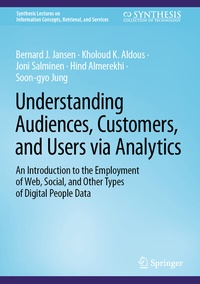
Understanding Audiences, Customers, and Users via Analytics
Description

This book presents the foundations of using analytics from the laboratory, social media platforms, and the web. The authors cover key topics including analytics strategy, data gathering approaches, data preprocessing, data quality assessment, analytical methods, tools, and validation methods. The book includes chapters explaining web analytics, social media analytics, and how to create an analytics strategy. The authors also cover on data sources, such as online surveys, crowdsourcing, eye tracking, mouse tracking, social media APIs, search logs, and analytics triangulation. The book also discusses analytical tools for social media analytics, search analytics, persona analytics, user studies, and website analytics. The authors conclude by examining the validity of online analytics.
More details
Other editions
Additional editions
Persons
Bernard J. Jansen, P.D., is a Principal Scientist in the artificial intelligence center of the Qatar Computing Research Institute. He is a West Point graduate with a Ph.D. in computer science from Texas A&M University. Professor Jansen is editor-in-chief of the journal Information Processing & Management.
Kholoud Khalil Aldous, Ph.D., is a Post Doctoral Researcher at Qatar Computing Research Institute. She got her Bachelor's and Master's degrees in Computer Science from Qatar University. She has a Ph.D. in computer science and engineering from Hamad Bin Khalifa University. Her research interest relates to user engagement on social media platforms.
Joni Salminen, PhD., is a faculty member of the School of Marketing and Communication, University of Vaasa, Finland, and he is also an Adjunct Professor at the Turku School of Economics at the University of Turku. Previously, he worked as a Scientist at the Qatar Computing Research Institute, Hamad Bin Khalifa University. Joni's current research interests relate to user personas, quantitative UX, and human-centered AI.
Hind Ali Almerekhi, Ph.D., is a research associate at Qatar National Research Fund (QNRF), Doha, Qatar. She received a B.E. degree in computer science in 2012 and an M.S. degree in computer science in 2015 from Qatar University. She is a graduate of the Ph.D. program at the College of Science and Engineering, Hamad Bin Khalifa University, and her research interests span a range of critical areas, including machine learning and online hate in social media.
Soon-gyo Jung is a software engineer at Qatar Computing Research Institute, Doha, Qatar. He has been working on data analytics/data-driven/data intensive systems by applying research-oriented full-stack software engineering skills (Computer Science, Data Science/Analytics) for years. He received the B.E. degree in computer software from Kwangwoon University, Seoul, Korea, in 2014, and an M.S. degree in electrical and computer engineering from Sungkyunkwan University, Suwon, Korea, in 2016.
Content
The Foundations of Web Analytics.- The Foundations of Social Media Analytics.- Web and Social Media Analytics Strategy.- Data Collection Methods.- Data Quality Assessment.- Data Preprocessing.- Search Analytics.- Persona Analytics.- User Study Analytics.- Website Analytics.- A Discussion of the Validity of Data Analytics.
