

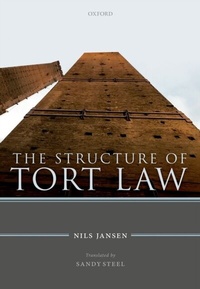
The Structure of Tort Law
1st Edition
Published on 17. December 2021
550 pages
978-0-19-101510-6 (ISBN)
Description

This English translation makes available to anglophone readers a modern classic of German tort theory. It argues that modern German tort law is faced with doctrinal tensions based on problematic theoretical assumptions which stem from historical conceptions of tortious liability, inappropriate to modern times. From a theoretical perspective, it argues against the prevalent doctrinal view in Germany that conceives of tortious liability as split between two tracks - a fault-based track and a strict liability track - each with different normative foundations.
Instead, Jansen asserts that there is no rigid distinction between the normative foundations of each form of liability. Rather, both fault liability and strict liability in German law, and indeed other European systems, are best considered as resting upon the unifying theoretical structure of outcome responsibility. The book thus places responsibility rather than wrongdoing at the centre of the normative foundations of tort law. Historically, the book traces in detail how conceptions of tort liability have changed from Roman law to contemporary legal doctrine. It shows how particular historical understandings of the normative basis of tort law have led to continuing normative tensions in contemporary doctrine. Finally, the book examines how a reconstruction of modern German - and, indeed, European - law as based upon outcome responsibility should affect its doctrinal structure.
This book makes contributions to the study of the theory, history, and doctrinal structure of tort law. While drawing on and explaining German tort law, its comparative, theoretical, and historical analysis will be of interest to scholars in all legal systems.
More details
Other editions
Additional editions
Nils Jansen
The Structure of Tort Law
History, Theory, and Doctrine of Non-Contractual Claims for Compensation
Book
12/2021
Oxford University Press
€136.50
Shipment within 15-20 days
Persons
Professor Dr. Nils Jansen currently serves on the Law Faculty of the University of Münster, Germany. He holds the Chair for Roman Law, Legal History, German and European Private Law, and is member of the board of the Cluster of Excellence Religion and Politics in the Cultures of Pre-Modernity and Modernity.
Dr. Sandy Steel is a Lecturer in Law at King's College London. His BA and PhD are from the University of Cambridge. His research interests are in the law of obligations, primarily tort law, and private law theory. His monograph on proof of causation in tort law will be published in 2014 by Cambridge University Press.
Content
- Cover
- Half-Title
- Title
- Copyright
- Preface
- Contents
- Abbreviations
- Legislation
- Logical Symbols
- Introduction to the English Translation
- I. Structuring Tort Law
- II. Transformations of Tort Law
- III. Doctrine
- Translator's Note
- Introduction-?The Aim of the Inquiry
- I. Problems
- 1. Delict, Risk Distribution, and Liability
- 2. The Problem of Unlawfulness
- 3. On Tort Law's Twin-?Track Nature
- II. On the Current State of Legal Doctrine
- 1. 'The Metamorphoses of Tort Law'
- 2. Towards a New Understanding
- III. The Need for a Satisfactory Doctrinal Structuring of Tort Law
- IV. A Map of the Book and its Terminology
- Part I A Theoretical Framework
- § 1 Tort Law Norms
- I. Three Models
- 1. The Sanction Model
- 2. The Strict Liability Model
- 3. The General Standard of Conduct Model
- II. The Descriptive Adequacy of the Models of Tort Law
- 1. The Sanction Thesis
- 2. The Irrelevance of Legal Duties Thesis
- 2.1 Law without legal duties?
- 2.2 On economic norm theory
- 2.3 Breach of duty and compensatory damages
- 3. A Proviso: On the 'Twin-?Track Nature' of Tort Law
- III. The Subject Matter of Tort Law
- 1. The Demarcation of Legal Spheres: Actual and Economic Integrity
- 2. Compensatory Damages: A Restriction upon One's Freedom?
- 3. An Excursus: The Distribution of Risk as a Two-?Sided Issue
- IV. Conclusions
- § 2 The Structure of Normative Reasoning in Tort Law
- I. The Aristotelian Legacy
- 1. A Categorical Distinction
- 2. Distributions and Interactions
- 3. Hierarchical Relationships and Relationships of Equality
- 4. Distributive Principles and Conduct Rules
- 5. Some Conclusions
- II. Compensation, Distribution, and Liability
- 1. The Correspondence Thesis
- 2. The Correction of Infringements of Rights
- 2.1 Epstein's definition of rights
- 2.2 Epstein's theory of causation
- 2.3 Distributive elements in Epstein's theory
- 3. The Correction of Breaches of Duties
- 3.1 Weinrib's theory
- 3.2 'Normative' gains and 'factual' losses
- 3.3 Critique
- 3.4 Distributive elements in Weinrib's theory
- 4. Protected Interests and Liability Standards
- 5. Distribution as an Alternative?
- 5.1 Wealth effects and distribution of wealth
- 5.2 The distribution of the risk of loss
- 5.3 The distribution of liability amongst collective agencies
- 5.4 Excursus: liability and liability insurance
- 6. Some Conclusions
- III. The Idea of Outcome Responsibility
- 1. The Framework of Tort Law
- 2. Substantive Issues
- 3. Complementarities and Conflicts
- 4. Excursus: Delimiting Tort Law from Causes of Action Independent of Individual Responsibility
- 5. Some Conclusions
- IV. Outcome Responsibility and Duties to Compensate
- 1. Generating Liability and Excluding Liability
- 2. Excursus: The Ambiguity in the Idea of an Accident-?on Equity-?Based Liability in Tort Law
- V. Conclusions
- § 3 The Effect of Tort Liability upon Behaviour
- I. The Economic Model . . .
- 1. Types of Tort Rule
- 1.1 Strict liability without a contributory negligence defence and a rule of no liability
- 1.2 Fault liability and strict liability with the defence of contributory fault
- 1.3 Complex liability rules
- 1.3.1 Fault liability and contributory fault
- 1.3.2 Strict liability, contributory fault, and operational risk
- 1.3.3 Differentiated standards of care
- 2. The Extent of Liability
- 3. The Bearers of Liability
- 4. The Effect of Insurance
- II. . . . And a Glimpse at Reality
- 1. Theses about the Effect of Tort Law upon Behaviour
- 2. An Empirical Overview
- 2.1 Accidents in the workplace
- 2.2 Medical liability
- 2.3 Some further areas
- 2.4 Traffic accidents
- 2.5 Some results
- 3. Explaining these Results
- III. Consequences
- Part II A Step Back . . .
- § 4 Delictual Liability in Roman Law
- I. Iniuria and Poena: On the Development of the Law of Delict
- 1. Penalty and Retaliation: The Law of XII Tables
- 1.1 The sanctions: talion and poena
- 1.2 Compensation for loss
- 1.3 Retribution as a private law claim: the law of delict as a 'private criminal law'
- 2. Compensation as Poena: The Lex Aquilia
- 2.1 Damnum
- 2.2 Iniuria
- 2.2.1 The puzzle of its original meaning
- 2.2.1.1. An abstract concept of iniuria and a concrete delictual cause of action?
- 2.2.1.2. The infringement of a right as a delict
- 2.2.2 The function of iniuria
- 3. Some Conclusions
- II. From Sanction to Compensation
- 1. Shifts in the Law of Delict (I)
- 2. Steps towards a Public Criminal Law
- 2.1 Iudicia publica
- 2.2 The imperial cognitiones extra ordinem
- 2.3 Conclusions
- 3. Actio Mixta
- 3.1 Id quod interest
- 3.2 Expansion of the elements of the Aquilian claim
- 3.3 Damnum culpa datum
- 3.3.1 An overview
- 3.3.2 Duties of conduct and the distribution of risks of loss
- 3.3.2.1 Liability for culpa levissima and infirmitas
- 3.3.2.2 Liability of the homo liber bona fide serviens
- 4. Conclusions
- III. The Burdens of Justinian's Legacy
- § 5 Sanction and Duty, Individual Rights, and Compensation: On the Rebirth of the Roman Law of Delict in Natural Law Discussions
- I. The Glossators and Commentators
- 1. Transforming the Law of Delict (II)
- 1.1 Pure economic losses
- 1.2 Indirect injuries
- 1.3 Corpus liberi
- 1.4 Problems of understanding
- 2. From Punishment to Sanction
- 2.1 The differentiation of compensation from punishment
- 2.2 Compensation as sanction
- 3. The Fault Principle
- 4. Culpa Levissima
- 5. Some Conclusions
- II. Transformations (III) in the Usus Modernus
- 1. A Private Law General Clause
- 2. Dependency Claims, Claims for Pain and Suffering
- 3. Doctrinal Consequences
- 3.1 Iniuria and the idea of conduct-?based unlawfulness
- 3.2 The problem of culpa levissima
- 3.3 The idea of a delictual guarantee liability
- 4. Some Conclusions
- III. Dominium, Ius, and Iniuria
- 1. Ius Perfecte Disponendi
- 2. Dominium as Power of Control and Absolute Right
- 2.1 Dominium as ius
- 2.2 Freedom and the assignment of legal goods
- 2.3 The doctrine of restitution and the Aquilian law of delict
- 3. Ius and Iniuria
- 3.1 Quod vere et proprie nostrum est: outcome unlawfulness in Hugo Donellus
- 3.2 Individual, absolute rights as the foundation of the law of delict in Hugo Grotius
- 4. Some Conclusions
- 2. Dominium as Power of Control and Absolute Right
- 2.1 Dominium as ius
- 2.2 Freedom and the assignment of legal goods
- 2.3 The doctrine of restitution and the Aquilian law of delict
- 3. Ius and Iniuria
- 3.1 Quod vere et proprie nostrum est: outcome unlawfulness in Hugo Donellus
- 3.2 Individual, absolute rights as the foundation of the law of delict in Hugo Grotius
- 4. Some Conclusions
- IV. Natural Duties and Natural Fairness
- 1. Moral Duties and Compensation in Samuel Pufendorf's Theory
- 1.1 Delictual liability as legal sanction
- 1.2 Strict liability and culpa levissima
- 1.3 Some conclusions
- 2. Larva Legis Aquiliae Detracta Actioni de Damno Dato: Tort Law in Christian Thomasius
- 2.1 Imputation, compensation, and punishment
- 2.2 Protection of legal goods and distribution of risk
- 2.3 Some conclusions
- 3. Christian Wolff and the Legacy of Natural Law
- V. Conclusions
- § 6 Steps towards a Modern Tort Law
- I. Pandectist Theory and Pragmatic Practice: Private Punishment, the Fault Axiom, and Strict Liability in Claims between Neighbours
- II. The Development of Strict Liability for Risk
- III. Damages as Compensation
- IV. The Fault Principle in Crisis
- 1. The Normative Foundations of Tort Law
- 1.1 Edgar Loening
- 1.2 Joseph Unger
- 1.3 Rudolf Merkel and Emil Steinbach
- 1.4 Victor Mataja
- 1.5 Problems
- 2. On the Theory of Strict Liability for Risk
- V. A View Ahead
- Part III Doctrinal Foundations
- § 7 Injurious Conduct
- I. Duties of Care (Verkehrspflichten)
- 1. Delictual Duties of Conduct in the Nineteenth Century
- 2. Developments under the BGB
- II. Unlawfulness and Fault
- 1. Steps towards a Conceptual Differentiation
- 2. Normative Considerations
- 3. Difficulties
- 3.1 The 'concept of unlawfulness'
- 3.2 The dominant doctrinal understanding
- 3.3 Unlawfulness, standards of care, and objective negligence
- 4. A View Ahead
- III. Negligence, Fault, and Liability Standards
- 1. Culpa levissima?
- 1.1 The system of the doctrine
- 1.2 The reaction of the case law
- 2. Will-?Based Fault and Objective Standards
- 3. Liability Guarantees and Personal Responsibility
- 3.1 'Personal unacceptability'
- 3.2 'Error of law'
- 3.3 Flexible standards
- IV. Conclusions
- § 8 Violation of a Right, Economic Loss, and Compensation
- I. Absolute, Individual Rights?
- 1. Violation of a Right as Delict
- 2. On the Idea of an Individual Right
- 2.1 Rights as reasons
- 2.2 Individual rights and objective legal duties
- II. The Twentieth-?Century Discussion
- 1. Rights as Reasons for Duties Not to Injure
- 2. Objective Duties Instead of Individual Rights?
- 3. The Allocative Content of Rights
- 3.1 Protection of legal goods and Obliegenheiten to take care
- 3.2 Problems
- 3.2.1 Interference with business activity
- 3.2.2 The personality right
- III. The Allocation of Legal Goods
- 1. Reliance upon the Integrity of an Object
- 2. Right Infringement and Allocation of Legal Goods
- 2.1 The protected scope of ownership
- 2.2 Free-?standing allocated legal positions
- 2.3 Some conclusions
- 3. Allocative Content and Loss
- 3.1 Opportunities to use
- 3.2 Infringement of intellectual property rights
- 4. Allocation and Deterrence
- 5. Conclusions
- IV. Liability for Pure Economic Loss
- 1. Reliance on the Integrity of Wealth
- 2. Justified Reliance
- 2.1 Special dependencies
- 2.2 Reliance upon legal transactions
- 3. Standards of Liability
- 4. Conclusions
- V. Allocation of Legal Goods and Protection of Reliance in Tort Law
- § 9 The Structure of Tort Law
- I. Preliminary Considerations on Tort Law System-?Building
- 1. Criteria of Successful System-?Building
- 1.1 Normative appropriateness
- 1.2 Clarity of formulation of requirements of liability
- 1.3 Historical linkage
- 2. Consequences
- 3. The Variety of Normative Considerations and a Unified System
- 3.1 Interconnections
- 3.2 The justice of differentiated risk allocations
- 3.3 A general clause for strict liability?
- 4. A Uniform Model for Tort Law
- 4.1 Wrongdoing as a special case of responsibility?
- 4.2 Accident and wrongdoing
- 4.3 On the splintering of tort law
- 4.4 A general model
- 5. Some Conclusions
- II. Generating Liability
- 1. Infringement and Attribution
- 2. On the Infringement of Absolute Rights
- 3. Attribution
- 4. Conclusion
- III. Defences
- 1. On the Idea of Liability-?Excluding Permissions to Interfere
- 2. Liability Standards
- 2.1 Reasonableness tests and risk distribution
- 2.2 Wrongdoing and graded Obliegenheiten: the concept of tort law negligence
- 3. Conclusions
- IV. The Description of Complex Normative Considerations
- 1. A Flexible System?
- 2. Flexible Elements and Firm Structure
- 3. Balancing in Tort Law
- 3.1 Compensation and collision
- 3.2 On the rationality of balancing decisions
- 4. Liability Principles, Conflict Decisions, and Liability Rules
- 5. Implications
- V. Liability Standards
- 1. Vis maior
- 2. Unavoidable Accident
- 3. Duties of Care as Obliegenheiten: The Fault Principle as a Legal Principle
- 4. Results
- VI. Liability Principles
- 1. Required Principles
- 1.1 The fault principle
- 1.2 The risk principle
- 2. Excluded Principles
- 3. Permissible Principles
- 3.1 The principle of strict enterprise liability
- 3.2 The protection of everyday activities
- 3.3 The privileging of children
- 3.4 Better ability to insure
- 3.5 Deterrence and deterrence as an aim
- 4. Some Conclusions
- VII. An Integrative Conception of Tort Law
- Literature
- Index
