

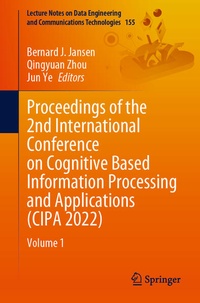
Proceedings of the 2nd International Conference on Cognitive Based Information Processing and Applications (CIPA 2022)
Description

This book contains papers presented at the 2nd International Conference on Cognitive based Information Processing and Applications (CIPA) in Changzhou, China, from September 22 to 23, 2022. The book is divided into a 2-volume series and the papers represent the various technological advancements in network information processing, graphics and image processing, medical care, machine learning, smart cities. It caters to postgraduate students, researchers, and practitioners specializing and working in the area of cognitive-inspired computing and information processing.
More details
Other editions
Additional editions
Persons
Jim Jansen is a Principal Scientist in the social computing group of the Qatar Computing Research Institute. He is a graduate of West Point and has a Ph.D. in computer science from Texas A&M University. Professor Jansen is editor-in-chief of the journal, Information Processing & Management (Elsevier), a member of the editorial boards of seven international journals, and former editor-in-chief of the journal, Internet Research (Emerald). He has received several awards and honors, including an ACM Research Award, six application development awards, and a university-level teaching award, along with other writing, publishing, research, teaching, and leadership honors. Dr. Jansen has authored or co-authored 300 or so research publications, with articles appearing in a multi-disciplinary range of journals and conferences. He is author of the book, Understanding Sponsored Search: A Coverage of the Core Elements of Keyword Advertising (Cambridge University Press).
Qingyuan Zhou received Ph.D. degrees from Sichuan University (SCU), Chengdu in 2014, respectively. Currently, he is a professor in Changzhou Institute of Mechatronic Technology, China. He has joined and accomplished 5 national and 6 provincial research programs. He has also authored/coauthored over 60 papers in international/national journals and conferences including Computers in Human Behavior, Electronic Commerce Research, Intelligent Automation & Soft Computing etc. His current research interests include electronic commerce, artificial intelligence, and computational economics.
Jun Ye received his B.S. degree in Applied Mathematics at Chongqing University. M.S. degree in Cryptography at Guilin University of Electronic Technology. Ph.D in Xidian University, He is a high level talent of Hainan Province, and he is working at school of Computer Science and Cyberspace Security of Hainan University. His current research interests include computer science and information security. He has authored or co-authored more than 20 high level publications, and he is also a reviewer of many well-known journals. He is one of the high level talents of Hainan Province, and got the "First prize" of science and technology progress prize of Hainan Province in 2019.
