

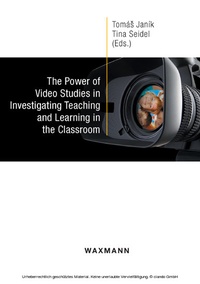
The Power of Video Studies in Investigating Teaching and Learning in the Classroom
Description

The history of methods of observation illustrates a gradual development from lay observation to systematic scientific observation. Over the past centuries, observing scientists have learned to take advantage of various research tools. Just as natural scientists came to appreciate the aid of the microscope to observe very small objects and telescopes to observe very distant objects, we have come to see video technology as a tool for social scientists to observe phenomena that are too complex to be studied by the naked eye. The investigative potential of such video studies lies in the fact that complex phenomena and events captured on video are available for analysis that can focus ex-post facto on various aspects of the material under investigation. Video study is a complex methodological approach, which enables the employing of various strategies, methods or techniques for generating, collecting and analysing video data, i.e. audiovisual data grounded in rich situational contexts.
The book is structured in three sections which comprise chapters that focus on a specific power of video technology in classroom research. The chapters in section I focus on the power of video to describe the dynamics of teaching and learning in the classroom. They present various video studies conducted in the past fifteen years that aimed to describe the practices of teaching. The chapters in section II focus on the use of video in investigating the effects of teaching on student learning. They present approaches that build on video studies in order to link data about classroom processes with data about learning outcomes. The chapters in section III discuss possibilities offered by the use of video in professional development of teachers.
Contributors: Peter (Reggie) Bowman, Geraldine Blomberg, Hilda Borko, David Clarke, Inger Marie Dalehefte, Erin Marie Furtak, Constanze Herweg, Dana Hübelová, Jennifer Jacobs, Tomáš Janík, Marcela Janíková, Kirsti Klette, Eckhard Klieme, Petr Knecht, Mareike Kobarg, Karen Koellner, Milan Kubiatko, Peter Labudde, Cameron Mitchell, Petr Najvar, Veronika Najvarová, Christine Pauli, Manfred Prenzel, Kurt Reusser, Rolf Rimmele, Kathleen Roth, Katharina Schwindt, Simona Šebestová, Tina Seidel, Richard J. Shavelson, Kathleen Stürmer, Elke Sumfleth, Maik Walpuski
More details
Other editions
Additional editions
Content
2 - 1 Introduction: On the Power of Video Studies in Investigating Teaching and Learning [Seite 8]
2.1 - 1.1 Video Studies in Educational Research: An Overview [Seite 9]
2.2 - 1.2 Recent Developments in Video-Based Research [Seite 12]
2.3 - 1.3 Highlighting the Power of Video Studies: Goals and Overview of the Volume [Seite 14]
2.4 - References [Seite 17]
2.5 - Acknowledgements [Seite 20]
3 - Describing the dynamics of teaching and learning [Seite 22]
3.1 - 2 Using Video Studies to Compare and Understand Science Teaching: Results from the TIMSS Video Study of 8th Grade Science Teaching [Seite 24]
3.1.1 - 2.1 Rationales [Seite 24]
3.1.2 - 2.2 Research Questions and Methods [Seite 27]
3.1.3 - 2.3 Results [Seite 28]
3.1.4 - 2.4 The Power of Video Methodology in the TIMSS Video Study [Seite 36]
3.1.5 - References [Seite 37]
3.2 - 3 Optimising the Use of Available Technology to Support International Collaborative Research in Mathematics Classrooms [Seite 40]
3.2.1 - 3.1 Advances in Techniques and Equipment for the Generation of Audio- Visual Data in Classrooms [Seite 41]
3.2.2 - 3.2 Tools for the Compression, Editing and Storage of Digitised Video and Other Data [Seite 47]
3.2.3 - 3.3 Storage Facilities that Support Networked Access to Large Complex Databases [Seite 47]
3.2.4 - 3.4 Analytical Tools Capable of Supporting Sophisticated Analyses of Such Complex Databases [Seite 49]
3.2.5 - 3.5 Sample Analysis [Seite 51]
3.2.6 - 3.6 Research as the Enactment of the Researcher's Epistemology [Seite 57]
3.2.7 - 3.7 Conclusions [Seite 58]
3.2.8 - References [Seite 60]
3.2.9 - Acknowledgements [Seite 61]
3.3 - 4 Challenges in Strategies for Complexity Reduction in Video Studies. Experiences from the PISA+ Study: A Video Study of Teaching and Learning in Norway [Seite 62]
3.3.1 - 4.1 Benefits and Challenges in Analyzing Video Data [Seite 65]
3.3.2 - 4.2 Challenges in Analyzing Video Data: Scales and Categories as Analytical Devices for Complexity Reduction [Seite 67]
3.3.3 - 4.3 Analyzing Video Data: Strategies for Complexity Reduction in the PISA+ Study [Seite 68]
3.3.4 - 4.4 Why Coding Schemes [Seite 70]
3.3.5 - 4.5 Empirical Illustrations: Features of Classroom Discourse Across Three Analytical Levels [Seite 75]
3.3.6 - 4.6 Conclusive Discussion [Seite 79]
3.3.7 - References [Seite 80]
3.4 - 5 Observing Instruction "next-door": A Video Study about Science Teaching and Learning in Germany and Switzerland [Seite 84]
3.4.1 - 5.1 Theoretical Background [Seite 85]
3.4.2 - 5.2 Research Questions and Design [Seite 86]
3.4.3 - 5.3 Findings from the Swiss-German Video Study [Seite 90]
3.4.4 - 5.4 Value and Limitations of the Swiss-German Video Study [Seite 97]
3.4.5 - References [Seite 99]
3.5 - 6 CPV Video Study: Comparative Perspectives on Teaching in Different School Subjects [Seite 104]
3.5.1 - 6.1 The Comparative Perspective on School Subjects [Seite 105]
3.5.2 - 6.2 The Comparative and the Multi-Perspective Approach [Seite 107]
3.5.3 - 6.3 Video-Based Observation in Comparative Research [Seite 108]
3.5.4 - 6.4 An International Perspective on Classroom Organisation: the TIMSS Video Study [Seite 111]
3.5.5 - 6.5 An Inter-Subject Perspective on Classroom Organisation: the CPV Video Study [Seite 113]
3.5.6 - 6.6 Discussion and Future Perspectives [Seite 118]
3.5.7 - References [Seite 119]
3.5.8 - Acknowledgement [Seite 120]
3.6 - 7 The Use of Video Data to Evaluate Inquiry Situations in Chemistry Education [Seite 122]
3.6.1 - 7.1 Purpose of the Study [Seite 122]
3.6.2 - 7.2 Using Video-Analyses Software: Videograph [Seite 124]
3.6.3 - 7.3 Process Plots [Seite 126]
3.6.4 - 7.4 Discussion [Seite 132]
3.6.5 - References [Seite 133]
4 - Investigating the effects of teaching [Seite 136]
4.1 - 8 The Pythagoras Study: Investigating Effects of Teaching and Learning in Swiss and German Mathematics Classrooms [Seite 138]
4.1.1 - 8.1 Theoretical Background: A Model of Instructional Quality [Seite 140]
4.1.2 - 8.2 Research Questions [Seite 144]
4.1.3 - 8.3 Methods [Seite 145]
4.1.4 - 8.4 Findings [Seite 151]
4.1.5 - 8.5 Discussion [Seite 156]
4.1.6 - References [Seite 157]
4.1.7 - Acknowledgements [Seite 161]
4.2 - 9 The Link between Teaching and Learning - Investigating Effects of Physics Teaching on Student Learning in the Context of the IPN Video Study [Seite 162]
4.2.1 - 9.1 Theoretical Background: Teaching and Learning Processes in Science Classrooms [Seite 164]
4.2.2 - 9.2 Design of the IPN Video Study [Seite 166]
4.2.3 - 9.3 Methods [Seite 168]
4.2.4 - 9.4 Science Teaching and Learning: How do Teaching Practices Influence Student Learning [Seite 172]
4.2.5 - 9.5 Perspective [Seite 176]
4.2.6 - References [Seite 177]
4.2.7 - Acknowledgements [Seite 181]
4.3 - 10 Guidance, Conceptual Understanding, and Student Learning: An Investigation of Inquiry- Based Teaching in the US [Seite 182]
4.3.1 - 10.1 Investigating Guidance at the Intersection of Inquiry-Based Teaching and Standards- Based Content [Seite 182]
4.3.2 - 10.2 Method [Seite 186]
4.3.3 - 10.3 Results [Seite 194]
4.3.4 - 10.4 Discussion [Seite 200]
4.3.5 - References [Seite 202]
5 - Using video in teacher professionalization [Seite 206]
5.1 - 11 Exploring Different Ways of Using Video in Teacher Education: Examples from CPV Video Web [Seite 208]
5.1.1 - 11.1 Purposes of Using Video in Teacher Education [Seite 208]
5.1.2 - 11.2 Videocases: From Observing 'Good Practice' To Analysing the Teacher's Own Actions [Seite 213]
5.1.3 - 11.3 CPV Video Web [Seite 217]
5.1.4 - 11.4 Perspectives: Integrative Use of Video in Teacher Education [Seite 222]
5.1.5 - References [Seite 223]
5.1.6 - Acknowledgement [Seite 225]
5.2 - 12 Using Video Studies to Transform Science Teaching and Learning: Results from the STeLLA Professional Development Program [Seite 226]
5.2.1 - 12.1 Building on the TIMSS Video Study: The Science Content Storyline Idea [Seite 227]
5.2.2 - 12.2 The STeLLA Video Study: Using Video to Transform Science Teaching [Seite 229]
5.2.3 - 12.3 Discussion [Seite 239]
5.2.4 - 12.4 Conclusions and Implications [Seite 240]
5.2.5 - 12.5 The Power of Video [Seite 241]
5.2.6 - References [Seite 242]
5.3 - 13 LUV and Observe: Two Projects Using Video to Diagnose Teacher Competence [Seite 244]
5.3.1 - 13.1 Theoretical Background [Seite 244]
5.3.2 - 13.2 Project LUV - Learning from Classroom Videos [Seite 247]
5.3.3 - 13.3 Project OBSERVE [Seite 251]
5.3.4 - 13.4 Outlook [Seite 255]
5.3.5 - References [Seite 256]
5.3.6 - Acknowledgements [Seite 259]
5.4 - 14 The Power of Video as a Tool for Professional Development and Research: Examples from the Problem- Solving Cycle [Seite 260]
5.4.1 - 14.1 An Overview of the Problem Solving Cycle [Seite 262]
5.4.2 - 14.2 The Power of Video as a Professional Development Tool [Seite 263]
5.4.3 - 14.3 The Power of Video as a Research Tool [Seite 267]
5.4.4 - 14.4 Conclusion [Seite 270]
5.4.5 - References [Seite 272]
6 - List of Figures [Seite 276]
7 - List of Tables [Seite 278]
8 - Editors [Seite 280]
