

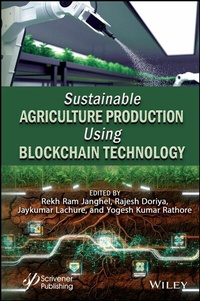
Sustainable Agriculture Production Using Blockchain Technology
Description

Revolutionize the agricultural supply chain with this essential guide, which provides the practical knowledge to leverage blockchain technology for transparency, traceability, and trust, alongside AI for overcoming modern farming challenges.
As technology continues to advance, agriculture has begun to implement digital computing and data-driven innovations. This surge of smart farming has resulted in a variety of improvements, including automated equipment and data collection of soil quality, seed quality, fertilizer, pests, climate, and the supply chain in agriculture. As connectivity and data management continue to revolutionize the farming industry, it is essential for researchers to study these technological advances.
This book offers a unique opportunity to revolutionize the supply chain in the agricultural industry, emphasizing the growing role blockchain technology plays. It explores how blockchain enables transparency, traceability, and trust in the agricultural supply chain, from production to distribution. The book also discusses the ethical and social impact of implementing AI and blockchain in agriculture, addressing data privacy, algorithmic bias, and community empowerment. By exploring the integration of AI and blockchain in agriculture, this book serves as a practical guide to overcoming the modern challenges this industry faces.
More details
Other editions
Additional editions
Persons
Rekh Ram Janghel, PhD is an Assistant Professor in the Department of Information Technology at the National Institute of Technology. He has published more than 30 research papers in national and international journals and conferences and two book chapters. His areas of research include deep learning, machine learning, biomedical healthcare systems, expert systems, neural networks, hybrid computing, and soft computing.
Rajesh Doriya, PhD is an Assistant Professor in the Department of Information Technology at the National Institute of Technology with more than ten years of experience. He has authored over 50 research papers published in international journals and conferences. His research interests include distributed computing, cloud computing, artificial intelligence, robotics, soft computing techniques, and network security.
Jaykumar Lachure is pursuing a PhD in the Department of Information Technology at the National Institute of Technology. He has published more than 15 research papers in national and international journals and conferences and two book chapters in reputed publications. His interests include cyber physical systems, security, precision agriculture, quantum computing, blockchain, pattern recognition, image processing, and video processing.
Yogesh Kumar Rathore is an Assistant Professor in the Department of Computer Science Engineering at the Shri Shankaracharya Institute of Professional Management and Technology with more than 16 years of experience. Raipur. He has published more than 40 research papers in various conferences and journals, many book chapters, and two patents. His interests include pattern recognition, image processing, video processing, deep learning, machine learning, and artificial intelligence.
Content
1
A Critical Review of Ethical Challenges in the Use of Deep Learning, Blockchain, and Big Data in Agriculture
Kirti Nahak1*, Anurag Shrivastava2, Sheela Hundekari3, Qasem AlAttaby4, Lavish Kansal5 and Saloni Bansal6
1Information Technology National Institute of Technology, Raipur, Chhattisgarh, India
2Saveetha School of Engineering, Saveetha Institute of Medical and Technical Sciences, Chennai, Tamilnadu, India
3School of Computer Applications, Pimpri Chinchwad University, Pune, India
4Department of computers Techniques Engineering, College of Technical Engineering, The Islamic University, Najaf, Iraq
5School of Electronics and Communication Engineering, Lovely Professional University, Phagwara, India
6Department of Electronics and Communication Engineering, GLA University, Mathura, India
Abstract
The integration of deep learning, blockchain, and big data in agriculture has transformed traditional farming practices, enhancing productivity, efficiency, and sustainability. However, these advancements also introduce significant ethical challenges that must be critically examined. This review explores the ethical concerns associated with the use of these technologies in agricultural decision-making, supply chain management, and data governance. Key issues include data privacy, ownership, and security in big data analytics, potential biases in deep learning models impacting decision accuracy, and ethical dilemmas surrounding blockchain transparency versus confidentiality. Additionally, concerns related to technological accessibility, environmental sustainability, and the displacement of traditional farming practices are evaluated. The study also highlights the regulatory gaps and challenges in establishing fair policies that ensure equitable technology adoption, particularly for small-scale farmers. By synthesizing existing literature, this review provides insights into how stakeholders-including policymakers, researchers, and agricultural practitioners-can address these ethical challenges while maximizing the benefits of emerging technologies. Future research directions are proposed to develop ethically responsible and sustainable AI-driven agricultural systems. This study underscores the importance of a balanced approach that integrates innovation with ethical considerations to ensure a fair and inclusive agricultural future.
Keywords: Deep learning, blockchain, big data, agriculture, ethical challenges, data privacy, bias, sustainability
1.1 Introduction
The agricultural sector is experiencing significant transformation with the integration of deep learning, blockchain, and big data analytics. These technologies have the potential to revolutionize farming practices by enhancing productivity, efficiency, and sustainability. Deep learning, a subset of artificial intelligence (AI), is widely used in precision agriculture, enabling predictive analytics, pest detection, and yield forecasting by analyzing vast datasets [1]. Blockchain technology ensures data integrity, transparency, and traceability in agricultural supply chains by providing tamper-proof and decentralized record-keeping [2]. Big data analytics, on the other hand, allows for real-time monitoring and data driven decision-making, optimizing resource allocation and mitigating environmental risks [3]. While these technological advancements offer numerous benefits, they also present ethical challenges that must be carefully addressed to ensure responsible and equitable implementation.
Deep learning models depend on large data sets to generate accurate predictions, raising concerns about data privacy, ownership, and bias. Farmers produce sensitive data related to soil conditions, crop yields, and weather patterns, which, if misused, could lead to privacy violations and corporate exploitation [4]. The centralization of agricultural data by large agribusinesses further exacerbates data sovereignty issues, particularly in developing regions where farmers have limited control over their own data [5]. Additionally, algorithmic bias in AI models can result in discriminatory or inaccurate predictions, especially when models are trained on non-representative datasets [6]. Such biases can lead to inequitable resource distribution, favoring large commercial farms while marginalizing smallholders. Another critical concern is the lack of explainability and transparency in deep learning models, which operate as black-box systems, making it difficult for farmers to interpret AI-driven recommendations [7].
Blockchain technology plays a crucial role in enhancing supply chain transparency, fraud prevention, and secure transactions in agriculture. By recording transactions on an immutable ledger, blockchain ensures trust and accountability among stakeholders [8]. However, ethical concerns arise due to the conflict between transparency and privacy. While blockchain promotes openness, farmer-specific data, trade secrets, and business transactions may become permanently stored on public ledgers, potentially compromising confidentiality [9]. Another significant challenge is the environmental impact of blockchain networks, particularly those utilizing proof-of-work (PoW) consensus mechanisms, which consume large amounts of energy [10]. The high cost and technical expertise required for blockchain implementation may also limit its accessibility to small-scale farmers, widening the digital divide between technologically advanced agribusinesses and rural farmers [11].
Big data analytics enable advanced monitoring, predictive modeling, and precision farming by leveraging vast amounts of agricultural information. However, issues related to data privacy, ownership, and fair data access remain major ethical challenges. Large agritech corporations often collect and monetize farmer-generated data without providing fair compensation or obtaining explicit consent [12]. This raises concerns about data exploitation and corporate monopolization of agricultural insights, potentially giving large companies undue influence over food production and market pricing [13]. Additionally, inequitable access to big data resources may deepen the divide between large and small-scale farmers. Farmers in developing regions often lack the necessary infrastructure, tools, and technical knowledge to fully benefit from big data driven agriculture, leading to further disparities [14]. The absence of robust regulatory frameworks governing agricultural data usage adds to these concerns, making it difficult to ensure ethical and fair data practices [15].
Addressing the ethical challenges associated with deep learning, blockchain, and big data in agriculture requires comprehensive regulatory frameworks and ethical guidelines. Policymakers, researchers, and agricultural stakeholders must work together to establish transparent and responsible policies that promote fair technology adoption. Some of the key measures include the development of strong data protection laws to safeguard farmer rights, promoting fairness in AI models to reduce algorithmic bias, adopting energy-efficient blockchain solutions to minimize environmental harm, and ensuring equitable access to big data resources to prevent digital exclusion. By fostering ethical AI, responsible blockchain implementation, and inclusive data policies, the agricultural sector can leverage these advanced technologies while ensuring that smallholder farmers, agribusinesses, and consumers benefit equitably. This review critically analyzes the ethical challenges associated with the adoption of these technologies and suggests sustainable solutions for building an ethically sound AI-driven agricultural system.
1.2 Related Works
Precision farming has seen significant advancements in recent years, driven by the convergence of IoT technologies, remote sensing techniques, and machine learning algorithms. A comprehensive review of existing literature provides insights into various approaches and methods used to enhance crop monitoring, soil nutrient analysis, and decision support systems in agriculture. An IoT-enabled soil nutrient analysis and crop recommendation model was proposed, integrating IoT sensors with machine learning techniques to analyze soil nutrient levels in real-time and provide personalized crop recommendations to farmers [16]. Another study explored remote monitoring of crop nitrogen nutrition to adjust crop models, emphasizing the importance of remote sensing data in optimizing nitrogen management practices, improving crop yields, and reducing environmental impacts [17].
A separate study focused on digitizing crop nitrogen modeling, highlighting the role of advanced computational techniques in improving the accuracy and efficiency of nitrogen management strategies [6]. An intelligent agricultural decision support system was introduced to predict soil nutrient values using IoT and ridge regression. By leveraging IoT sensors and regression analysis, a predictive model was developed to evaluate soil nutrient levels, helping farmers make informed decisions regarding fertilizer application [18]. Research on sugarcane biomass and carbon stock estimation utilized combined time-series Sentinel data with machine learning algorithms, demonstrating the feasibility of using remote sensing data for biomass estimation and promoting sustainable sugarcane farming practices [19]. An open-source IoT platform for optimal irrigation scheduling and decision-making in olive orchards was proposed,...
