

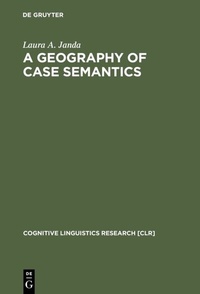
A Geography of Case Semantics
The Czech Dative and the Russian Instrumental
1st Edition
Published on 31. July 2013
XIII, 225 pages
978-3-11-086793-0 (ISBN)
Description

No detailed description available for "A Geography of Case Semantics".
More details
Series
Edition
Reprint 2013
Language
English
Place of publication
Berlin/Boston
Germany
Publishing group
de Gruyter Mouton
Target group
Professional and scholarly
US School Grade: College Graduate Student
Illustrations
26 Abbildungen
26 ill.
File size
10,01 MB
ISBN-13
978-3-11-086793-0 (9783110867930)
Schweitzer Classification
Other editions
Additional editions
Book
08/1993
1st Edition
De Gruyter Mouton
€139.95
Shipment within 7-9 days
Content
- Intro
- Acknowledgements
- Preface
- Part I - Theory
- 0. Introduction
- 1. What cognitive semantics is
- 1.1 Support for cognitive semantics from other disciplines
- 1.2. Case as a semantic entity
- 1.3. What a cognitive description of case should look like
- 2. Cognitive semantics compared with other descriptions of case
- 2.1. Case semantics in previous traditions
- 2.2. How the cognitive model has been implied by various authors
- 2.3. Advantages of the cognitive approach
- 2.4. An ideal description of case: Skalicka's challenge
- Part II - Analysis
- 3. Why the Czech dative and the Russian instrumental?
- 3.1. Schema 1 - indirect object
- 3.2. Schema 2 and variants - free dative
- 3.3. Dative network bound by syntagmatic variants of the schemas
- 3.4. Reflexive uses of the dative
- 3.5. Semantic extension via mapping - pragmatic uses of the dative
- 4. Comparison of cognitive networks - the Russian dative
- 4.1. Schema 1 - indirect object
- 4.2. Schema 2 and variants - free dative
- 4.3. Dative reflexives
- 5. Analysis of the Russian instrumental
- 5.1. Conduit instrumental - schema 1 and syntagmatic variants
- 5.2. Schema 2 - instrumental of setting
- 5.3. Attributive instrumental
- 5.4. Instrumental used with a preposition
- 5.5. Instrumental network bound by paradigm of peripherality and by alliance
- 6. The Czech instrumental
- 6.1. Conduit instrumental
- 6.2. Instrumental of setting
- 6.3. Attributive instrumental
- 6.4. Instrumental with a preposition
- 7. Concluding remarks and possible universals
- Notes
- References
