

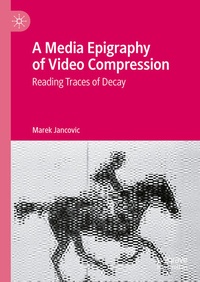
A Media Epigraphy of Video Compression
Reading Traces of Decay
1st Edition
Published on 29. July 2023
XVI, 268 pages
978-3-031-33215-9 (ISBN)
Description

This book explores the historical interrelationships between mathematics, medicine and media, and offers a unique perspective on how video compression has shaped our relationship with moving images and the world. It situates compression in a network of technological, visual and epistemic practices spanning from late 18th-century computational methods to the standardization of electrical infrastructure and the development of neurology throughout the 1900s.
Bringing into conversation media archaeology, science and technology studies, disability studies and queer theory, each chapter offers an in-depth look at a different trace of compression, such as interlacing, macroblocking or flicker. This is a story of forgotten technologies, unusual media practices, strange images on the margins of visual culture and inventive ways of looking at the world. Readers will find illuminating discussions of the formation of complex scientific and medical systems, and of the violent and pleasurable interactions between our bodies and media infrastructure.Reviews / Votes
"This is the book I've been waiting to read! Jancovic's exciting method of media epigraphy draws, out of a still image, deep histories of mathematics, technologies, power, embodiment, and energy. In just one of his many stimulating discoveries, it is very moving to find that that those annoying compression artifacts arise from a discrepancy between calculus' assumption of infinity (woven into the DCT or discrete cosine transform that undergirds almost every image) and the physical finitude of signals. An ontological struggle lodges in our squinting eyes." (Dr. Laura U. Marks, Grant Strate University Professor, School for the Contemporary Arts at Simon Fraser University, Vancouver)"With A Media Epigraphy of Video Compression , Marek Jancovic combines key lessons offered by media archaeology, science/technology studies, and forensics and he pushes all three of these fields forward with a new approach he calls 'media epigraphy.' Jancovic defines this new approach as "the study of media inscriptions as traces." Through his deep-seeing analyses of media inscriptions such as compressions, format changes, and standards, he reveals not only how these inscriptions are deeply material but how they have deeply material effects on the physical world, from environments to human bodies. This is a must-read book for anyone looking for a model of how to successfully undertake a detailed, nuanced, and layered materialist study of even the most seemingly immaterial process." (Dr. Lori Emerson, Associate Professor of English and Director of the Intermedia Arts, Writing, and Performance Program at University of Colorado at Boulder, and Founding Director of the Media Archaeology Lab)
"Marek Jancovic's erudite tracing of that liminal threshold where visuality is just about to blur and to glitch is a magnificent take on the cultural politics of perception. As a media garbologist interested in waste and remains, Jancovic shows that compression is much more than makingsmaller. Cultural techniques of folding and trimming link media periods from paper and books to signals and electromagnetic waves." (Dr. Jussi Parikka, Professor in Digital Aesthetics and Culture at Aarhus University, and Winchester School of Art (University of Southampton))
More details
Other editions
Additional editions
Book
07/2023
Palgrave Macmillan
€128.39
Shipment within 15-20 days
Person
Marek Jancovic is Assistant Professor of Media Studies at the Vrije Universiteit Amsterdam. His research is centered around the materialities of the moving image, media and the environment, film preservation practices, and format studies.
Content
Chapter 1: Media Epigraphy.- Chapter 2: Et cetera in infinitum: Harmonic Analysis and the Material History of Digital Video Compression.- Chapter 3: Interlacing: The First Video Compression Method.- Chapter 4: Viewer Discretion is Advised: Flicker in Media, Medicine and Art.- Chapter 5: Close Exposure: Of Seizures, Irritating Children and Strange Visual Pleasures./
