

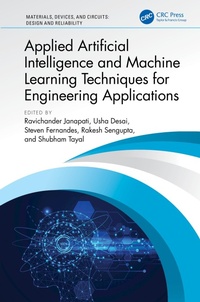
Applied Artificial Intelligence and Machine Learning Techniques for Engineering Applications
1st Edition
Published on 19. August 2025
196 pages
978-1-040-35969-3 (ISBN)
Description

This book presents various machine learning applications in the field of engineering with a focus on deep learning-based machine learning approaches. It examines the relationship between three different multidisciplinary engineering branches: biomedical engineering, signal processing, and computer science.
Applied Artificial Intelligence and Machine Learning Techniques for Engineering Applications explores recent advancements in the use of AI/ML in practical engineering applications by inviting top experts to share the outcomes of their most recent work. Among the topics explored are detection, measurement, and monitoring of signals (biosensors and biomedical devices) and the use of diagnostic interpretations of bioelectric data using signal-processing techniques. The authors also address several machine learning tasks, such as classification (supervised learning) and clustering (unsupervised learning), in the context of engineering. Finally, the book also describes the development of new biomaterials for use in the body.
The book will be a great help to researchers and academics working in the fields of biomedical signaling and/or human-machine interface.
Applied Artificial Intelligence and Machine Learning Techniques for Engineering Applications explores recent advancements in the use of AI/ML in practical engineering applications by inviting top experts to share the outcomes of their most recent work. Among the topics explored are detection, measurement, and monitoring of signals (biosensors and biomedical devices) and the use of diagnostic interpretations of bioelectric data using signal-processing techniques. The authors also address several machine learning tasks, such as classification (supervised learning) and clustering (unsupervised learning), in the context of engineering. Finally, the book also describes the development of new biomaterials for use in the body.
The book will be a great help to researchers and academics working in the fields of biomedical signaling and/or human-machine interface.
More details
Series
Edition
1. Auflage
Language
English
Place of publication
London
United Kingdom
Publishing group
Taylor & Francis Ltd
Target group
College/higher education
Professional and scholarly
Illustrations
15 Tables, black and white; 22 Line drawings, color; 29 Line drawings, black and white; 2 Halftones, color; 21 Halftones, black and white; 24 Illustrations, color; 50 Illustrations, black and white
File size
14,41 MB
ISBN-13
978-1-040-35969-3 (9781040359693)
Copyright in bibliographic data and cover images is held by Nielsen Book Services Limited or by the publishers or by their respective licensors: all rights reserved.
Schweitzer Classification
Other editions
Additional editions
Ravichander Janapati | Usha Desai | Steven L. Fernandes
Applied Artificial Intelligence and Machine Learning Techniques for Engineering Applications
Book
08/2025
1st Edition
CRC Press
€160.00
Shipment within 10-20 days
Persons
Dr. Ravichander Janapati is presently working as an Associate Professor at Department of ECE, SR University, Warangal, Telangana, India. He is a senior member of IEEE, and he graduated in Electronics and Communication Engineering from JNTU Hyderabad. He received his PhD in the Adhoc Wireless Sensor Networks field and M. Tech in Digital Electronics and Communication Systems from the Jawaharlal Nehru Technical University, Anantapur. His research papers are published in reputed international journals and international conferences. He had successfully completed a UGC sponsored project and one project funded by DST-SERB. Interests for research are wireless senor networks and brain computer interface. He is a reviewer for the Adhoc Network journal (Elsevier). He has eight patents.
Dr. Usha Desai is presently working as a Professor and Dean (Research & Development) for S.E.A College of Engineering & Technology, Bengaluru, India. She received her PhD in Biomedical Signal Processing from REVA University, Bengaluru, and M. Tech and B.E. from Visvesvaraya Technological University (VTU), Belagavi, Karnataka, India. She received the DST International Travel Grant to present her research paper at 39th IEEE EMBS International Annual Conference held at Jeju Island, South Korea. She has organized International Conference on Innovative Research Development (ICIRD-2024) at Shinawatra University, Bangkok, Thailand and received Best Academician and Organizing member awards.
She served as an Organizer and Session Chair at the reputed IEEE International Conferences. Also, she has presented technical research papers in numerous international indexed conferences and authored more than 50 research publications. She has authored five books on biomedical healthcare. She has six patents. She is presently a Senior Member of IEEE and Life Member of ISTE.
Dr. Steven Fernandes began his postdoctoral research at the University of Alabama-Birmingham after receiving his Ph.D. in Electronics and Communication Engineering from Karunya Institute of Technology and Science and his Masters in Microelectronics from Manipal Institute of Technology. There, he worked on NIH-funded projects. He also conducted postdoctoral research at the University of Central Florida. This research included working on DARPA, NSF, and RBC funded projects. Steven's current area of research is focused on using artificial intelligence techniques to extract useful patterns from big data. This includes robust computer vision applications using deep learning and computer-aided diagnosis using medical image processing.
Dr. Rakesh Sengupta is a cognitive scientist specializing in vision, attention, and working memory. While working on his dissertation, Rakesh spent two years as a visiting fellow at Center for Mind/Brain Sciences (CiMec) at the University of Trento, Italy. He completed his PhD from the Center for Neural and Cognitive Science, University of Hyderabad in 2015. His current research involves building a visual working memory module for selective tuning based cognitive architecture, as well as building computational models of the human motor system using computational, theoretical, behavioral, and neuroimaging methods.
Dr. Shubham Tayal is a Layout Design Engineer at Synopsys India Pvt. Ltd., Hyderabad, India. He has more than 8 Years of academic/research experience of teaching at UG and PG level. He has received his Ph.D. in Microelectronics & VLSI Design from National Institute of Technology, Kurukshetra, M.Tech (VLSI Design) from YMCA University of Science and Technology, Faridabad and B.Tech (Electronics and Communication Engineering) from MDU, Rohtak. His research interests include Simulation and Modelling of Multigate Semiconductor Devices, Device-Circuit Co-design in Digital/Analog Domain, Machine Learning and IOT.
Dr. Usha Desai is presently working as a Professor and Dean (Research & Development) for S.E.A College of Engineering & Technology, Bengaluru, India. She received her PhD in Biomedical Signal Processing from REVA University, Bengaluru, and M. Tech and B.E. from Visvesvaraya Technological University (VTU), Belagavi, Karnataka, India. She received the DST International Travel Grant to present her research paper at 39th IEEE EMBS International Annual Conference held at Jeju Island, South Korea. She has organized International Conference on Innovative Research Development (ICIRD-2024) at Shinawatra University, Bangkok, Thailand and received Best Academician and Organizing member awards.
She served as an Organizer and Session Chair at the reputed IEEE International Conferences. Also, she has presented technical research papers in numerous international indexed conferences and authored more than 50 research publications. She has authored five books on biomedical healthcare. She has six patents. She is presently a Senior Member of IEEE and Life Member of ISTE.
Dr. Steven Fernandes began his postdoctoral research at the University of Alabama-Birmingham after receiving his Ph.D. in Electronics and Communication Engineering from Karunya Institute of Technology and Science and his Masters in Microelectronics from Manipal Institute of Technology. There, he worked on NIH-funded projects. He also conducted postdoctoral research at the University of Central Florida. This research included working on DARPA, NSF, and RBC funded projects. Steven's current area of research is focused on using artificial intelligence techniques to extract useful patterns from big data. This includes robust computer vision applications using deep learning and computer-aided diagnosis using medical image processing.
Dr. Rakesh Sengupta is a cognitive scientist specializing in vision, attention, and working memory. While working on his dissertation, Rakesh spent two years as a visiting fellow at Center for Mind/Brain Sciences (CiMec) at the University of Trento, Italy. He completed his PhD from the Center for Neural and Cognitive Science, University of Hyderabad in 2015. His current research involves building a visual working memory module for selective tuning based cognitive architecture, as well as building computational models of the human motor system using computational, theoretical, behavioral, and neuroimaging methods.
Dr. Shubham Tayal is a Layout Design Engineer at Synopsys India Pvt. Ltd., Hyderabad, India. He has more than 8 Years of academic/research experience of teaching at UG and PG level. He has received his Ph.D. in Microelectronics & VLSI Design from National Institute of Technology, Kurukshetra, M.Tech (VLSI Design) from YMCA University of Science and Technology, Faridabad and B.Tech (Electronics and Communication Engineering) from MDU, Rohtak. His research interests include Simulation and Modelling of Multigate Semiconductor Devices, Device-Circuit Co-design in Digital/Analog Domain, Machine Learning and IOT.
Content
Chapter 1- AI in Communication: A chatbot to practice a clinical interview in Spanish (BOTES)
Chapter 2- AI-driven Diagnostic Assistance for the Gastrointestinal Tract
Chapter 3- Data-driven Techniques for Fault Diagnosis and Predictive Maintenance
Chapter 4- Harnessing Machine Learning for Peptidase Inhibitor Prediction in Therapeutic Discovery
Chapter 5- Enhancing Breast Cancer Detection with Radiomics and Machine Learning: A Comprehensive Analysis Using MRI Datasets
Chapter 6- Enhancing Deep Learning-based Colon Cancer Detection Using Attention Module
Chapter 7-Acoustic-Based Parkinson's Disease Diagnosis Using Transfer Learning: Combining VGG-16 with Light Gradient Boosting Machine (LGBM) Classifier
Chapter 8- Advances in Machine Learning for QSAR Modeling: Enhancing Drug Discovery Through Predictive Precision and Data Integration
Chapter 9-Stability Analysis of Recurrent Shunting On-Center Off-Surround Neural Networks with Nonlinear Transfer Functions: An Energy Function Approach
Chapter 10-ChatGPT: A Critical Analysis of its Performance and Virtue Exploration
Chapter 11-Fundus Image Restoration and Enhancement using Multi Resolution CNN Framework
Chapter 12-An Application of Improved Support Vector Machine Classifier for the Study of Breast Cancer Detection
Chapter 2- AI-driven Diagnostic Assistance for the Gastrointestinal Tract
Chapter 3- Data-driven Techniques for Fault Diagnosis and Predictive Maintenance
Chapter 4- Harnessing Machine Learning for Peptidase Inhibitor Prediction in Therapeutic Discovery
Chapter 5- Enhancing Breast Cancer Detection with Radiomics and Machine Learning: A Comprehensive Analysis Using MRI Datasets
Chapter 6- Enhancing Deep Learning-based Colon Cancer Detection Using Attention Module
Chapter 7-Acoustic-Based Parkinson's Disease Diagnosis Using Transfer Learning: Combining VGG-16 with Light Gradient Boosting Machine (LGBM) Classifier
Chapter 8- Advances in Machine Learning for QSAR Modeling: Enhancing Drug Discovery Through Predictive Precision and Data Integration
Chapter 9-Stability Analysis of Recurrent Shunting On-Center Off-Surround Neural Networks with Nonlinear Transfer Functions: An Energy Function Approach
Chapter 10-ChatGPT: A Critical Analysis of its Performance and Virtue Exploration
Chapter 11-Fundus Image Restoration and Enhancement using Multi Resolution CNN Framework
Chapter 12-An Application of Improved Support Vector Machine Classifier for the Study of Breast Cancer Detection
