

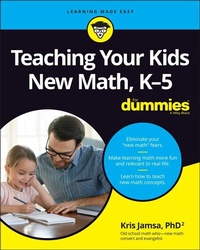
Teaching Your Kids New Math, K-5 For Dummies
Description

Teaching Your Kids New Math, K-5 For Dummies makes it easy to understand the new math being taught to students in kindergarten to Grade 5, showing parents and guardians how to help their kids with the new methods and concepts that have been introduced since they finished school.
You'll discover the math-teaching basics you need to help your kids with their math homework while becoming familiar with the grids, arrays, diagrams, and arrows that math students use today. You'll also get:
* A step-by-step walkthrough for teaching young students essential math concepts, even if you think you're not a "math person"
* Best practices, example problems, and tips and tricks about specific math topics that will help your youngster move forward
* Ways to avoid common and typical math pitfalls and frustrations that trap math students and teachers
Full of real-world examples and applications, Teaching Kids New Math, K-5, For Dummies is your essential companion to helping your child master their math assignments and have fun while you're doing it!
More details
Other editions
Additional editions
Person
Content
Chapter 2
Knowing the Number Names 1 to 9
IN THIS CHAPTER.
- Counting by the numbers 1 through 9
- Writing numbers 1 through 9
- Learning your phone number
Numbers and counting are important. Without them, musicians could not keep the beat, sports teams could not keep score, and Neil Armstrong could not have taken "One small step for man." Without numbers, there'd be no speed limits - wait, that might be kind of cool, not that you want to tell your kids that. But anyway, counting requires numbers, and in this chapter, your child is going to start learning them. So, let's get going; it will be as easy as 1, 2, 3!
Before you get started, you'll want to have the following supplies on hand:
- Box of 100 straws
- Deck of 3x5 index cards
- Deck of playing cards
Preparing for a Lesson
Before you start teaching your child, first prepare a few key teaching tools. To start, write the numbers 1 through 9 on individual 3x5 index cards, as shown below:
1
2
3
4
5
6
7
8
9
If you don't have 3x5 index cards, sheets of paper will do - however, because you'll be practicing daily, the index cards may be more durable and easier to store. Next, I recommend using straws as objects your child can count. They're also sturdy, and colorful straws can make the activity more fun. You can buy boxes of 100 (or more) straws from the grocery story, a wholesale store, or an online retailer such as Amazon.com. If you don't have straws, you can substitute pennies or any other small objects. Later, I suggest that you use playing cards, so if you don't already have some, you may want to pick some up while you are shopping.
Try to pick a quiet location where you and your child can work without distraction such as the kitchen table away from a TV.
-
Place the index card with the number 1 face up on the table and give your child one straw.
Tell your child, "This is the number 1, and you have one straw."
-
Repeat this process with the index card with the number 2, and place the second straw in front of your child on the table.
Place the card with the number 1 next to the card with the number 2:
1
2
-
Ask your child to point to the number that matches the number of straws they have.
They should point to the number 2. If not, take one straw away from them and say, "You pointed to the number 1. You had two straws, but now you have one."
- Place the card with the number 3 on the table and pick up three straws:
1
2
3
-
Count the straws out loud, "one, two, three," as you place them in front of your child.
Point to each card, again counting out loud.
- Ask your child to point to the number 3.
- Repeat this process for the numbers 4 and then 5:
1
2
3
4
5
-
Ask your child to point to the number 1 and ask them to pick up one straw.
As they pick up the straw, have them count out loud. Repeat this process for two straws, then three, four, and five. Then ask your child to put down the straws.
- Point to any number and ask your child to pick up the corresponding number of straws, counting the straws out loud as they take them.
-
With the five index cards facing up, present one to five straws to your child, allowing them to count them out loud.
Then have your child point to the corresponding number on the index cards.
- Repeat this process until your child masters the numbers 1 through 5 - which may take a few lessons.
As your child starts with counting, count the numbers out loud with your child as they count.
Learning math takes time and patience. Pay attention to when your child has had enough, and always try to end the lesson on a successful note. As a general rule, 10-minute sessions work well for most concepts.
In your next lesson, you can add the numbers 6 and 7:
1
2
3
4
5
6
7
After your child masters the numbers 1 through 7, you can repeat this process for the numbers 8 and 9.
1
2
3
4
5
6
7
8
9
Practicing Counting with Flash Cards
One of the best ways to master essential math skills is to practice them regularly. Flash cards are a great learning tool.
Using the numbered index cards, place the cards in order from 1 through 9.
-
Start with the number 1 and present the card to your child, having them say the number out loud.
Repeat the process one or two times as you present the cards in order.
-
After your child has mastered the ordered numbers, shuffle the cards and present the cards one at a time out of order.
If you do not have index cards, you can point to the numbers printed here, first in order and then out of order:
1
2
3
4
5
6
7
8
9
Also, if you happen to have the Uno card game, you can use the cards to practice counting with your child.
Counting different objects
Throughout the day, there are many opportunities for your child to master counting through the numbers you have practiced thus far. You might, for example, count your child's books, the number of socks in the laundry, the number of plates on the table, and so on. Find opportunities for your child to count. The more you practice with your child, the stronger their counting skills will become.
Pointing out numbers
As you encounter numbers throughout your day, point out the numbers to your child and have them say the numbers out loud. You might count the numbers on your phone, prices at the grocery store, gas prices at the pump, or even the page numbers of this book. When you encounter large numbers, such as a price ($19.95), have your child say the numbers one at a time: "One, nine, nine, five."
Writing the Numbers 1 through 9
After your child can read and recognize the numbers 1 through 9, they can learn to write each of them. Worksheet 2-1 at this book's companion website (www.dummies.com/go/teachingyourkidsnewmathfd) is good practice for tracing and printing the numbers 1 through 9, as shown in Figure 2-1.
FIGURE 2-1: Use a worksheet to practice writing the numbers 1 through 9.
Allow your child to write the numbers within this book. Also, as your child traces the numbers on worksheets you print, your focus should be on whether they draw the correct number rather than on using perfect handwriting.
Counting Objects and Writing the Corresponding Number
After your child knows the numbers 1 through 9, they should demonstrate that they can transfer their understanding by counting objects on a worksheet and writing the corresponding number.
Download and print Worksheet 2-2 from this book's companion website and help your child count the pictures out loud and write the corresponding number.
Identifying Numbers on Playing Cards
Throughout this book, you will use a deck of playing cards for different purposes. Here's one example of how you can use playing cards to practice with your child:
-
Remove the face cards and the '10' card from the deck of cards, leaving the rest, aces through nine.
Explain to your child that in most card games, the ace card counts as 1.
-
Mix up the cards in your hand, flip them over one at a time, and ask your child to name the corresponding number.
If your child misses a number, have them count the number of objects on the card and name it again.
- Repeat the process until your child masters the numbers 1 through 9.
Then place your cards face down on the table (hiding the numbers), and tell your child that you are going to play a game like so:
- Tell your child that they will turn over a card.
-
If your child can name the number correctly, they get to keep the card. Otherwise, you get to keep the card.
Tell your child that they can count the objects on the card to help.
- After your child names the last card, the one with the most cards wins!
If your child has difficulty with all the numbers in the card deck, work first with the cards for the numbers 1 through 5. After your child has mastered those numbers, you can move on to additional numbers, adding first the cards for 6, then 7, and so on.
