

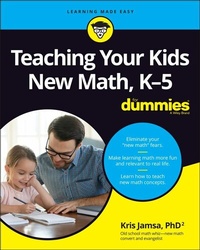
Teaching Your Kids New Math, K-5 For Dummies
1st Edition
Published on 5. April 2022
384 pages
978-1-119-86710-4 (ISBN)
Description

Help your child unlock their math potential with this intuitive guide to teaching new math
Teaching Your Kids New Math, K-5 For Dummies makes it easy to understand the new math being taught to students in kindergarten to Grade 5, showing parents and guardians how to help their kids with the new methods and concepts that have been introduced since they finished school.
You'll discover the math-teaching basics you need to help your kids with their math homework while becoming familiar with the grids, arrays, diagrams, and arrows that math students use today. You'll also get:
* A step-by-step walkthrough for teaching young students essential math concepts, even if you think you're not a "math person"
* Best practices, example problems, and tips and tricks about specific math topics that will help your youngster move forward
* Ways to avoid common and typical math pitfalls and frustrations that trap math students and teachers
Full of real-world examples and applications, Teaching Kids New Math, K-5, For Dummies is your essential companion to helping your child master their math assignments and have fun while you're doing it!
Teaching Your Kids New Math, K-5 For Dummies makes it easy to understand the new math being taught to students in kindergarten to Grade 5, showing parents and guardians how to help their kids with the new methods and concepts that have been introduced since they finished school.
You'll discover the math-teaching basics you need to help your kids with their math homework while becoming familiar with the grids, arrays, diagrams, and arrows that math students use today. You'll also get:
* A step-by-step walkthrough for teaching young students essential math concepts, even if you think you're not a "math person"
* Best practices, example problems, and tips and tricks about specific math topics that will help your youngster move forward
* Ways to avoid common and typical math pitfalls and frustrations that trap math students and teachers
Full of real-world examples and applications, Teaching Kids New Math, K-5, For Dummies is your essential companion to helping your child master their math assignments and have fun while you're doing it!
More details
Other editions
Additional editions
Kris Jamsa
Teaching Kids New Math For Dummies
Book
07/2022
1st Edition
Wiley
€24.00
Shipment within 15-20 days
Person
Dr. Kris Jamsa is the author of 115 books on computing and education. He holds eight college degrees, which include a PhD in Computer Science, a PhD in Education, and a Masters in Education with a focus on multiple intelligences. Jamsa was the founder of the Head of the Class series, an e-learning portal for kindergarten through fifth grade.
Content
- Intro
- Title Page
- Copyright Page
- Table of Contents
- Introduction
- About This Book
- Foolish Assumptions
- Icons Used in This Book
- Beyond the Book
- Where to Go from Here
- Part 1 Laying Down the Basics with Kindergarten Math
- Chapter 1 Unleashing Your Inner Math Teacher
- I'm Not Sure I Remember "Old Math," and Now There Is "New Math"
- Old Math, New Math, Common Core Math
- It's Not Too Late to Get Started
- Your Return on Investment
- Establish Your Routine
- Keep a Positive Attitude
- Chapter 2 Knowing the Number Names 1 to 9
- Preparing for a Lesson
- Practicing Counting with Flash Cards
- Counting different objects
- Pointing out numbers
- Writing the Numbers 1 through 9
- Counting Objects and Writing the Corresponding Number
- Identifying Numbers on Playing Cards
- Counting Numbers on a Number Line
- Learning Your Phone Number
- Chapter 3 Moving on up to 20
- Tiptoeing into the Teens
- Working with a number line for numbers 1 through 15
- Identifying matching numbers on a number line
- Reviewing Your Phone Number
- Going All the Way to 20
- Counting the Numbers 1 through 20 Using a Number Line
- Reviewing the Numbers 1 through 20 Using Flash Cards
- Counting the numbers from 1 through 20 forward and backward
- Identifying and writing missing numbers from 1 through 20
- Counting objects from 1 through 20 using a worksheet
- Learning the Relationship between Numbers 1 through 10 and 11 through 20
- Counting by Twos through 20
- Where To? Knowing Your Address
- Chapter 4 Comparing Numbers: Understanding More and Less
- Understanding More, Less, and Equal
- Bringing out the straws!
- Comparing numbers on a number line
- Learning the Greater-than, Less-than, and Equal Symbols
- Learning the less-than symbol
- Learning the greater-than symbol
- Learning the equal symbol
- Practicing all three symbols
- Comparing numbers using a deck of cards
- Comparing numbers on a worksheet
- Knowing and Counting the Numbers 1 through 30
- Filling in the gaps: Identifying missing numbers from 1 through 30
- Comparing numbers from 1 through 30
- Comparing numbers 1 through 30 using a worksheet
- Revisiting Counting Straws
- Chapter 5 Understanding Positions, Sorts, and Categorization of Objects
- Understanding In Front, Behind, and Next To
- Categorizing Objects
- Working up to Fabulous 40
- Identifying Missing Numbers from 1 through 40
- Moving on to Fantastic 50
- Identifying Missing Numbers from 1 through 50
- Comparing Numbers from 1 through 50
- Comparing Numbers 1 through 50 Using a Worksheet
- Revisiting Counting Straws
- Chapter 6 Getting Specific about Size and Shape
- Knowing the Concepts of Bigger, Smaller, and the Same
- Learning to Measure
- Learning to measure with a ruler
- Understanding and measuring inches
- Drawing lines using the ruler
- Using a tape measure
- Weighing Different Objects
- Edging up to 80
- Identifying missing numbers from 1 through 80
- Comparing numbers from 1 through 80
- Comparing numbers through 80 using a worksheet
- Counting straws through 80
- Evaluating Common Shapes
- Knowing the Numbers 1 through 100
- Identifying missing numbers from 1 through 100
- Comparing numbers from 1 through 100
- Comparing numbers through 100 using a worksheet
- Chapter 7 Adding and Subtracting the Numbers 1 through 10
- Starting with Basic Addition
- Using straws to understand addition
- Practicing written addition using index cards
- Demonstrating comprehension of expressions using straws
- Doing addition on a worksheet
- Using a number line to add numbers
- Adding numbers on a worksheet using a number line
- Adding numbers using flash cards
- Practicing addition through 10 using a worksheet
- Take It Away! Understanding Subtraction
- Subtracting with straws
- Practicing written subtraction using index cards
- Learning to subtract using a number line
- Subtracting numbers on a worksheet using a number line
- Subtracting numbers using flash cards
- Practicing subtraction through 10 using a worksheet
- Mixing It Up: Doing Addition and Subtraction
- Understanding the Concept of Zero
- Adding zero to a number
- Subtracting zero from a number
- Using flash cards to add zero to a number
- Adding zero to a number on a worksheet
- Subtracting zero from a number using flash cards
- Subtracting zero from a number on a worksheet
- Part 2 Figuring Out First Grade Math
- Chapter 8 Adding and Subtracting through 100 without Regrouping
- Identifying the Tens and Ones Places
- Recognizing the tens and ones places
- Recognizing tens on the number line
- Identifying the tens and ones places using a worksheet
- Adding and Subtracting Numbers through 100 without Regrouping
- Adding numbers through 100 without regrouping
- Using a number line to add large numbers
- Using boxes to add large numbers
- Adding numbers through 100 without regrouping and without boxes
- Subtracting numbers through 100 without regrouping
- Using a number line to subtract large Numbers
- Using boxes to subtract large numbers
- Subtracting large numbers without regrouping or boxes
- Mixing addition and subtraction problems on the same worksheet
- Reviewing Flash Cards for Addition and Subtraction through 10
- Completing a Timed Worksheet
- Chapter 9 Pairing Numbers with Telling Time
- Understanding the Concept of Time
- Understanding how time relates to day and night
- Knowing that an hour has 60 minutes
- Identifying hours and minutes on a digital clock
- Adding one minute to a time with 59 minutes
- Counting by Fives
- Telling Time Using an Analog Clock
- Knowing the five-minute intervals on the clock
- Learning the concept of seconds
- Working on Addition and Subtraction through 20
- Reviewing addition through 20
- Reviewing addition through 20 using a worksheet
- Reviewing subtraction through 20
- Reviewing subtraction through 20 using a worksheet
- Counting by 2 through 100
- Reviewing Counting by 10 through 100
- Chapter 10 Getting a Feel for Fractions
- Understanding Fractions
- Identifying the Parts of a Fraction
- Drawing Equivalent Fractions
- Understanding Mixed Numbers
- Recognizing Equivalent Fractions
- Measuring Using Fractions
- Comparing Fractions
- Chapter 11 Introducing Charts, Graphs, and Word Problems
- Reading Simple Charts
- Creating Their Own Chart
- Starting with Simple Word Problems
- Part 3 Advancing with Second Grade Math
- Chapter 12 Starting to Do Math in Their Head
- Beginning to Add and Subtract Mentally
- Mentally adding numbers through 20
- Adding numbers through 20 using a number line
- Adding numbers through 20 using a deck of playing cards
- Mentally adding numbers through 20 using a worksheet
- Mentally subtracting numbers through 20
- Subtracting numbers through 20 using a number line
- Subtracting numbers through 20 using a deck of playing cards
- Mentally subtracting numbers through 20 using a worksheet
- Counting to 1,000 by One Hundreds
- Reviewing the Tens and Ones Places
- Knowing the Hundreds, Tens, and Ones Places
- Identifying Missing Numbers from 1 to 1,000
- Adding and Subtracting Large Numbers without Regrouping
- Adding using boxes
- Adding without boxes
- Subtracting three-digit numbers using boxes
- Subtracting without boxes
- Revisiting Mental Addition and Subtraction
- Mentally adding 10
- Mentally subtracting 10
- Mentally adding 100 to a number
- Mentally subtracting 100 from a number
- Comparing Large Numbers
- Chapter 13 Having Some Fun with Money and Calendars
- Counting Change
- Counting pennies on a worksheet
- Understanding the value of a nickel
- Knowing that a dime is worth 10 cents
- Knowing that a quarter equals 25 cents
- Counting the correct amount of change
- Understanding Calendars
- Knowing the days of the week
- Knowing the months of the year
- Understanding a calendar
- Writing a date
- Chapter 14 Revisiting Fractions
- Reviewing Fractions
- Mixing Things up with Mixed Numbers
- Understanding What Equivalent Fractions Are
- Comparing Fractions
- Creating Equivalent Expressions
- Creating equivalent expressions using addition
- Creating equivalent expressions using subtraction
- Creating Equivalent Expressions Using Addition and Subtraction
- Chapter 15 Adding and Subtracting with Regrouping
- Reviewing Addition without Regrouping
- Using Boxes to Solve Addition Problems that Require Regrouping
- Solving Addition Problems that Require Regrouping without Boxes
- Adding Numbers Using Decomposition
- Reviewing Subtraction without Regrouping
- Understanding the Concept of "Borrowing"
- Learning to Check Their Work
- Using New Math to Add and Subtract Large Numbers
- Using an open number line to add numbers
- Performing subtraction using a number line
- Checking Their Work Using a Number Line
- Part 4 Tackling Third Grade Math
- Chapter 16 Introducing Basic Multiplication and Division
- Understanding the Multiplication Process
- Using tables to multiply numbers
- Multiplication is repeated addition
- Multiplying by 1
- Multiplying by 0
- Practicing multiplication flash cards
- Completing multiplication problems on a worksheet
- Multiplying any number by 10
- Understanding the Division Process
- Solving division problems using multiplication
- Using tables to perform division
- Dividing by 1
- Knowing that you cannot divide a number by 0
- Practicing with division flash cards
- Completing division problems on a worksheet
- Checking Their Work
- Chapter 17 Multiplying and Dividing Large Numbers
- Reviewing Multiplication through 10 and Preparing for Timed Tests
- Multiplying Two-Digit Numbers by Single-Digit Numbers (Old School)
- Multiplying two, two-digit numbers
- Multiplying numbers through 100
- Multiplying Numbers Using the Box Method (New Math)
- Revisiting Division through 100 and Preparing for Timed Tests
- Recognizing the Second Format for Division
- Dividing with a Remainder
- Dividing Larger Numbers
- Dividing Large Numbers with a Remainder
- Reviewing How to Check Work
- Chapter 18 Going Deeper with Charts, Fractions, and Word Problems
- Rounding Numbers
- Rounding numbers through 10
- Rounding numbers through 100
- Reviewing Charts
- Charting data
- Using point data
- Reading data on pie charts
- Adding Like Fractions
- Subtracting Like Fractions
- Reducing Fractions
- Revisiting Word Problems
- Part 5 Focusing on Fourth Grade Math
- Chapter 19 Mixing and Matching Operations
- Working with Complex Expressions
- Performing Multiplication and Division before Addition and Subtraction
- Performing Operations within Parentheses First
- Chapter 20 Understanding Factors through 100 and Numbers through 1,000,000
- Factoring a Number
- Understanding and Recognizing Prime Numbers
- Creating a Factor Tree
- Recognizing Place Values through 1,000,000
- Placing a Comma in Big Numbers
- Chapter 21 Pressing on with Even and Odd Numbers and Number Patterns
- Knowing Even and Odd Numbers
- Recognizing Number Patterns
- Chapter 22 Doing Math with Multi-digit Numbers
- Reviewing Addition with Regrouping
- Adding Three Rows of Multi-digit Numbers
- Adding Numbers through 1,000 (Old School)
- Adding Multi-digit Numbers through 10,000
- Adding Multi-digit Numbers Using a Number Line (New School)
- Adding Numbers Using Rounding
- Subtracting Multi-digit Numbers
- Subtracting multi-digit numbers using borrowing (old school)
- Subtracting multi-digit numbers using a number line (new school)
- Solving subtraction problems using rounding
- Multiplying Multi-digit Numbers (Old School)
- Multiplying Multi-digit Numbers Using the Box Method (New School)
- Dividing Multi-digit Numbers
- Chapter 23 Going Deeper with Fractions
- Reviewing Adding Fractions
- Reviewing Subtracting Fractions
- Revisiting Fractions and Mixed Numbers
- Reducing Improper Fractions
- Reducing Fractions
- Solving Word Problems That Use Fractions
- Part 6 Advancing to Fifth Grade Math
- Chapter 24 Interpreting Mathematical Expressions
- Solving Problems Using Multiple Operations
- Solving Problems with Multi-digit Numbers
- Solving Problems Grouped by Parentheses
- Completing Equivalent Expressions
- Revisiting Expressions with Parentheses
- Comparing Expressions Using &, &, and =
- Chapter 25 Revisiting Fractions, One More Time
- Comparing Fractions
- Adding Unlike Fractions
- Subtracting Unlike Fractions
- Multiplying Fractions
- Dividing Fractions
- Working with Mixed Numbers
- Multiplying mixed numbers
- Dividing mixed numbers
- Chapter 26 Knowing the Point of Decimals
- Revisiting Money
- Knowing the Tenths and Hundredths Places
- Recognizing the tenths place
- Recognizing the hundredths place
- Adding Numbers with Decimal Points
- Subtracting Numbers with Decimal Points
- Multiplying Numbers with Decimal Points
- Recognizing Equivalent Decimals
- Dividing Numbers with Decimal Points
- Chapter 27 Looking at Lines, Angles, Areas, and Perimeters
- Recognizing Parallel and Perpendicular Lines
- Recognizing Common Angles
- Calculating the Perimeter of a Rectangle
- Understanding the Special Rectangle: The Square
- Calculating the Perimeter of a Triangle
- Knowing the Parts of a Circle
- Calculating the Circumference of a Circle
- Calculating the Area of a Shape
- Calculating the area of a rectangle or square
- Calculating the area of a triangle
- Calculating the area of a circle
- Part 7 The Part of Tens
- Chapter 28 Top Ten Things to Remember about Teaching Your Child Math
- Establish Your Child's Baseline
- Set Aside 15 Minutes a Day, Every Day
- Keep the Focus on Your Child
- Be Patient
- Use Additional Resources
- Take Time to Master Each Grade Level
- Point Out Math in the Real World
- Praise the Things Your Child Does Well
- Talk with Your Child's Teacher
- Keep It Fun
- Chapter 29 Ten Next Steps in Your Child's Education
- Read with Your Child
- Be Involved
- Keep Video Games to a Reasonable Amount
- Help Your Child Learn Computer Skills
- Implement a Word of the Day
- Ensure Adequate Sleep Time
- Encourage Learning a Musical Instrument
- Learn a Second Language Together
- Listen and Talk to Your Child
- Involve Your Child
- Index
- EULA
