

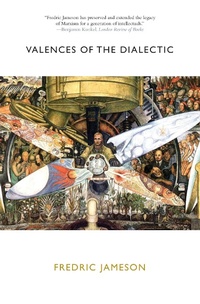
Valences of the Dialectic
Published on 5. May 2020
634 pages
978-1-78960-123-7 (ISBN)
Description

After half a century exploring dialectical thought, renowned cultural critic Fredric Jameson presents a comprehensive study of a misunderstood yet vital strain in Western philosophy. The dialectic, the concept of the evolution of an idea through conflicts arising from its inherent contradictions, transformed two centuries of Western philosophy. To Hegel, who dominated nineteenth-century thought, it was a metaphysical system. In the works of Marx, the dialectic became a tool for materialist historical analysis.
Jameson brings a theoretical scrutiny to bear on the questions that have arisen in the history of this philosophical tradition, contextualizing the debate in terms of commodification and globalization, and with reference to thinkers such as Rousseau, Luk¿cs, Heidegger, Sartre, Derrida, and Althusser. Through rigorous, erudite examination, Valences of the Dialectic charts a movement toward the innovation of a "spatial" dialectic. Jameson presents a new synthesis of thought that revitalizes dialectical thinking for the twenty-first century.
Jameson brings a theoretical scrutiny to bear on the questions that have arisen in the history of this philosophical tradition, contextualizing the debate in terms of commodification and globalization, and with reference to thinkers such as Rousseau, Luk¿cs, Heidegger, Sartre, Derrida, and Althusser. Through rigorous, erudite examination, Valences of the Dialectic charts a movement toward the innovation of a "spatial" dialectic. Jameson presents a new synthesis of thought that revitalizes dialectical thinking for the twenty-first century.
More details
Edition
Ebook UK & RoW
Language
English
Place of publication
London
United Kingdom
Product notice
Reflowable
ISBN-13
978-1-78960-123-7 (9781789601237)
Copyright in bibliographic data and cover images is held by Nielsen Book Services Limited or by the publishers or by their respective licensors: all rights reserved.
Schweitzer Classification
Other editions
Additional editions
Person
Fredric Jameson is Distinguished Professor of Comparative Literature at Duke University. The author of numerous books, he has over the last three decades developed a richly nuanced vision of Western culture's relation to political economy. He was a recipient of the 2008 Holberg International Memorial Prize. He is the author of many books, including Postmodernism, Or, The Cultural Logic of Late Capitalism, The Cultural Turn, A Singular Modernity, The Modernist Papers, Archaeologies of the Future, Brecht and Method, Ideologies of Theory, Valences of the Dialectic, The Hegel Variations and Representing Capital.
Content
- Cover Page
- Halftitle Page
- Title Page
- Copyright Page
- Dedication
- Contents
- Part I: The Three Names of the Dialectic
- Chapter 1: The Three Names of the Dialectic
- Part II: Hegel Without Aufhebung
- Chapter 2: Hegel and Reification
- Chapter 3: Hegel's Contemporary Critics
- Part III: Commentaries
- Chapter 4: Marx's Purloined Letter
- Chapter 5: Deleuze and Dualism
- Chapter 6: History and Class Consciousness as an Unfinished Project
- Chapter 7: Sartre's Critique, Volume 1: An Introduction
- Chapter 8: Sartre's Critique, Volume 2: An Introduction
- Part IV: Entries
- Chapter 9: Commodification
- Chapter 10: Cultural Revolution
- Chapter 11: Persistencies of the Dialectic: Three Sites
- Chapter 12: Lenin as Political Thinker
- Chapter 13: Rousseau and Contradiction
- Chapter 14: Ideological Analysis: A Handbook
- Part V: Politics
- Chapter 15: Actually Existing Marxism
- Chapter 16: Utopia as Replication
- Chapter 17: Globalization as a Philosophical Issue
- Chapter 18: Globalization and Political Strategy
- Part VI: The Valences of History
- Chapter 19: The Valences of History
- Part I: Making Time Appear
- 1. Temporality and Figuration
- 2. Ricoeur's Project
- 3. Aristotle vs. Semiotics
- 4. The Phenomenology of Narrative
- 5. Augustine vs. Aristotle
- 6. Ricoeur's Three Mimeses
- 7. Eudaimonics
- 8. Closure of the Act
- 9. Modernism and the Categories of Time
- 10. The Time of the Historians
- Part II. Making History Appear
- 1. Taking Sides
- 2. Peripeteia
- 3. Anagnorisis
- 4. Pathos
- Acknowledgments
- Notes
- Index
