

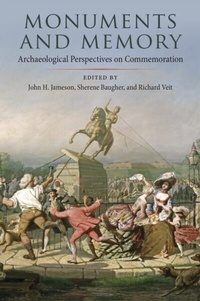
Monuments and Memory
Description

Examining the pasts, evolving meanings, and silenced histories surrounding public monuments
This volume examines many different public monuments to increase understanding of the cultural factors that have shaped their creation, maintenance, and?in some cases?removal. The role of monuments in communities and society continues to be an important and controversial topic, and the case studies in this volume contribute to this conversation by assessing the ways such markers can be empowering or marginalizing from a wide range of perspectives.
The monuments discussed here represent historical events from the Revolutionary War through the Korean War, including the ?slave auction block? formerly located on the streets of Fredericksburg, Virginia; memorials to Confederate soldiers across the South and in northern POW cemeteries; and the Pullman National Monument in Chicago for workers who participated in the 1894 Pullman Strike. This volume also highlights the dearth of statues memorializing the achievements of women and minorities, especially women of color, and contributors discuss whether recent movements advocating for more inclusive histories will lead to an increase in monuments honoring people whose narratives have been suppressed.
Looking at the powerful role of monuments in conveying the memory of history to future generations, the contributors to Monuments and Memory show why it is important to address the messages of these sites and ask whose histories they may be silencing. This book demonstrates how conversations surrounding preservation and interpretation of monuments encourage community involvement.
A volume in the series Cultural Heritage Studies, edited by Katherine Hayes
Contributors: Mark Cassello | Richard F. Veit | MarkCianciosi | Joshua Butchko | Diane Wallman | Suzanne Spencer-Wood | ShereneBaugher | Lu Ann De Cunzo | John H. Jameson | Jeffrey Smith | Hilary Green | BrantVenables | Timo Ylimaunu | Paul R. Mullins | Kerri Barile | Harold Mytum | MelissaZiobro | M. Jay Stottman | Levi Fox | Matthew Litteral
All prices
More details
Other editions
Additional editions
Persons
John H. Jameson, retired archaeology public interpretation lead with the United States National Park Service, is coeditor of Unlocking the Past: Celebrating Historical Archaeology in North America.
Sherene Baugher is professor emeritus of anthropology and landscape architecture at Cornell University. Richard Veit is professor of anthropology and provost and senior vice president for academic affairs at Monmouth University. Baugher and Veit are coeditors of The Archaeology of Cemeteries and Gravemarkers.Content
List of Figures vii
List of Tables ix
Foreword xi
1.Introduction 1
Sherene Baugher, Richard Veit, and John H. Jameson
2.Monuments and Memories: Irish, Polish, and Haudenosaunee Engagements with the Heritage Narratives of the American Revolutionary War 21
Brant Venables
3.The Fredericksburg Slave Auction Block: A Monumental Reminder of Race Relations in Virginia 40
Kerri Barile Tambs
4.?Each Soldier's Grave a Shrine?: Confederate Cemetery Monuments 56
Jeffrey Smith
5.Remembering, Reconciliation, and Forgetting: Monuments of Northern Cemeteries for Confederate Prisoners of War, Especially Elmira 74
Sherene Baugher
6.Race, Gettysburg Memory, and the Jenkins Monument in Pennsylvania, 1990s?2020 92
Hilary N. Green
7.Confronting Confederate Narratives: Archaeology at the Judah P. Benjamin Confederate Memorial at Gamble Plantation Historic State Park 107
S. Matthew Litteral and Diane Wallman
8.Hidden in Public: The Power of the Memorial Landscape and the Archaeology of a Cornerstone Deposit from Louisville's Confederate Monument 126
M. Jay Stottman
9.Pullman: A Model Town Becomes a National Monument 144
Mark Cassello
10.A Feminist Intersectional Perspective Addressing the Dearth of Statues of Women and Minorities Resulting from the Great Predominance of Racist Patriarchal Public Statues in the United States 163
Suzanne Spencer-Wood
11.Three Ways of Remembering World War I: The Sledmere Memorials, Yorkshire, England 186
Harold Mytum
12.Memorializing Defeat: Remembering Civil Wars in Finland and USA 202
Timo Ylimaunu and Paul R. Mullins
13.The Forgotten War Memory Boom: State and Local Korean War Memorials, 1987?2003 219
Levi Fox
14.?Be Assured That . . . All . . . Memorials Will Be Kept Sacred and Beautiful?: The Life Cycle of Memorials at Fort Monmouth, New Jersey 237
Melissa Ziobro
15.Cannons by the Courthouse: War Memorials, Memory, and Commemoration in Modern Suburbia 255
Richard Veit, Mark Cianciosi, and Joshua Butchko
16.Contested Monuments, Contested Spaces, and Contested Narratives 275
Lu Ann De Cunzo
List of Contributors 293
Index 297
