

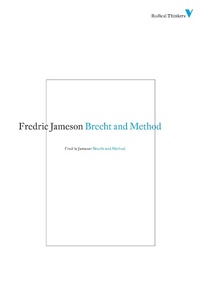
Brecht and Method
Published on 5. May 2020
240 pages
978-1-78960-023-0 (ISBN)
Description

The legacy of Bertolt Brecht is much contested, whether by those who wish to forget or to vilify his politics, but his stature as the outstanding political playwright and poet of the twentieth century is unforgettably established in this major critical work. Fredric Jameson elegantly dissects the intricate connections between Brecht's drama and politics, demonstrating the way these combined to shape a unique and powerful influence on a profoundly troubled epoch.
Jameson sees Brecht's method as a multi-layered process of reflection and self-reflection, reference and self-reference, which tears open a gap for individuals to situate themselves historically, to think about themselves in the third person, and to use that self-projection in history as a basis for judgment. Emphasizing the themes of separation, distance, multiplicity, choice and contradiction in Brecht's entire corpus, Jameson's study engages in a dialogue with a cryptic work, unpublished in Brecht's lifetime, entitled Me-ti; Book of Twists and Turns. Jameson sees this text as key to understanding Brecht's critical reflections on dialectics and his orientally informed fascination with flow and flux, change and the non-eternal.
For Jameson, Brecht is not prescriptive but performative. His plays do not provide answers but attempt to show people how to perform the act of thinking, how to begin to search for answers themselves. Brecht represents the ceaselessness of transformation while at the same time alienating it, interrupting it, making it comprehensible by making it strange. And thereby, in breaking it up by analysis, the possibility emerges of its reconstitution under a new law.
Jameson sees Brecht's method as a multi-layered process of reflection and self-reflection, reference and self-reference, which tears open a gap for individuals to situate themselves historically, to think about themselves in the third person, and to use that self-projection in history as a basis for judgment. Emphasizing the themes of separation, distance, multiplicity, choice and contradiction in Brecht's entire corpus, Jameson's study engages in a dialogue with a cryptic work, unpublished in Brecht's lifetime, entitled Me-ti; Book of Twists and Turns. Jameson sees this text as key to understanding Brecht's critical reflections on dialectics and his orientally informed fascination with flow and flux, change and the non-eternal.
For Jameson, Brecht is not prescriptive but performative. His plays do not provide answers but attempt to show people how to perform the act of thinking, how to begin to search for answers themselves. Brecht represents the ceaselessness of transformation while at the same time alienating it, interrupting it, making it comprehensible by making it strange. And thereby, in breaking it up by analysis, the possibility emerges of its reconstitution under a new law.
More details
Series
Edition
Ebook UK & RoW
Language
English
Place of publication
London
United Kingdom
Product notice
Reflowable
Readable offline
ISBN-13
978-1-78960-023-0 (9781789600230)
Copyright in bibliographic data and cover images is held by Nielsen Book Services Limited or by the publishers or by their respective licensors: all rights reserved.
Schweitzer Classification
Other editions
Additional editions
Person
Fredric Jameson is Distinguished Professor of Comparative Literature at Duke University. The author of numerous books, he has over the last three decades developed a richly nuanced vision of Western culture's relation to political economy. He was a recipient of the 2008 Holberg International Memorial Prize. He is the author of many books, including Postmodernism, Or, The Cultural Logic of Late Capitalism, The Cultural Turn, A Singular Modernity, The Modernist Papers, Archaeologies of the Future, Brecht and Method, Ideologies of Theory, Valences of the Dialectic, The Hegel Variations and Representing Capital.
Content
- Cover Page
- Title Page
- Copyright Page
- Dedication
- Contents
- Prologue
- 1. Nützliches
- 2. Monadic Chronologies
- 3. Triangulating Brecht
- Part I: Doctrine/Lehre
- 4. Estrangements of the Estrangement-Effect
- 5. Autonomization
- 6. Episch, or, the Third Person
- 7. Dualities of the Subject
- 8. From Multiplicity to Contradiction
- Part II: Gestus
- 9. Pedagogy as Autoreferentiality
- 10. Parable
- 11. Grundgestus
- 12. Casus
- 13. Allegory
- Part III: Proverbs/Sprüche
- 14. Proverbs and Peasant History
- 15. Registers and Generic Discontinuities
- 16. Representability of Capitalism
- 17. 'Beinah'
- Epilogue
- 18. Modernity
- 19. Actuality
- 20. Historicity
- Notes
- Index
