

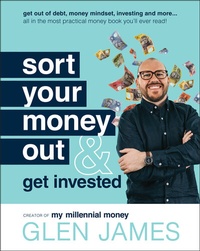
Sort Your Money Out
Description

It's time to learn how to manage your money and understand investing
In Sort Your Money Out: and Get Invested, former financial adviser and host of the money money money podcast (formerly my millennial money) Glen James shares a life-changing approach to the major milestones of your personal finances. Learn how to deal with debt, embrace a realistic spending plan that works, buy your first home, invest in shares and create the plan you need for long-term financial success. You'll get the accessible and friendly help you need to get smart with your money and equip yourself with the skills and tools to understand and secure your financial future and invest in a property, in shares and in yourself.
Written in a matter-of-fact style perfect for anyone who just wants to know what works for them, you'll also learn about:
- Realistic ways to increase your income and help balance your budget
- The methods that lead to a safer, more stable financial future
- The smart way to invest in real estate and purchase a home or investment property
- How to understand the share market, ethical investing, and your superannuation
- Getting out of debt and getting the most out of your life
Ideal for anyone trying to get a handle on their personal finances and get started building a portfolio, Sort Your Money Out is a one-of-a-kind must-read book filled with practical and entertaining financial help to make sense of an intimidating, but crucial, part of everyone's lives.
More details
Other editions
Additional editions
Person
GLEN JAMES is the host of the popular podcast, my millennial money. A retired financial adviser, he brings practical and fun financial help, making the boring bearable and the complex engaging. With a particular interest in personal finance and small business, his advice is not only for millennials, but suitable for all.
Content
hi, I'm Glen! ix
introduction xi
let's get this party started! 1
1 debt and how to get out of it 2
2 get rich and make it rain: mindset and money 44
can we fix it? yes, we can! 67
3 a sound financial house 68
4 budgets suck: setting up your spending plan 100
getting invested 135
5 learn how to be the wolf of your own street 136
6 move over Warren Buffett, I'll take it from here 158
7 property and mortgages: how to pass go with a plan 232
looking at important topics 273
8 superannuation: your first-ever investment account 274
9 sex, drugs and insurance 308
where to from here? 339
money myths, hacks, luxury items and digital assets 345
disclosures 361
index 363
introduction
I am not a writer and I hate reading. I am not an economist and I hate maths. I am not a behavioural therapist and I hate getting told what to do. I am not a naturally frugal person and I hate budgets. I do, however, happen to be a retired financial adviser and I have been in an ideal position to observe what works and what doesn't work when it comes to people's personal finances. I have seen hundreds of individuals' secrets (good and bad!) when it comes to money and how they do things. My own struggles with wanting to spend every living cent that walks into my life meant that I needed to create a system that works on its own and allows me to not have to think or care about money day to day while still saving and building wealth in the background.
When it comes to money, personal development, goal setting and motivation, I love books that are of a self-help nature. (Yes, I hate reading - so I listen to audio books.)
There are some books that I love because they nail certain concepts, but I would struggle to recommend them to you as they are American and not specifically relevant to our way of doing things in Australia. Don't get me wrong: while there are many things to glean in every book, I wanted to put something together that was clear, concise and could be read over dinner. A pamphlet, even. (If you've watched Curb Your Enthusiasm, where Larry David and Jerry Seinfeld hassle Jason Alexander for his book Acting without Acting, you'll know what I'm talking about.)
If this book encourages and changes only one person, I will be happy. I understand that my way of doing things may not be the silver bullet you're after (if you find one, please let me know), but it is a way that works and will work for most people. The trick is to live purposefully with your money and to have a system in place that works for you and your particular personality style.
I will show you how to set up your personal finances so you never feel broke again. (I am not talking about joining a powerball syndicate with friends at work - but hey, if the shoe fits, right?)
I will show you step by step how easy it is to invest for your future and teach you enough that you will feel empowered and be informed to make your own decisions.
I will show you how to set up your financial life from the ground up so you build it in the right order.
Yes, I may be provocative and sarcastic; however, I will be extremely practical and will give you the tools to win in all areas of your finances.
Make sure you look at the resources at the end of each chapter as there will be useful tools for reference along the way.
Life On Own Terms (LOOT: my version of FIRE)
Financial Independence Retire Early (FIRE) is a movement of people who follow a mantra of being able to live your life your own way and working towards having financial autonomy not linked to a source of income that you have to work for (e.g. salaried employment). It's the ultimate goal of amassing enough passive income so you don't have to work! Love it! At the risk of offending thousands of people who are dedicated FIRE followers, I believe this movement can be summed up as 'just do what you want on your own terms'. (Sorry to offend you so early in the book.) This is why I prefer to use the acronym LOOT. That being said, throughout my life I have always had a recurring existential crisis in my mind. Like, does anything actually matter? What is the point? Why should we conform to societal norms? We are just floating on a speck of dust travelling 1600 kilometres per hour into infinity.
Now, that thought can become pretty heavy on the mind, so to counteract it, I often find myself thinking about life as a game. There are laws that our human societies have agreed on, but on balance we are fortunate enough to live in a world - and particularly fortunate to live in a developed country like Australia - where we can generally do as we wish. Please don't go quoting any Maslow's hierarchy of needs at me saying I am just pursuing self-actualisation and I am a privileged and entitled brat (guilty). That would be weird; however, as I was having these thoughts at a very young age, maybe I was a brat and have not grown up since age 12.
We should on occasion step back and have a detailed look at our own situation and life from a different angle, as perspective can make a world of difference. It could be the difference between a park full of people re-enacting the 'Thriller' music video or individual people holding up the Leaning Tower of Pisa (if you've seen the meme). Perspective matters.
If you are part of the millennial generation or Gen Z cohort, you may have been influenced by the perspective of a parent, grandparent or other significant influence in your life - and if not a specific person, you will have been influenced and moulded by society in general.
The trap in this situation is that Gen Xers and baby boomers lived in different economic conditions from those that exist today.
It used to be pretty linear: it went education, then work, then retirement. A job for life and then out to pasture. The average age for the big events in Australians' lives has basically shifted 10 years further into the future compared with the baby boomer generation. Fifty years ago, people reaching age 65 were considered 'old'. Nowadays, age 65 is considered being within the 'lifestyle years'.
Why do we build our lives on a structure that is modelled from another era so different from today's? Why do we go to work, go home, sleep, rinse and repeat? Why do we get told that we have to save for a magical line in the sands of our time - age 65 - so that we can then suddenly stop the conveyor belt of our working life to do nothing but enjoy life in retirement?
Well, I'm here to say that from this time on, things will be different. For example, at the time of writing I am mid-30s and I am working in my third occupation. I left school at age 16 and commenced a trade (telecommunications), then re-trained and studied financial planning (which I worked in for about 15 years), started a passion project on the side and now I am a full-time podcaster with a team of people that has morphed into some weird new media company. What the heck will the next 10 years look like? My point here is, I'm like many others - there is no longer one career for life.
If you are reading this and saying, 'But Glen, I love my job and life!', that is perfect. You are killing it. Keep it up.
If you're just leaving school, at university or under 30, the key to life at this stage is to keep away from consumer debt and keep your cash flow as lean and agile as possible (all of which I will help you with in this book). It is a good rule for any age, to be honest.
You may be reading this thinking you have found yourself on a treadmill of working to live, you have no real passion for what you are doing and you feel too old. Let this book be the sign you are after: you can change; it is not too late. Anything is possible with your life and your money. Perhaps you have been in the workforce for some time, have financial commitments that are beyond you (in other words, you're in a crap load of debt!) or you're just bored. You have been accustomed to a life of apathy and have accepted defeat. That is the last we will speak of it. You need to decide enough is enough and start to make a change. This book could be the catalyst you need.
I want you to think, is your life how it is now because of a specific person in your life who is influencing you with their perspective on how things 'should be done'? Has your mindset been influenced by a societal structure that has changed over time? You might be thinking, 'everything is fine, I want "the Great Australian Dream" '. Do you even know what that is and who made it up? Well, I don't know the name of the person who envisioned the Great Australian Dream or coined the phrase, but it is a derivative of the American Dream in the 1940s and really took off in the 1950s and 1960s. The Dream was basically to buy a home as this was a symbol of success and the house provided security. Yes, I get it - the security of owning an owner-occupied (your own) home must surely be a good thing, right? But why are we applying 1940s (almost a century ago) logic to today's crazy house prices and way of life?
Your job while reading this book is to step back and look at your life and finances from the perspective of the you of tomorrow. What would the you of tomorrow want you to do? How would they want you to handle money? Would they want you to put some money away for them? Would they want you to set up your life now right, so they are in the best lifestyle position? If you're not happy with where you are at, let's change that now!
I'm setting the new Great Australian Dream . LOOT: life on own terms.
Your own terms might include buying a house and having one job for life. Great. I love it. But don't just jump into the car, flick on cruise control, get a blindfold and then at the end ask, 'How did I get here and who set the course?'
I love that the new Great Australian Dream does not include any 'have to' pressures; it does not include particular physical things to attain; it does not include a...
