

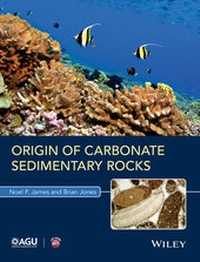
Origin of Carbonate Sedimentary Rocks
Description

More details
Other editions
Additional editions
Persons
Content
Preface xiii
Acknowledgements xv
PART I: CARBONATE SEDIMENTOLOGY: AN OVERVIEW 1
1 CARBONATE ROCKS AND PLATFORMS 5
What are carbonate sedimentary rocks? 6
Why should we care about studying these rocks? 6
What is the scientific approach? 6
The carbonate continuum 7
How do carbonate sediments form? 9
Where are carbonates produced and where do they accumulate? 10
Tectonic settings and the nature of carbonate platforms 11
How do we study carbonate sediments and rocks? 14
Further reading 14
2 CARBONATE CHEMISTRY AND MINERALOGY 15
Introduction 16
Chemistry 16
Carbonate precipitation and dissolution in the ocean 19
Further reading 21
3 THE CARBONATE FACTORY 22
Introduction 23
Sediment production 23
Component modification 28
Karst and carbonate spring precipitates 36
Further reading 37
4 MARINE CARBONATE FACTORIES AND ROCK CLASSIFICATIONS 38
Introduction 39
Environmental controls 39
Benthic marine factories 46
Pelagic marine factories 47
Limestone classification schemes 47
Further reading 50
5 THE CARBONATE FACTORY: MICROBES AND ALGAE 51
Introduction 52
Microbes and carbonates 52
Microbialites 52
Modern stromatolites 54
Calcimicrobes 60
Calcareous algae 60
Further reading 66
6 THE CARBONATE FACTORY: SINGLE CELLS AND SHELLS 67
Introduction 68
Single?]cell microfossils 68
Macrofossils 71
Further reading 78
7 THE CARBONATE FACTORY: ECHINODERMS AND COLONIAL INVERTEBRATES 79
Introduction 80
Echinoderms 80
Sponges 82
Bryozoans 85
Corals 89
Further reading 93
Part II: CARBONATE DEPOSITIONAL SYSTEMS: AN OVERVIEW 95
8 LACUSTRINE CARBONATES 99
Introduction 100
Modern lakes: Zonation and classification 100
Controls on lake sedimentation 101
Lake sedimentation 103
Lacustrine microbialites 107
Classification of ancient lake deposits 108
Further reading 108
9 CARBONATE SPRINGS 110
Introduction 111
Spring systems 111
Classification of springs 112
Tufa, travertine, or sinter? 113
Biota of spring systems 114
Carbonate precipitation in spring systems 114
Spring architecture 115
Calcareous spring carbonate facies 117
Further reading 122
10 WARM?]WATER NERITIC CARBONATE DEPOSITIONAL SYSTEMS 123
Introduction 124
The carbonate factory 124
Depositional systems 125
Further reading 134
11 THE COOL?]WATER NERITIC REALM 135
Introduction 136
The Carbonate Factory 136
Depositional settings 139
Warm?]temperate carbonates 141
Cool?]temperate carbonates 144
Cold?]water, polar carbonate systems 144
The rock record 145
Further reading 148
12 MUDDY PERITIDAL CARBONATES 150
Introduction 151
Andros Island: The Bahamas 152
Shark Bay: Western Australia 154
The United Arab Emirates: Persian Gulf 155
Stratigraphy 158
The shallowing?]upward peritidal cycle 158
How do numerous peritidal cycles form? 158
Temporal variations on the peritidal cycle theme 162
Further reading 163
13 NERITIC CARBONATE TIDAL SAND BODIES 165
Introduction 166
Tides and tidal currents 166
Tidal sand bodies 167
Bahamian platform ooid sand bodies 169
Types of Bahamian platform sand bodies 170
Some examples of Bahamian sand bodies 171
Inter?]island tidal ooid sand bodies (tidal deltas) 173
Platform interior Bahamian ooid sand bodies 174
Carbonate ramp tidal ooid sand bodies 175
Carbonate sand bodies in straits and seaways 175
Carbonate sands in flooded incised valleys 176
Carbonate sands in hypersaline basins 177
The rock record of tidal ooid sands 177
Ancient sand body geometries 178
Further reading 178
14 MODERN REEFS 179
Introduction 180
The reef mosaic 180
The coral reef growth window 182
Shallow?]water reefs 184
Deep?]water reefs 189
Further reading 191
15 ANCIENT REEFS 192
Introduction 193
The ancient reef factory 193
Microbes, calcimicrobes, and calcareous algae 194
Internal cavities 195
Lithification 195
Boring and bioerosion 196
Reef stratigraphic nomenclature 196
The spectrum of ancient reefs 198
Reefs 198
Reef mounds 199
Reef geohistory 202
Reef rock classification 206
Further reading 217
16 CARBONATE SLOPES 212
Introduction 213
Depositional bathymetry 213
The deposits 213
Contourites 217
Slope types 218
Temporal and spatial variability 220
Further reading 222
17 DEEP?]WATER PELAGIC CARBONATES 223
Introduction 224
Universal controls 224
Depositional controls 225
Universal attributes 226
Old pelagic sediments 226
Young pelagic sediments 228
The pelagic factory 228
Chalk 229
Associated sediments 233
Ocean anoxia 233
Further reading 233
18 PRECAMBRIAN CARBONATES 234
Introduction 235
Precambrian carbonate systems 235
The carbonate factory 235
Reefs 242
Further reading 246
19 CARBONATE SEQUENCE STRATIGRAPHY 247
Introduction 248
Carbonate sequence stratigraphy 249
Shallow?]water reef sequence stratigraphy 250
Photozoan rimmed platforms 252
Evaporites and siliciclastics 255
Heterozoan unrimmed carbonate platforms 255
Ramps 257
Higher?]order cycles (parasequences) 259
Depositional cycles 259
Further reading 259
20 THE TIME MACHINE 261
Introduction 262
Carbonates and plate tectonics 262
Paleoclimate and paleoceanography 265
Carbonates and the evolving biosphere 268
Ocean acidification 271
Further reading 271
Part III: CARBONATE DIAGENESIS: AN OVERVIEW 273
21 THE PROCESSES AND ENVIRONMENTS OF DIAGENESIS 277
Introduction to the processes 278
Carbonate dissolution 278
Carbonate precipitation 278
The environments 281
Synsedimentary marine diagenetic environment 282
Meteoric diagenetic environment 282
Burial diagenetic environment 284
Dolomite and dolostone 285
Further reading 285
22 ANALYTICAL METHODS 286
Introduction 287
Petrography 288
X?]ray diffraction analysis 291
Scanning electron microscopy 292
Electron microprobe analysis 294
Chemical analyses 294
Further reading 296
23 THE CHEMISTRY OF CARBONATE DIAGENESIS 297
Introduction 298
Trace elements and element ratios 298
Stable isotopes 301
Oxygen isotopes 301
Carbon isotopes 303
Stable isotope values for modern biogenic carbonates 304
Carbonate stable isotope values through geologic time 305
Strontium isotopes 307
Further reading 309
24 LIMESTONE: THE SYNSEDIMENTARY MARINE DIAGENETIC ENVIRONMENT 311
Introduction 312
The setting 312
Dissolution 312
Precipitation 313
Alteration 315
Synsedimentary limestone 316
Spatial distribution of early lithification 318
Strandline diagenesis 319
The rock record 323
Isotopic composition of ancient marine cements 324
Further reading 325
25 METEORIC DIAGENESIS OF YOUNG LIMESTONES 326
Introduction 327
Processes 327
Cements and cementation 330
Diagenesis of calcite sediments 333
Importance of grain size 333
Diagenesis in different meteoric settings 334
Importance of climate 335
How long does it take? 335
The ultimate product 336
Geochemistry 337
Further reading 339
26 KARST AND WATER?]CONTROLLED DIAGENESIS 341
Introduction 342
Surficial processes and products 342
Surface karst facies 342
Calcrete facies 346
Subsurface karst facies 348
Surface and subsurface carbonate geochemistry 355
Further reading 356
27 BURIAL DIAGENESIS OF LIMESTONE 357
Introduction 358
The setting 358
Controlling factors 358
Processes and products 359
Burial cementation 362
Burial diagenetic models 365
Paragenesis via cement stratigraphy 368
Further reading 369
28 DOLOMITE AND DOLOMITIZATION 370
Introduction 371
Scientific approach 371
Dolomite: the mineral 371
Dolostone: the rock 373
The limestone to dolostone transition 376
Early diagenetic alteration of dolomite 376
Dolomite geochemistry 380
Further reading 382
29 DOLOMITIZATION PROCESSES AND SYNSEDIMENTARY DOLOMITE 383
Introduction 384
What limits dolomite formation? 384
How to form extensive dolomite 385
The different types of dolomite and dolostone 386
Synsedimentary (authigenic) dolomite 386
Further reading 390
30 SUBSURFACE DOLOMITIZATION AND DOLOSTONE PARAGENESIS 392
Introduction 393
Shallow?]burial early?]diagenetic dolomites 393
Deep?]burial late?]diagenetic dolomites 396
Synthesis 399
Dolomite paragenesis 399
Further reading 402
31 DIAGENESIS AND GEOHISTORY 403
Introduction 404
Eogenetic diagenesis 404
Approach 406
Lowstand systems tract 406
Transgressive systems tract 408
Highstand systems tract 410
Post?]eogenetic diagenesis 411
Further reading 413
32 CARBONATE POROSITY 414
Introduction 415
Porosity 415
Porosity measurement 415
Permeability 416
Types of porosity 416
Porosity classification 421
Porosity evolution through time 422
Porosity and dolomitization 423
The evolution of porosity 423
Integration 425
Further reading 426
GLOSSARY 427
INDEX 000
PREFACE
This is a textbook. It is an overview highlighting the origin and preservation of carbonate sedimentary rocks. The approach is general and universal and draws heavily on fundamental discoveries, arresting interpretations of ancient limestones and dolostones, and keystone syntheses over the last five decades. The volume is designed as a teaching tool for upper-level undergraduate classes, a fundamental reference for graduate and research students, and a scholarly source of information for practicing professionals whose expertise lies outside this specialty. It is not a compendium of the current state of research, but is instead designed as a digestible synthesis of the science written for newcomers to the topic. We encourage those of you who have been drawn into the ancient world that is entombed in carbonate rocks to read the profound works upon which this book is based to see how this science evolved and to capture the fascinating details of the geology that our words here can only summarize. We have shamelessly borrowed from these fundamental works, but they are referenced at the end of this preface and at the end of each chapter. The genesis of carbonate rocks is far from completely understood - much remains to be discovered - and in this light we urge you to use this book as a stepping-stone towards new understanding.
The focus is on carbonate rocks and the sediments from which they are derived. To fully understand this science it is necessary to be as much of a natural scientist as possible and yet remain grounded in geology. We, your authors, have studied modern sediments and reefs where the deposits are born, using scuba in shallow tropical and temperate seas, submersibles to over 3 km in the deep ocean, slogged through rainy swamps, tiptoed across muddy tidal flats scorched by the desert sun, stumbled about in deep caves, and carefully sampled steaming and bubbling hot springs. Our study of ancient rocks spans those formed on the young Earth more than 3 billion years ago to those made just yesterday in the Holocene. This research has taken us from the high Arctic, to the Rocky Mountains of North America, to the steaming tropics of Australia, to the warm reefs of the Caribbean, to the shark-infested waters of the Southern Ocean, to hot and cold springs in New Zealand, Iceland, and China, to the barren hills of Arabia, and yes, to innumerable local rock quarries. Finally, we have also been lucky enough to study exquisite carbonate cores taken from the subsurface worldwide in the search for hydrocarbons. Having said that, it will quickly become apparent upon reading that the book is founded mostly on the modern and ancient environments that we have seen and the ancient carbonates that we have interpreted; this book is therefore a personal journey, and one that we hope you will enjoy.
Our approach is rigorous with every chapter following a similar format. Each one is designed as a separate lecture on a specific topic that is encased within a larger scheme. It is hoped that this approach allows a teacher to use the information as a base and to elaborate on aspects as they wish, while enabling the student to read and view the major concepts as a whole in an engaging fashion. With this in mind, there are no references in the narrative in order to keep the reader focused. The critical references are, however, present at the end of each chapter. There is repetition throughout by design in order to highlight and reinforce major concepts. We hope it works! Finally, we want to share our love of this challenging topic and our amazement that so much of the ancient marine world is preserved in these widespread rocks.
Key reference texts
This book contains a wealth of information that is useful background or extended reading. Each part of this volume contains further references for those readers who want to delve deeper into specific aspects of the science.
- Bathurst, R.G.C. (1975) Carbonate Sediments and their Diagenesis. Amsterdam: Elsevier Science, Developments in Sedimentology. A classic text with detailed descriptions of key modern environments.
- Crevello, P.D., Wilson, J.S., Sarg, J.S., and Read, J.F. (1989) Controls on Carbonate Platform and Basin Development. Society for Sedimentary Geology, SEPM Special Publication no. 44. Numerous papers on a wide spectrum of depositional systems several decades ago.
- Demicco, R.V. and Hardie, L.A. (1994) Sedimentary Structures and Early Diagenetic Features of Shallow Marine Carbonate Deposits. Society for Sedimentary Geology, Atlas No. 1. Beautiful illustrations of carbonate sedimentary rocks.
- Einsele, G. (2000) Sedimentary Basins: Evolution, Facies and Sediment Budget. Second edition. Berlin, Heidelberg: Springer-Verlag. The section on carbonate depositional systems is a required synthesis.
- Flügel, E. and Munnecke, A. (2010) Microfacies of Carbonate Rocks: Analysis, Interpretation and Application. Second edition. Berlin, Heidelberg: Springer-Verlag. The most up-to-date synthesis of carbonate rocks and a critical reference work.
- Ginsburg, R.N. (ed.) (2001) Subsurface Geology of a Prograding Carbonate Platform Margin, Great Bahama Bank; Results of the Bahamas Drilling Project. Tulsa, OK; Society for Sedimentary Geology, SEPM Special Publication no. 271, vol. 70. Numerous papers detailing this critical series of boreholes on the iconic Bahamian platforms.
- James, N.P. and Dalrymple, R.W. (eds) (2010) Facies Models 4. St John's, Newfoundland: Geological Association of Canada, GEOtext 6. The section on biochemical sedimentary rocks should be read in conjunction with this book.
- Lukasik, J. and Simo, J.A. (2008) Controls on development of carbonate platforms and reefs. In: Lukasik J. and Simo J.A.T. (eds) Controls on Carbonate Platforms and Reef Development. Society for Sedimentary Geology, SEPM Special Publication no. 89, pp. 15-43. A series of papers summarizing our understanding prior to the information in this book.
- Milliman, J.D. (1974) Marine Carbonates. Part 1 Recent Sedimentary Carbonates. New York: Springer-Verlag. A classic text that summarizes the attributes of modern carbonate systems and formed the basis for much subsequent research.
- Moore, C.H. (2001) Carbonate Reservoirs; Porosity Evolution and Diagenesis in a Sequence Stratigraphic Framework. Netherlands: Elsevier, Developments in Sedimentology. The text to consult when trying to understand the relationship between carbonate sedimentology-diagenesis and porosity.
- Mutti, M., Piller, W.E., and Betzler, C. (eds) (2010) Carbonate Systems during the Oligocene-Miocene Climatic Transition. Wiley-Blackwell, International Association of Sedimentologists, Special Publication no. 42. A relatively recent compendium of carbonate deposition systems during the middle Cenozoic, with applications to the older rock record.
- Reading, H.G. (ed.) (1986) Sedimentary Environments and Facies. Second edition. Oxford: Blackwell Scientific Publications. Several useful articles on carbonate facies.
- Roehl, P.O. and Choquette, P.W. (eds) (1985) Carbonate Petroleum Reservoirs. New York: Springer-Verlag. Numerous papers describing the details, in a uniform framework, of carbonate reservoir rocks.
- Schlager, W. (2005) Carbonate Sedimentology and Sequence Stratigraphy. Society for Sedimentary Geology, Concepts in Sedimentology and Paleontology, vol. 8. A book that successfully marries recent concepts in carbonate sedimentology with the latest advances in sequence stratigraphy.
- Scholle, P.A. and Ulmer-Scholle, D.A. (eds) (2003) A Color Guide to the Petrography of Carbonate Rocks: Grains, Textures, Porosity, Diagenesis. Tulsa, Oklahoma: American Association of Petroleum Geologist, Memoir no. 77. This is the book to read when you need to understand what is under the microscope and unravel paragenesis.
- Scholle, P.A., Bebout, D.G., and Moore, C.H. (eds) (1983) Carbonate Depositional Environments. Tulsa, OK: American Association of Petroleum Geologists, Memoir no. 33. An exquisite volume totally in color that beautifully illustrates a wide spectrum of depositional environments.
- Simo, J.A.T., Scott, R.W., and Masse, J.-P. (eds) (1993) Cretaceous Carbonate Platforms. Tulsa, OK: American Association of Petroleum Geologists, Memoir no. 56. Several key papers that illustrate carbonate deposition during this extraordinary period in geological history.
- Swart, P.K., Eberli, G.P., and McKenzie, J.A. (eds) (2009) Perspectives in Carbonate Geology. A Tribute to the Career of Robert Nathan Ginsburg. Wiley-Blackwell, International Association of Sedimentologists, Special Publication no. 41. A variety of introspective papers on carbonate sedimentology throughout geologic history.
- Tucker, M.E. and Wright, V.P. (1990) Carbonate Sedimentology. Oxford: Blackwell Scientific Publications. This scholarly text addresses all aspects of carbonate sedimentology and diagenesis.
- Tucker, M.E., Wilson, J.L., Crevello, P.D., Sarg, J.R., and Read, J.F. (eds) (1990) Carbonate Platforms: Facies, Sequences and Evolution. Oxford: Blackwell Scientific Publications, International Association of Sedimentologists, Special Publication no. 9. Numerous papers on a spectrum of carbonate platforms throughout geological history.
- Wilson, J.L. (1975) Carbonate Facies in...
