

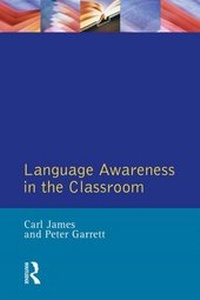
Language Awareness in the Classroom
1st Edition
Published on 6. June 2014
358 pages
978-1-317-89813-9 (ISBN)
Description

Language Awareness in the Classroom addresses the central educational question of the impact that explicit language knowledge has on learning and language learning.
A substantial Introduction defines the issues and key concepts and relates them to contemporary educational policy and practice in Europe and internationally. The papers are organised into four thematic sections: the extent and nature of language awareness in teacher education; school-based language awareness programmes; tertiary education initiatives and modes of evaluation of language awareness programmes.
A substantial Introduction defines the issues and key concepts and relates them to contemporary educational policy and practice in Europe and internationally. The papers are organised into four thematic sections: the extent and nature of language awareness in teacher education; school-based language awareness programmes; tertiary education initiatives and modes of evaluation of language awareness programmes.
More details
Series
Language
English
Place of publication
London
United Kingdom
Publishing group
Taylor & Francis Ltd
Target group
College/higher education
File size
14,52 MB
ISBN-13
978-1-317-89813-9 (9781317898139)
Copyright in bibliographic data and cover images is held by Nielsen Book Services Limited or by the publishers or by their respective licensors: all rights reserved.
Schweitzer Classification
Other editions
Additional editions
Carl James | Peter Garrett | Peter (Lecturer In Linguistics, University Of Wales, Bangor) Garett
Language Awareness in the Classroom
Book
12/2016
1st Edition
Routledge
€206.70
Shipment within 10-20 days
Carl James | Peter Garrett
Language Awareness in the Classroom
Book
12/1991
1st Edition
Routledge
€79.70
Shipment within 10-20 days
Persons
Carl James, Peter Garrett, Peter Garett (Lecturer In Linguistics University Of Wales, Bangor), Christopher N. Candlin
Content
The Contributors
Preface
Acknowledgements
Section I: Introduction
1. The scope of Language Awarness, Carl James and Peter Garrett
Section II: Language Awareness in teacher training and education
2. Language Awareness in teacher education, Christopher Brumfit
3. Teacher's views of language knowledge, Rosamond Mitchell
4. Linguistic diversity and Language Awareness: the views of primary school teachers, Guy Merchant
5. Language Awareness in teacher education programmes for non-native speakers, Tony Wright
6. Language Awareness and second language development, Howard Nicholas
Section III: Language Awareness in schools
7. Language Awareness and the teaching of English language in the upper secondary school, Tony Tinkel
8. Old problems and new solutions: LA work in GCSE foreign language classrooms, Gillian Donmall
9. Authentic texts, pedagogical grammar and Language Awareness in foreign language learning, David Little and David Singleton
10. The potential of Language Awareness as a focus for cross-curricular work in the secondary school, Jim Anderson
11. Switching off: learners' perception of the appropriacy of input, Elizabeth Toncheva
12. Learners' awareness of their learning, Nicholas Chryshochoos
Section IV: Language Awareness at tertiary level
13. Consciousness-raising about the writing process, Romy Clark and Roz Ivanic
14. Language Awareness and EAP courses, Nicki Hedge and Hugh Gosden
15. Talking about learning: establishing a framework for discussing and changing learning processes, John Holmes and Rosinda Ramos
16. Language Awareness on area studies degrees, Lindsay Silvester
17. Language Awareness and the computer, Phil Scholfield
Section V: Evaluation of Language Awareness
18. Evaluating the effectiveness of an LA course, Brian Heap
19. The effect of explicit instruction on the acquisiton of English grammatical structures by Chinese learners, Zhou Yan-Ping
20. A Brazilian view of LA, Mike Scott
21. Language learning and Linguistic Awareness: the relationship between proficiency and acceptability judgements in L2, Diana Masny
Section VI: Conclusion
22. Language Awareness: a way ahead, Peter Garrett and Carl James
Composite bibliography
Index
Preface
Acknowledgements
Section I: Introduction
1. The scope of Language Awarness, Carl James and Peter Garrett
Section II: Language Awareness in teacher training and education
2. Language Awareness in teacher education, Christopher Brumfit
3. Teacher's views of language knowledge, Rosamond Mitchell
4. Linguistic diversity and Language Awareness: the views of primary school teachers, Guy Merchant
5. Language Awareness in teacher education programmes for non-native speakers, Tony Wright
6. Language Awareness and second language development, Howard Nicholas
Section III: Language Awareness in schools
7. Language Awareness and the teaching of English language in the upper secondary school, Tony Tinkel
8. Old problems and new solutions: LA work in GCSE foreign language classrooms, Gillian Donmall
9. Authentic texts, pedagogical grammar and Language Awareness in foreign language learning, David Little and David Singleton
10. The potential of Language Awareness as a focus for cross-curricular work in the secondary school, Jim Anderson
11. Switching off: learners' perception of the appropriacy of input, Elizabeth Toncheva
12. Learners' awareness of their learning, Nicholas Chryshochoos
Section IV: Language Awareness at tertiary level
13. Consciousness-raising about the writing process, Romy Clark and Roz Ivanic
14. Language Awareness and EAP courses, Nicki Hedge and Hugh Gosden
15. Talking about learning: establishing a framework for discussing and changing learning processes, John Holmes and Rosinda Ramos
16. Language Awareness on area studies degrees, Lindsay Silvester
17. Language Awareness and the computer, Phil Scholfield
Section V: Evaluation of Language Awareness
18. Evaluating the effectiveness of an LA course, Brian Heap
19. The effect of explicit instruction on the acquisiton of English grammatical structures by Chinese learners, Zhou Yan-Ping
20. A Brazilian view of LA, Mike Scott
21. Language learning and Linguistic Awareness: the relationship between proficiency and acceptability judgements in L2, Diana Masny
Section VI: Conclusion
22. Language Awareness: a way ahead, Peter Garrett and Carl James
Composite bibliography
Index
