

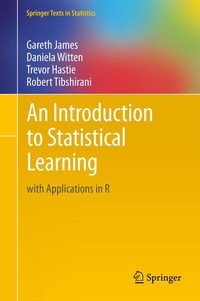
An Introduction to Statistical Learning
Description

An Introduction to Statistical Learning provides an accessible overview of the field of statistical learning, an essential toolset for making sense of the vast and complex data sets that have emerged in fields ranging from biology to finance to marketing to astrophysics in the past twenty years. This book presents some of the most important modeling and prediction techniques, along with relevant applications. Topics include linear regression, classification, resampling methods, shrinkage approaches, tree-based methods, support vector machines, clustering, and more. Color graphics and real-world examples are used to illustrate the methods presented. Since the goal of this textbook is to facilitate the use of these statistical learning techniques by practitioners in science, industry, and other fields, each chapter contains a tutorial on implementing the analyses and methods presented in R, an extremely popular open source statistical software platform.
Two of the authorsco-wrote The Elements of Statistical Learning (Hastie, Tibshirani and Friedman, 2nd edition 2009), a popular reference book for statistics and machine learning researchers. An Introduction to Statistical Learning covers many of the same topics, but at a level accessible to a much broader audience. This book is targeted at statisticians and non-statisticians alike who wish to use cutting-edge statistical learning techniques to analyze their data. The text assumes only a previous course in linear regression and no knowledge of matrix algebra.
Reviews / Votes
"Data and statistics are an increasingly important part of modern life, and nearly everyone would be better off with a deeper understanding of the tools that help explain our world. Even if you don't want to become a data analyst-which happens to be one of the fastest-growing jobs out there, just so you know-these books are invaluable guides to help explain what's going on." (Pocket, February 23, 2018)More details
Other editions
Additional editions
Persons
Gareth James is a professor of data sciences and operations at the University of Southern California. He has published an extensive body of methodological work in the domain of statistical learning with particular emphasis on high-dimensional and functional data. The conceptual framework for this book grew out of his MBA elective courses in this area.
Daniela Witten is an associate professor of statistics and biostatistics at the University of Washington. Her research focuses largely on statistical machine learning in the high-dimensional setting, with an emphasis on unsupervised learning.
Trevor Hastie
and
Robert Tibshirani
are professors of statistics at Stanford University, and are co-authors of the successful textbook Elements of Statistical Learning. Hastie and Tibshirani developed generalized additive models and wrote a popular book of that title. Hastie co-developed much of the statistical modeling software and environmentin R/S-PLUS and invented principal curves and surfaces. Tibshirani proposed the lasso and is co-author of the very successful An Introduction to the Bootstrap.
