

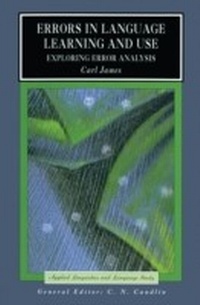
Errors in Language Learning and Use
Exploring Error Analysis
1st Edition
Published on 2. December 2013
320 pages
978-1-317-89030-0 (ISBN)
Description

Errors in Language Learning and Use is an up-to-date introduction and guide to the study of errors in language, and is also a critical survey of previous work. Error Analysis occupies a central position within Applied Linguistics, and seeks to clarify questions such as `Does correctness matter?', `Is it more important to speak fluently and write imaginatively or to communicate one's message?'
Carl James provides a scholarly and well-illustrated theoretical and historical background to the field of Error Analysis. The reader is led from definitions of error and related concepts, to categorization of types of linguistic deviance, discussion of error gravities, the utility of teacher correction and towards writing learner profiles. Throughout, the text is guided by considerable practical experience in language education in a range of classroom contexts worldwide.
Carl James provides a scholarly and well-illustrated theoretical and historical background to the field of Error Analysis. The reader is led from definitions of error and related concepts, to categorization of types of linguistic deviance, discussion of error gravities, the utility of teacher correction and towards writing learner profiles. Throughout, the text is guided by considerable practical experience in language education in a range of classroom contexts worldwide.
More details
Series
Language
English
Place of publication
London
United Kingdom
Publishing group
Taylor & Francis Ltd
Target group
Professional and scholarly
File size
16,14 MB
ISBN-13
978-1-317-89030-0 (9781317890300)
Copyright in bibliographic data and cover images is held by Nielsen Book Services Limited or by the publishers or by their respective licensors: all rights reserved.
Schweitzer Classification
Other editions
Additional editions
Book
02/2015
1st Edition
Routledge
€231.80
Shipment within 10-20 days
Book
01/1998
1st Edition
Longman
€111.90
Shipment within 10-20 days
Person
The book is written by Carl James, Senior Lecturer in the Linguistics Department at the University of Wales, Bangor, who is author of Contrastive Analysis and co-editor of Language Awareness in the Classroom, also published in this series. The book is suitable for students of Applied Linguistics, Educational Linguistics, teachers of English as a Foreign Language and teachers of Modern Languages.
Content
General editor's preface
Author's preface
Abbreviations
1. Definition and Delimitation
Human error
Successive paradigms
Interlanguage and the veto on comparison
Learners and native speakers
The heyday of Error Analysis
Mounting criticism of Error Analysis
Data collection for Error Analysis
2. The Scope of Error Analysis
Good English for the English
Good English for the L2 learner
The native speaker and the power dimension
The Incompleteness hypothesis
3. Defining 'Error'
Ignorance
Measures of deviance
Other Dimensions of Error: Error and Mistake
Error: Mistake and Acquisition: Learning - An Equation?
Lapsology
4. The Description of Errors
Error detection
Describing errors
Error Classification
Error Taxonomies
Counting errors
Profiling and Error Analysis
Computerized Corpora of Errors: ICLE - COALA
5. Levels of Error
Medium errors
Text errors
Lexical errors
Classifying Lexical errors
Grammar errors
Discourse errors
6. Diagnosong Error
Description and diagnosis
Ignorance and avoidance
Mother tongue influence: Interlingual errors
Target language causes: Intralingual errors
Learning-strategy based errors
Communication strategy based errors
Induced errors
Compound and ambiguous errors
7. Error Gravity and Error Evaluation
Evaluation
Criteria for error gravity
8. Error Correction
What is correction?
Whether to correct: pros and cons
How to do error correction: some options and principles
Noticing error
9. A Case Study
Elicitation and registration
Error identification
Categorizing the errors
Status: error or mistake?
Diagnosis
Bibliography
Index
Author's preface
Abbreviations
1. Definition and Delimitation
Human error
Successive paradigms
Interlanguage and the veto on comparison
Learners and native speakers
The heyday of Error Analysis
Mounting criticism of Error Analysis
Data collection for Error Analysis
2. The Scope of Error Analysis
Good English for the English
Good English for the L2 learner
The native speaker and the power dimension
The Incompleteness hypothesis
3. Defining 'Error'
Ignorance
Measures of deviance
Other Dimensions of Error: Error and Mistake
Error: Mistake and Acquisition: Learning - An Equation?
Lapsology
4. The Description of Errors
Error detection
Describing errors
Error Classification
Error Taxonomies
Counting errors
Profiling and Error Analysis
Computerized Corpora of Errors: ICLE - COALA
5. Levels of Error
Medium errors
Text errors
Lexical errors
Classifying Lexical errors
Grammar errors
Discourse errors
6. Diagnosong Error
Description and diagnosis
Ignorance and avoidance
Mother tongue influence: Interlingual errors
Target language causes: Intralingual errors
Learning-strategy based errors
Communication strategy based errors
Induced errors
Compound and ambiguous errors
7. Error Gravity and Error Evaluation
Evaluation
Criteria for error gravity
8. Error Correction
What is correction?
Whether to correct: pros and cons
How to do error correction: some options and principles
Noticing error
9. A Case Study
Elicitation and registration
Error identification
Categorizing the errors
Status: error or mistake?
Diagnosis
Bibliography
Index
