

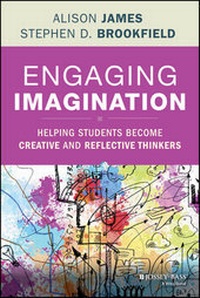
Engaging Imagination
Description

More details
Other editions
Additional editions
Persons
Content
Preface
This book is a tale of two coffees. It had its origins in a London café in summer 2011, when we met for the first time to share mutual interests in student reflection. Alison had contacted Stephen by e-mail to let him know she had been using his Critical Incident Questionnaire (Brookfield, 2006) in her teaching at the London College of Fashion. Because Stephen would be visiting London a few months later, we decided to get together and chat about the different ways we each worked with students to develop reflective and critical thinking. Although Stephen had done some workshops at the Fashion Institute of Technology in New York, the world of creative arts education was unfamiliar to him. But he was intrigued to find out more about how Alison worked within that setting.
As we talked, we both agreed that visual and kinesthetic approaches to teaching reflective thought and practice, although central to certain creative arts disciplines, are largely unknown to teachers in other areas. We agreed that these kinds of approaches hold the possibility of migrating effectively from creative arts teaching to multiple settings. We wondered about drawing together our different experiences of teaching reflection under the umbrella of engaging imagination. We both want our classrooms to be ones in which students are engaged as learners, and we talked about the link between the use of imaginative activities and the creation of enlivening and engaging classrooms.
Eventually our conversation morphed into a book proposal and then into the book you now have in your hands (or on your screen). We decided to collaborate partly because this would open us up to each other's different worldviews and practices. Our assumption is that a strong part of becoming a better teacher is committing to learning new ways of thinking about, and doing, our pedagogic work. Our collaboration across a physical ocean and two continents, and across different intellectual paradigms, has been mutually engaging, and we hope this spirit of playful creativity comes through in our writing. An English College of Fashion and an American Catholic university are certainly very different environments. Yet we believe that colleagues in both institutions are equally interested in helping students become critically reflective and in creating lively classrooms that engage students.
In Engaging Imagination our purpose is to show how students develop and sharpen their personal, professional, and political understandings through an engagement in multiple classroom activities. We draw on multisensory approaches to learning—visual and verbal, kinesthetic and cognitive, online and off-line, solo study and group work, large and small numbers of students—and travel across domains of time and space. Our focus, as befits our different backgrounds, is interdisciplinary, but what unites us is the focus on using creativity, imagination, and play to help students learn how to be critically reflective. We recognize that our approaches are not for every unit of study or every classroom; learners, teachers, outcomes, contexts, purposes, and subjects are all deciding factors in selecting what techniques to use and determining what will work. Some of you may have come across some of the activities described in this book in some guise already. What you decide to use, as with any teaching ideas, materials, or theories, will be a matter of personal preference, teaching style, and selection according to curricular purpose.
This is a book about practice, yet we would classify it not so much as a “how to,” but as more of a “what if?” book. What if we take more imaginative approaches and integrate them into what we do already, in whatever form that exists? What if we change the reflective questions, prompts, and structures that we, and our students, are used to using? What if we, and our students, step outside our comfort zone and do something differently? What if we are playful in our approaches to learning? What do we risk, lose, or gain?
Risk and uncertainty are things that we try to prepare our students to deal with in our volatile and unpredictable social, professional, financial, political, and educational climates. Trying new things in our teaching can be exhilarating but also risky; what if my students don't like new approaches and disengage from learning? Is the devil I know better than the one that's untested? Will playfulness be seen as anti-academic, as somehow not properly intellectual? The idea of playfulness is sometimes hard to fit with the kind of serious, high-minded endeavors that we expect of college and university students. Is this going to be a book about being silly?
Well, no, it is not about being silly. In fact, the ethic of play is a serious matter. When we use activities and approaches that seem like an entertaining distraction from “proper” study on the surface, we always have a deeper intent. We want to jolt ourselves, and students, out of our normal and routine ways of understanding and practicing. In this we build on Herbert Marcuse's (Reitz, 2000; Miles, 2012) argument that aesthetic experiences induce breaks and ruptures from the familiar. When students who are used to text- and teacher-dependent modes of learning switch into a playful mode, they are learning very differently. They are temporarily estranged from the typical experience of listening to a lecture, adding notes to PowerPoints projected during that lecture, and then being split into small-group discussions. Marcuse would argue that they are lifted into a different way of being.
Stephen once heard English philosopher Marghanita Laski on the BBC radio show Start the Week speaking about the notion of everyday ecstasy—the way listening to music for a few minutes, smelling or tasting a new food, or letting your eyes linger on something you thought to be beautiful took you into a different and heightened sensuous way of being for a brief time each day (Laski, 1980). We think what Laski was talking about was essentially the same as Marcuse's: the idea that an aesthetic experience challenges the normal ways of thinking and feeling in everyday life. By extension, we believe that creativity, imagination, and play also accomplish this rupture with ordinary experience, and that students remember imaginative classroom moments as some of the most powerful events in their learning trajectories.
Engaging Imagination offers a mixture of things: exercises, activities, theories, positions, approaches, and people. It is a text of different voices: stories, case studies, anecdotes, and project descriptions. It is a book about questions and assumptions, about dialogue and spaces. We seek to add to the library of resources on alternative modes of learning and assessment and to link the literature of creativity, imagination, and play explicitly to reflective practice. We are not about shutting out traditional approaches to reflection but about extending and adding to them. As we know already, and as you will see further illustrated, writing, the most dominant of these approaches, can be creative, imaginative, and playful as well.
How Should You Use This Book?
The shortest answer to this question is “In any way you like!” Although we have tried to group our chapters into themes, there are recurrent issues, approaches, and theories, such as identity and metaphor, that permeate them all. As befits a text on creativity, imagination, and play, we are fine with a serendipitous skimming, dipping in and out of chapters as particular paragraphs engage you. We also urge you to read the book in conjunction with the Web presence we have created to accompany the text. At http://www.engagingimagination.com you can watch demonstrations of many of the activities we describe in the following pages and also hear from their originators or enactors.
In terms of how the contents can be used in teaching, we have sought to provide all sorts of ideas and activities for encouraging reflective learning that can easily be integrated into a range of settings, whether for five minutes, two hours, or much longer. They can be used at student orientations, to support career progression, to enable someone to write a dissertation, to help with essays, to enhance classroom learning, to complete projects, to assist in formulating design ideas, to prepare for tutorials, to aid private introspection or decision making, to weigh choices, to work out whether a proposal is valid or has originality, or for any other tasks for which the teacher deems them relevant.
Although the theories and models adopted originate in a wide variety of disciplines, several of the case studies are taken from creative arts contexts. If you are an educator working outside these creative fields, do not let this put you off—or not at least until you have read the book and know what you are discarding. After all, one of us—Stephen—teaches in a typically text-dependent, content-heavy discipline. The field of the creative arts is huge and multifaceted. A small part of it might be about designing clothes or artifacts, but its other spheres of activity include creative and visual conception, commercial practice, business and management strategy, local and industrial-scale production systems, and community mobilization. To give just one example, the various encampments of the Occupy Wall Street movement involve cartoons, collage, free-form drawing, found poetry, music and drama, as well as more traditional modes of political education. So we see the possibility of adapting imaginative approaches that have their genesis in the creative arts to...
