

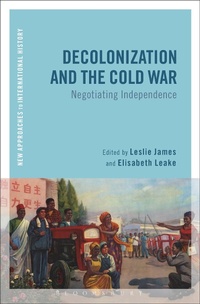
Decolonization and the Cold War
Negotiating Independence
1st Edition
Published on 26. February 2015
336 pages
978-1-4725-7121-2 (ISBN)
Description

The Cold War and decolonization transformed the twentieth century world. This volume brings together an international line-up of experts to explore how these transformations took place and expand on some of the latest threads of analysis to help inform our understanding of the links between the two phenomena.
The book begins by exploring ideas of modernity, development, and economics as Cold War and postcolonial projects and goes on to look at the era's intellectual history and investigate how emerging forms of identity fought for supremacy. Finally, the contributors question ideas of sovereignty and state control that move beyond traditional Cold War narratives.
Decolonization and the Cold War emphasizes new approaches by drawing on various methodologies, regions, themes, and interdisciplinary work, to shed new light on two topics that are increasingly important to historians of the twentieth century.
The book begins by exploring ideas of modernity, development, and economics as Cold War and postcolonial projects and goes on to look at the era's intellectual history and investigate how emerging forms of identity fought for supremacy. Finally, the contributors question ideas of sovereignty and state control that move beyond traditional Cold War narratives.
Decolonization and the Cold War emphasizes new approaches by drawing on various methodologies, regions, themes, and interdisciplinary work, to shed new light on two topics that are increasingly important to historians of the twentieth century.
More details
Series
Edition
1. Auflage
Language
English
Place of publication
London
United Kingdom
Publishing group
Bloomsbury Publishing PLC
Target group
Professional and scholarly
College/higher education
ISBN-13
978-1-4725-7121-2 (9781472571212)
Copyright in bibliographic data and cover images is held by Nielsen Book Services Limited or by the publishers or by their respective licensors: all rights reserved.
Schweitzer Classification
Other editions
Additional editions
Book
02/2015
Bloomsbury Academic
€40.60
Shipment within 15-20 days
Persons
Leslie James is Lecturer in World History at the University of Cambridge, UK.
Elisabeth Leake is a Leverhulme Early Career Fellow at Royal Holloway, University of London, UK.
Elisabeth Leake is a Leverhulme Early Career Fellow at Royal Holloway, University of London, UK.
Content
Preface Odd Arne Westad (LSE, UK)
Introduction Leslie James (University of Cambridge, UK) & Elisabeth Leake (Royal Holloway, University of London, UK)
Part 1: Developing the Nation: Economics, Modernity, and the 'State-project'
1. 'Fantastic Quantities of Food Grains': Cold War Visions and Agrarian Fantasies in Independent India Benjamin Siegel (Harvard University, USA)
2. 'The Life and Death of Our Republic': Modernization, Agricultural Development and the Peasantry in the Mekong Delta in the Long 1970s Simon Toner (LSE, UK)
3. Export Processing Zones, Special Economic Zones and the Long March of Capitalist Development Policies during the Cold War Patrick Neveling (Historical Institute, Berne, Germany)
Part 2: Intellectual Assertions in the Anti-Colonial Era
4. Class Struggle and Self-Determination at Political Affairs: An Intellectual History of Communist Anti-colonialism in the United States, 1945-1960 John Munro (Saint Mary's University, Canada)
5. 'A Unique Little Country': Lebanese Exceptionalism, Pro-Americanism and the Meanings of Independence in the Writings of Charles Malik, c. 1946-1962 Andrew Arsan (University of Cambridge, UK)
Part 3: Contesting Heritage and Identification
6. The Malayan Communist Party and the Malayan Chinese Association: Internationalism and Nationalism in Chinese Overseas Political Participation, c. 1920-1960 Anna Belogurova (Nanyang Technological University, Singapore)
7. Negotiating Russian Imperial Aryanism: Soviet Oriental Studies in the Cold War Hanna Jansen (University of Amsterdam, The Netherlands)
8. Grounding Ideologies: Archaeology, Decolonization and the Cold War in Egypt William Carruthers (University of Cambridge, UK)
Part 4: (Re)conceiving Sovereignty and Statehood
9. A 'Commonwealth Moment' in South Asian Decolonization Daniel Haines (Royal Holloway, University of London, UK)
10. Sovereignty in the Congo Crisis Ryan M. Irwin (University of Albany-SUNY, USA)
11. Malcolm X in France, 1964-1965: Anti-Imperialism and the Politics of Travel Control in the Cold War Era Moshik Temkin (Harvard University, USA)
12. From Foreign Concessions to Special Economic Zones: Decolonization and Foreign Investment in Twentieth-Century Asia Christopher Miller (Yale University, USA)
Part 5: Defending the State: Intelligence and Violence
13. Tinker, Tailor, Soldier, Subversive: India, Pakistan and the Politics of Cold War Intelligence Paul M. McGarr (University of Nottingham, UK)
14. British Colonial Violence in the Era of the Cold War Caroline Elkins (Harvard University, USA)
Index
Introduction Leslie James (University of Cambridge, UK) & Elisabeth Leake (Royal Holloway, University of London, UK)
Part 1: Developing the Nation: Economics, Modernity, and the 'State-project'
1. 'Fantastic Quantities of Food Grains': Cold War Visions and Agrarian Fantasies in Independent India Benjamin Siegel (Harvard University, USA)
2. 'The Life and Death of Our Republic': Modernization, Agricultural Development and the Peasantry in the Mekong Delta in the Long 1970s Simon Toner (LSE, UK)
3. Export Processing Zones, Special Economic Zones and the Long March of Capitalist Development Policies during the Cold War Patrick Neveling (Historical Institute, Berne, Germany)
Part 2: Intellectual Assertions in the Anti-Colonial Era
4. Class Struggle and Self-Determination at Political Affairs: An Intellectual History of Communist Anti-colonialism in the United States, 1945-1960 John Munro (Saint Mary's University, Canada)
5. 'A Unique Little Country': Lebanese Exceptionalism, Pro-Americanism and the Meanings of Independence in the Writings of Charles Malik, c. 1946-1962 Andrew Arsan (University of Cambridge, UK)
Part 3: Contesting Heritage and Identification
6. The Malayan Communist Party and the Malayan Chinese Association: Internationalism and Nationalism in Chinese Overseas Political Participation, c. 1920-1960 Anna Belogurova (Nanyang Technological University, Singapore)
7. Negotiating Russian Imperial Aryanism: Soviet Oriental Studies in the Cold War Hanna Jansen (University of Amsterdam, The Netherlands)
8. Grounding Ideologies: Archaeology, Decolonization and the Cold War in Egypt William Carruthers (University of Cambridge, UK)
Part 4: (Re)conceiving Sovereignty and Statehood
9. A 'Commonwealth Moment' in South Asian Decolonization Daniel Haines (Royal Holloway, University of London, UK)
10. Sovereignty in the Congo Crisis Ryan M. Irwin (University of Albany-SUNY, USA)
11. Malcolm X in France, 1964-1965: Anti-Imperialism and the Politics of Travel Control in the Cold War Era Moshik Temkin (Harvard University, USA)
12. From Foreign Concessions to Special Economic Zones: Decolonization and Foreign Investment in Twentieth-Century Asia Christopher Miller (Yale University, USA)
Part 5: Defending the State: Intelligence and Violence
13. Tinker, Tailor, Soldier, Subversive: India, Pakistan and the Politics of Cold War Intelligence Paul M. McGarr (University of Nottingham, UK)
14. British Colonial Violence in the Era of the Cold War Caroline Elkins (Harvard University, USA)
Index
