

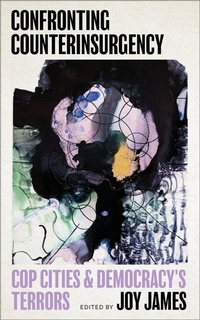
Confronting Counterinsurgency
Cop Cities and Democracy's Terrors
1st Edition
Published on 20. August 2025
978-0-7453-5155-1 (ISBN)
Description

As we step into an era of rising fascism and normalized genocide, Confronting Counterinsurgency: Cop Cities and Democracy's Terrors is an invaluable contribution to the fightback.
Joy James brings together the voices of frontline activists, artists, and organizers from movements against militarism and state violence in the USA, Puerto Rico, Colombia, Palestine, Brazil, the Democratic Republic of the Congo, and within prison walls. The book includes accessible and revealing discussions of the role of institutions, universities and nonprofit organizations in the suppression of radical movements. It introduces and analyzes contemporary militarized policing projects like Cop City, ICE, and the School of the Americas, and links them to historical and contemporary settler colonialism and slavery.
Made as an offering of revolutionary love, Confronting Counterinsurgency will be a crucial tool for deepening and radicalizing our analysis and learning from each other's movements, in order to strengthen our resistance and unite to fight for a better world.
Joy James brings together the voices of frontline activists, artists, and organizers from movements against militarism and state violence in the USA, Puerto Rico, Colombia, Palestine, Brazil, the Democratic Republic of the Congo, and within prison walls. The book includes accessible and revealing discussions of the role of institutions, universities and nonprofit organizations in the suppression of radical movements. It introduces and analyzes contemporary militarized policing projects like Cop City, ICE, and the School of the Americas, and links them to historical and contemporary settler colonialism and slavery.
Made as an offering of revolutionary love, Confronting Counterinsurgency will be a crucial tool for deepening and radicalizing our analysis and learning from each other's movements, in order to strengthen our resistance and unite to fight for a better world.
Reviews / Votes
'This is an essential and incendiary political and philosophical reflection on current global resistance movements. A collection of powerful narratives rooted in the liberation strategies of those who struggle against corporate and state conquest, brutality and death and who continue to resist' -- Ken Fero, radical filmmaker and convenor of The People's Tribunal on Police Killings 'Makes plain the relations between the U.S. as a militarized carceral police state, the imprisonment of our resistance, and the genocidal wars our technocracy imparts to the world in Gaza and beyond. This is a work of radical care and love, a study guide for the urgency of the moment where we must fight, to live, and to struggle' -- Dian Million, author of <i>Therapeutic Nations, Healing in an Age of Indigenous Human Rights</i> 'True to its title, this eye-opening book holds its readers steady while guiding us through a perturbing confrontation with counterinsurgency in empire's proxy wars, colonies, prisons and schools. Cop cities emerge as domestic forts to contain an unlikely enemy - us. But we're neither helpless, nor alone' -- Frances Madeson, writer, author of <i>Cooperative Village</i> 'A powerful collection that reminds us that the progress we build toward liberation must be constantly defended. Rooted in a radical sense of love, care, and self critique, this collection brings together necessary conversations and analyses surrounding our movements' -- Momodou Taal, <i>The Malcolm Effect Podcast</i> 'Woven to form a radical tapestry that leads the reader into and through vibrant sites of insurgency, life-making, and struggle against the crushing force of fascism, imperial rot, and racial capitalism' -- Lara Sheehi, author of <i>From the Clinic to the Streets: Psychoanalysis for Revolutionary Futures</i> 'Spanning geographies and different approaches to organizing, these essays consistently demonstrate that the struggle for abolition is a global Black struggle. Abolition breaches the gates of reformist logics of all sorts to articulate a radical account of community-making and to offer us a different account of what living better collectively together can be' -- Rinaldo Walcott, author of <i>On Property: Policing, Prisons and the Call for Abolition</i>More details
Edition
1. Auflage
Language
English
Place of publication
London
United Kingdom
Illustrations
12 Illustrations, black and white
File size
3,32 MB
ISBN-13
978-0-7453-5155-1 (9780745351551)
Copyright in bibliographic data and cover images is held by Nielsen Book Services Limited or by the publishers or by their respective licensors: all rights reserved.
Schweitzer Classification
Other editions
Additional editions
Book
08/2025
Pluto Press
€19.00
Available immediately
Person
Joy James is a political philosopher who works with organizers. Her books include In Pursuit of Revolutionary Love; New Bones Abolition: Captive Maternal Agency and the (After)Life of Erica Garner; and Contextualizing Angela Davis: The Agency and Identity of an Icon. Her edited volumes with Pluto include Beyond Cop Cities: Dismantling State and Corporate-Funded Armies and Prisons and ENGAGE: Indigenous, Black, Afro-Indigenous Futures.
Content
Preface
Introduction (Joy James)
PART I. Carceral Cities and Civil/Human Rights
1. Atlanta's Black Community Says "Stop Cop Cities!" (Rev. Keyanna Jones Moore, interview by Margaret Kimberley, Black Agenda Report)
2. Resisting [Global] Cop Cities and the Militarization of Policing (Liliana, Joy James, Kalonji Jama Changa, interview by Chris Browne)
3. 1492: Indigenous Sovereignty, Black Self-Determination amid Repression (Mohamed Abdou, Ashanti Alston, interview by Kalonji Changa, Joy James)
PART II. Battling Colonialism
4. UN Special Committee on Decolonization: Puerto Rico (Benjamin Ramos Rosado)
5. Oxford Union Address on Genocide, Israel, Palestine (susan albuhawa)
6. Fighting for the Congo (Maurice Carney, Claude Gatebuke, Dr. Ikema Ojore, Brother Passy, Kwame Wilburg, interview by Kalonji Changa and Rev. Keyanna Jones Moore)
PART III. Counter Moves
7. Prisoner Human Rights Movement [PHRM]: 2025 Nobel Letter and the Agency of PHRM (Joy James with Silicon Valley De-Bug Organization)
8. The Abolition of Carceral Schooling (rosalind hampton)
9. Black (Brazilian) Futurity (Andreia Beatriz dos Santos, Hamilton Borges dos Santos, interview by joao costa vargas)
10. When Opportunity Knocks... by Galley of the Streets (kai barrow, Jazz Franklin, Kara Lynch)
Conclusion: Democracy's Terrors and our Endless Resistance (Joy James)
Contributors
Introduction (Joy James)
PART I. Carceral Cities and Civil/Human Rights
1. Atlanta's Black Community Says "Stop Cop Cities!" (Rev. Keyanna Jones Moore, interview by Margaret Kimberley, Black Agenda Report)
2. Resisting [Global] Cop Cities and the Militarization of Policing (Liliana, Joy James, Kalonji Jama Changa, interview by Chris Browne)
3. 1492: Indigenous Sovereignty, Black Self-Determination amid Repression (Mohamed Abdou, Ashanti Alston, interview by Kalonji Changa, Joy James)
PART II. Battling Colonialism
4. UN Special Committee on Decolonization: Puerto Rico (Benjamin Ramos Rosado)
5. Oxford Union Address on Genocide, Israel, Palestine (susan albuhawa)
6. Fighting for the Congo (Maurice Carney, Claude Gatebuke, Dr. Ikema Ojore, Brother Passy, Kwame Wilburg, interview by Kalonji Changa and Rev. Keyanna Jones Moore)
PART III. Counter Moves
7. Prisoner Human Rights Movement [PHRM]: 2025 Nobel Letter and the Agency of PHRM (Joy James with Silicon Valley De-Bug Organization)
8. The Abolition of Carceral Schooling (rosalind hampton)
9. Black (Brazilian) Futurity (Andreia Beatriz dos Santos, Hamilton Borges dos Santos, interview by joao costa vargas)
10. When Opportunity Knocks... by Galley of the Streets (kai barrow, Jazz Franklin, Kara Lynch)
Conclusion: Democracy's Terrors and our Endless Resistance (Joy James)
Contributors
