

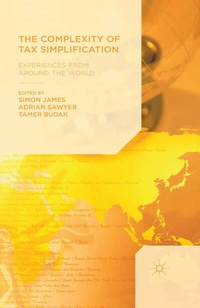
The Complexity of Tax Simplification
Experiences From Around the World
Published on 29. April 2016
XIV, 273 pages
978-1-137-47869-6 (ISBN)
Description

Simplicity in taxation has considerable potential advantages. However, attempts to simplify tax systems are only likely to be successful and enduring if they take account of the reasons why taxation is complex. There are strong pressures on tax systems to accommodate a range of important factors, as well as complex and changing national and international environments within which modern tax systems have to operate.
This book explores the experiences of simplification in a range of countries and jurisdictions. The authors analyse a range of manifestations of simplification, including tax systems, tax law, taxpayer communications and tax administration. They also review the longer term or more fundamental approaches to simplification, suggesting that in order to strike the optimum balance between simplicity and the aims of a tax system in terms of efficiency and equity, a range of complex environmental factors must all be taken into account. With chapters reflecting on experiences from Australia, China, Canada, Malaysia, New Zealand, Russia, South Africa, Thailand, Turkey, the UK and the US, the authors illustrate differences between jurisdictions and the changing environment in which they operate.
This book addresses the crucial balance between simplicity and the other objectives of tax design and reform, and suggests that reformers of the tax system should include simplicity as one of the key evaluators of any design or reform proposal.
More details
Other editions
Additional editions
Simon James | Adrian Sawyer | Tamer Budak
The Complexity of Tax Simplification
Experiences From Around the World
Book
12/2015
Palgrave Macmillan
€139.09
Shipment within 10-20 days
Simon James | Adrian Sawyer | Tamer Budak
The Complexity of Tax Simplification
Experiences from Around the World
Book
01/2014
Palgrave Macmillan
€112.34
The article will not be published
Persons
Simon James is an Associate Professor in Economics in the Department of Organisation Studies at the University of Exeter Business School, a Fellow of the Chartered Institute of Taxation and an Honorable Member of the Society for the Advancement of Behavioral Economics. He has also held visiting positions at six universities overseas including the Australian National University and recently a Visiting Erskine Fellowship at the University of Canterbury, New Zealand. He has published 66 research papers and his 18 books include The Economics of Taxation: Principles, Policy and Practice (with Chris Nobes) 14th edition, Fiscal Publications, 2014 and A Dictionary of Taxation, 2nd edition, Edward Elgar, 2012. He was also Editor of Taxation, Critical Perspectives on the World Economy, four volumes, Routledge, 2002.
Tamer Budak is an Associate Professor in Department of Fiscal Law at the Inonu University Law Faculty in Turkey. He has taught Turkish tax law and international tax law at different universities. He has also held visiting positions at two universities overseas including the University of Florida, Levin College of Law in 2012 and University of Exeter in 2013-2014. His research areas include Turkish tax law, public finance, and international taxation. He has published book chapters and articles in peer reviewed journals.
Adrian Sawyer is Professor of Taxation and Research Director for the School of Business and Economics at the University of Canterbury. Adrian holds an SJD from the University of Virginia, and MCom(Hons), BCom and LLB degrees from the University of Canterbury. He is a Chartered Accountant (NZICA), member of CPA Australia, and Barrister and Solicitor of the High Court of New Zealand. He has an extensive publication record, with articles appearing in scholarly and professional journals and chapters in books published in Asia, Australasia, Europe and North America. He is on numerous editorial boards and is Chair of the Editors of the New Zealand Journal of Taxation Law and Policy. His research interests include tax administration and compliance, international taxation (including international organisations), e-commerce taxation, environmental taxation, and goods and services tax (GST). Adrian was an Atax and Abe Greenbaum Fellow in 2009, recipient of the inaugural Cedric Sandford Medal in 2004 and recipient of the Hill ATTA Medal in 2015.
Tamer Budak is an Associate Professor in Department of Fiscal Law at the Inonu University Law Faculty in Turkey. He has taught Turkish tax law and international tax law at different universities. He has also held visiting positions at two universities overseas including the University of Florida, Levin College of Law in 2012 and University of Exeter in 2013-2014. His research areas include Turkish tax law, public finance, and international taxation. He has published book chapters and articles in peer reviewed journals.
Adrian Sawyer is Professor of Taxation and Research Director for the School of Business and Economics at the University of Canterbury. Adrian holds an SJD from the University of Virginia, and MCom(Hons), BCom and LLB degrees from the University of Canterbury. He is a Chartered Accountant (NZICA), member of CPA Australia, and Barrister and Solicitor of the High Court of New Zealand. He has an extensive publication record, with articles appearing in scholarly and professional journals and chapters in books published in Asia, Australasia, Europe and North America. He is on numerous editorial boards and is Chair of the Editors of the New Zealand Journal of Taxation Law and Policy. His research interests include tax administration and compliance, international taxation (including international organisations), e-commerce taxation, environmental taxation, and goods and services tax (GST). Adrian was an Atax and Abe Greenbaum Fellow in 2009, recipient of the inaugural Cedric Sandford Medal in 2004 and recipient of the Hill ATTA Medal in 2015.
Content
Preface
Notes On The Contributors
1. The Complexity Of Tax Simplification: Experiences From Around The World: Tamer Budak, Simon James And Adrian Sawyer
2. Tax Reform And Simplification: Conceptual And Measurement Issues And Australian Experiences: Bin Tran-Nam
3. Simplicity In The Chinese Context: The Categories Of Differential Income Tax Treatment And Their Complications: Nolan Cormac Sharkey
4. Tax Simplification In Canada - A Journey Not Yet Mapped: François Vaillancourt And Richard Bird
5. Tax Simplification: The Case Of Malaysia: Veerinderjeet Singh
6. Complexity Of Tax Simplification: A New Zealand Perspective: Adrian Sawyer
7. The Complexity Of Tax Simplification: Russia: Alexander I. Pogorletskiy, Elena V. Kilinkarova And Nadezhda N. Bashkirova
8. The Complexity Of Tax Simplification: Experiences From South Africa: Theuns Steyn And Madeleine Stiglingh
9. The Complexity Of Tax Simplification: Experiences From Thailand: Thamrongsak Svetalekth
10. The Complexity Of Tax Simplification: Turkey Perspective: Tamer Budak And Serkan Benk
11. The Complexity Of Tax Simplification: The UK Experience: Simon James
12. Complexity Of Tax Simplification: USA Perspective: Hughlene Burton And Stewart Karlinsky
Index
Notes On The Contributors
1. The Complexity Of Tax Simplification: Experiences From Around The World: Tamer Budak, Simon James And Adrian Sawyer
2. Tax Reform And Simplification: Conceptual And Measurement Issues And Australian Experiences: Bin Tran-Nam
3. Simplicity In The Chinese Context: The Categories Of Differential Income Tax Treatment And Their Complications: Nolan Cormac Sharkey
4. Tax Simplification In Canada - A Journey Not Yet Mapped: François Vaillancourt And Richard Bird
5. Tax Simplification: The Case Of Malaysia: Veerinderjeet Singh
6. Complexity Of Tax Simplification: A New Zealand Perspective: Adrian Sawyer
7. The Complexity Of Tax Simplification: Russia: Alexander I. Pogorletskiy, Elena V. Kilinkarova And Nadezhda N. Bashkirova
8. The Complexity Of Tax Simplification: Experiences From South Africa: Theuns Steyn And Madeleine Stiglingh
9. The Complexity Of Tax Simplification: Experiences From Thailand: Thamrongsak Svetalekth
10. The Complexity Of Tax Simplification: Turkey Perspective: Tamer Budak And Serkan Benk
11. The Complexity Of Tax Simplification: The UK Experience: Simon James
12. Complexity Of Tax Simplification: USA Perspective: Hughlene Burton And Stewart Karlinsky
Index
