

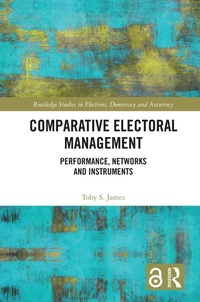
Comparative Electoral Management
Performance, Networks and Instruments
1st Edition
Published on 4. November 2019
336 pages
978-1-134-82098-6 (ISBN)
Description

This book offers the first comparative monograph on the management of elections.
The book defines electoral management as a new, inter-disciplinary area and advances a realist sociological approach to study it. A series of new, original frameworks are introduced, including the PROSeS framework, which can be used by academics and practitioners around the world to evaluate electoral management quality. A networked governance approach is also introduced to understand the full range of collaborative actors involved in delivering elections, including civil society and the international community. Finally, the book evaluates some of the policy instruments used to improve the integrity of elections, including voter registration reform, training and the funding of elections. Extensive mixed methods are used throughout including thematic analysis of interviews, (auto-)ethnography, comparative historical analysis and, cross-national and national surveys of electoral officials.
This text will be of key interest to scholars, students and practitioners interested and involved in electoral integrity and elections, and more broadly to comparative politics, public administration, international relations and democracy studies.
Chapters 1 and 4 of this book are freely available as downloadable Open Access PDFs at http://www.taylorfrancis.com under a Creative Commons Attribution-Non Commercial-No Derivatives (CC-BY-NC-ND) 4.0 license.
The book defines electoral management as a new, inter-disciplinary area and advances a realist sociological approach to study it. A series of new, original frameworks are introduced, including the PROSeS framework, which can be used by academics and practitioners around the world to evaluate electoral management quality. A networked governance approach is also introduced to understand the full range of collaborative actors involved in delivering elections, including civil society and the international community. Finally, the book evaluates some of the policy instruments used to improve the integrity of elections, including voter registration reform, training and the funding of elections. Extensive mixed methods are used throughout including thematic analysis of interviews, (auto-)ethnography, comparative historical analysis and, cross-national and national surveys of electoral officials.
This text will be of key interest to scholars, students and practitioners interested and involved in electoral integrity and elections, and more broadly to comparative politics, public administration, international relations and democracy studies.
Chapters 1 and 4 of this book are freely available as downloadable Open Access PDFs at http://www.taylorfrancis.com under a Creative Commons Attribution-Non Commercial-No Derivatives (CC-BY-NC-ND) 4.0 license.
Reviews / Votes
"Elections matter for so many reasons - not least for an orderly transfer for power and for citizens to reflect on, interact with, and directly affect their state institutions. The performance of electoral management bodies can make the difference between an election that is accepted with an orderly transition of power, or an election results that is challenged with ensuing problems of violence or societal instability. This ground-breaking study is the first to give election management the serious scholarly attention it rightly deserves. Toby James' insights on organising elections will provide valuable evidence-based advice for policy makers and election practitioners alike." - Therese Pearce Laanela, Head of Electoral Processes, International IDEA"In Comparative Electoral Management Toby James provides an in-depth comparative analysis of one of the core administrative functions of democracy. Rich in data and innovative conceptualisation, the book draws on insights from a variety of disciplines to address a topic, the urgency of which is rapidly becoming apparent to citizens the world over. The result is a highly informed and perceptive analysis of how elections are run and how they might be improved." - Sarah Birch, King's College London, UK
"Toby James demonstrates very convincingly in this major book that electoral management matters a lot for the quality of elections and for how reliable election results are as a reflection of the electorate's intentions. Comparative Electoral Management is, therefore, a book that will be of great value for at least three audiences: students of elections, electoral practitioners, and - hopefully - politicians interested in the improvement of the quality of elections and electoral administration in their country." - Jorgen Elklit, Aarhus University, Denmark
More details
Series
Edition
1. Auflage
Language
English
Place of publication
London
United Kingdom
Publishing group
Taylor & Francis Ltd
Target group
College/higher education
Product notice
Reflowable
Illustrations
36 Tables, black and white; 26 Line drawings, black and white; 26 Illustrations, black and white
ISBN-13
978-1-134-82098-6 (9781134820986)
Copyright in bibliographic data and cover images is held by Nielsen Book Services Limited or by the publishers or by their respective licensors: all rights reserved.
Schweitzer Classification
Other editions
Additional editions
Book
06/2021
1st Edition
Routledge
€66.00
Shipment within 10-20 days
Book
11/2019
1st Edition
Routledge
€207.10
Shipment within 10-20 days
Book
10/2019
Routledge
Unfortunately, price unknown
Available (delivery time upon request)
Person
Toby S. James is Professor of Politics and Public Policy at the University of East Anglia, UK.
Content
PART I
Foundations
1 Introduction
2 A realist sociological approach
PART II
Performance
3 Existing concepts and evidence
4 Evaluating electoral management performance: the PROSeS framework
PART III
Networks
5 Electoral management governance networks
6 UK electoral management governance networks
7 Comparative electoral management governance networks
8 International electoral management governance networks
PART IV
Instruments
9 Voter registration reform
10 Centralisation
11 Training and human resource practices
12 Austerity and financial investment in electoral management
PART V
Looking forward
13 Conclusions
Foundations
1 Introduction
2 A realist sociological approach
PART II
Performance
3 Existing concepts and evidence
4 Evaluating electoral management performance: the PROSeS framework
PART III
Networks
5 Electoral management governance networks
6 UK electoral management governance networks
7 Comparative electoral management governance networks
8 International electoral management governance networks
PART IV
Instruments
9 Voter registration reform
10 Centralisation
11 Training and human resource practices
12 Austerity and financial investment in electoral management
PART V
Looking forward
13 Conclusions
