

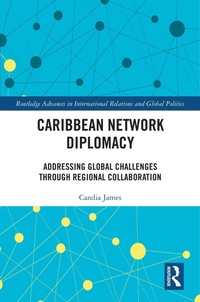
Caribbean Network Diplomacy
Addressing Global Challenges through Regional Collaboration
Will be published approx. on 8. July 2026
254 pages
978-1-040-57120-0 (ISBN)
Description

Caribbean Network Diplomacy: Addressing Global Challenges through Regional Collaboration analyses how Caribbean small states use communication networks, regional institutions, and collaborative coalitions to exercise diplomatic influence in an increasingly complex global system. This book advances a network-based understanding of diplomacy, demonstrating how strategic communication and coordination enable small states to shape outcomes beyond traditional bilateral and multilateral channels.
Drawing on original empirical research and in-depth case studies, including the Healthy Caribbean Coalition (HCC) and the Caribbean Youth Environment Network (CYEN), this book examines how networks facilitate collaboration, agenda-setting, and collective action in areas such as global health and climate governance. It also critically examines the limits of networked diplomacy, addressing challenges such as political fragmentation, uneven power relations, and resource constraints, and considers how to navigate them.
This book will appeal to scholars and postgraduate students of international relations, diplomacy, global governance, and Caribbean studies, as well as policymakers and practitioners interested in small-state diplomacy, regional cooperation, and networked approaches to global problem-solving.
Drawing on original empirical research and in-depth case studies, including the Healthy Caribbean Coalition (HCC) and the Caribbean Youth Environment Network (CYEN), this book examines how networks facilitate collaboration, agenda-setting, and collective action in areas such as global health and climate governance. It also critically examines the limits of networked diplomacy, addressing challenges such as political fragmentation, uneven power relations, and resource constraints, and considers how to navigate them.
This book will appeal to scholars and postgraduate students of international relations, diplomacy, global governance, and Caribbean studies, as well as policymakers and practitioners interested in small-state diplomacy, regional cooperation, and networked approaches to global problem-solving.
More details
Series
Language
English
Place of publication
London
United Kingdom
Publishing group
Taylor & Francis Ltd
Target group
College/higher education
Illustrations
3 Tables, black and white; 4 Line drawings, black and white; 4 Illustrations, black and white
File size
3,66 MB
ISBN-13
978-1-040-57120-0 (9781040571200)
Copyright in bibliographic data and cover images is held by Nielsen Book Services Limited or by the publishers or by their respective licensors: all rights reserved.
Schweitzer Classification
Other editions
Additional editions
Book
approx. 07/2026
1st Edition
Routledge
€192.50
Not yet published
Person
Candia James is Lecturer in International Relations and Communication and a researcher specialising in network diplomacy, global governance, and small-state
diplomacy. She is affiliated with the Institute of International Relations at the University of the West Indies and the College of Science, Technology and Applied Arts of Trinidad and Tobago (COSTAATT). Her research examines communication networks, regional cooperation, and the evolving dynamics of Caribbean diplomacy.
diplomacy. She is affiliated with the Institute of International Relations at the University of the West Indies and the College of Science, Technology and Applied Arts of Trinidad and Tobago (COSTAATT). Her research examines communication networks, regional cooperation, and the evolving dynamics of Caribbean diplomacy.
Content
Introduction: Caribbean Network Diplomacy-Addressing Global Challenges through Regional Collaboration. 1. Rethinking Diplomacy: From Traditional to Networked Approaches 2. Theoretical Foundations of Network Diplomacy in Small Island Developing States 3. From Independence to Integration-Caribbean Diplomacy in Context 4. Communicative Power and Information Politics in Network Diplomacy 5. Operationalising Network Diplomacy-The Case of the Healthy Caribbean Coalition 6. Operationalising Network Diplomacy-The Case of the Caribbean Youth Environment Network 7. Bridging Sectors, Amplifying Voices-A Comparative Analysis of HCC and CYEN 8. Towards a Caribbean Model of Coalitional Network Diplomacy 9. Tactical Influence in Caribbean Network Diplomacy: Framing, Symbolism, and Moral Authority as Strategic Tools 10. Anchoring Influence-Institutionalising Caribbean Network Diplomacy in a Global Context. Conclusion
