

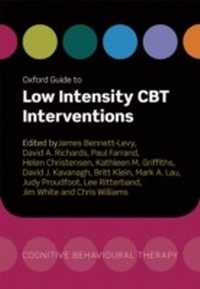
Oxford Guide to Low Intensity CBT Interventions
1st Edition
Published on 13. May 2010
629 pages
978-0-19-102935-6 (ISBN)
Description

Mental disorders such as depression and anxiety are increasingly common. Yet there are too few specialists to offer help to everyone, and negative attitudes to psychological problems and their treatment discourage people from seeking it. As a result, many people never receive help for these problems. The Oxford Guide to Low Intensity CBT Interventions marks a turning point in the delivery of psychological treatments for people with depression and anxiety. Until recently, the only form of psychological intervention available for patients with depression and anxiety was traditional one-to-one 60 minute session therapy - usually with private practitioners for those patients who could afford it. Now Low Intensity CBT Interventions are starting to revolutionize mental health care by providingcost effective psychological therapies which can reach the vast numbers of people with depression and anxiety who did not previously have access to effective psychological treatment. The Oxford Guide to Low Intensity CBT Interventions is the first book to provide a comprehensive guide to Low Intensity CBT interventions. It brings together researchers and clinicians from around the world who have led the way in developing evidence-based low intensity CBT treatments. It charts the plethora of new ways that evidence-based low intensity CBT can be delivered: for instance, guided self-help, groups, advice clinics, brief GP interventions, internet-based or book-based treatmentand prevention programs, with supported provided by phone, email, internet, sms or face-to-face. These new treatments require new forms of service delivery, new ways of communicating, new forms of training and supervision, and the development of new workforces. They involve changing systems androutine practice, and adapting interventions to particular community contexts. The Oxford Guide to Low Intensity CBT Interventions is a state-of-the-art handbook, providing low intensity practitioners, supervisors, managers commissioners of services and politicians with a practical, easy-to-read guide - indispensible reading for those who wish to understand and anticipate future directions in health service provision and to broaden access to cost-effective evidence-based psychological therapies.
More details
Other editions
Additional editions
James Bennett-Levy | David Richards | Paul Farrand
Oxford Guide to Low Intensity CBT Interventions
Book
05/2010
1st Edition
Oxford University Press
€73.50
Shipment within 15-20 days
Content
- Intro
- Contents
- Contributors
- Section 1 Low intensity CBT models and conceptual underpinnings
- 1 Low intensity CBT interventions: a revolution in mental health care
- 2 Access and organization: putting low intensity interventions to work in clinical services
- 3 The STEPS model: a high volume, multi-level, multi-purpose approach to address common mental health problems
- 4 Increasing access and effectiveness: using the internet to deliver low intensity CBT
- 5 A new language for CBT: new ways of working require new thinking, as well as new words
- Section 2 Low intensity CBT interventions: the new practices
- Section 2A Introducing and supporting guided CBT
- 6 Low intensity CBT assessment: in person or by phone
- 7 Monitoring and evaluation in low intensity CBT interventions
- 8 Introducing and supporting written and internet-based guided CBT
- 9 Matching clients to CBT self-help resources
- 10 Collaborative care: the effective organization of treatment for depression
- 11 Supervising low intensity workers in high volume clinical environments
- Section 2B Key low intensity CBT interventions in depression and anxiety
- 12 Behavioural activation
- 13 Problem solving as a low intensity intervention
- 14 Increasing physical activity as a low intensity treatment for depression
- 15 Using low intensity interventions in the treatment of anxiety disorders
- 16 Brief motivational interviewing for depression and anxiety
- 17 Low intensity CBT interventions for chronic insomnia
- Section 2C Guided CBT interventions using written materials
- 18 Choosing self-help books wisely: sorting the wheat from the chaff
- 19 Developing self-help books on prescription schemes
- 20 Using CBT-based self-help classes to deliver written materials in Health Service, further education and voluntary sector settings
- Section 2D Guided CBT interventions using the internet
- 21 Turn on, tune in and (don't) drop out: engagement, adherence, attrition, and alliance with internet-based interventions
- 22 Treatment credibility and satisfaction with internet interventions
- 23 Internet-based mental health screening
- 24 Standards and operating guidelines for internet interventions
- 25 Guided CBT internet interventions: specific issues in supporting clients with depression, anxiety and co-morbid conditions
- Section 2E Novel uses of communication technologies: supporting low intensity CBT in new environments
- 26 Using different communication channels to support internet interventions
- 27 Supporting low intensity interventions using the telephone
- 28 Use of the short message service (SMS)-based interventions to enhance low intensity CBT
- 29 Email in low intensity CBT interventions
- 30 Online mutual support bulletin boards
- 31 Low intensity CBT by mail
- Section 2F Stepping further outside the box: extending the environments for low intensity CBT
- 32 Large group didactic CBT classes for common mental health problems
- 33 Cognitive Behavioural Group Therapy (CBGT): capitalizing on efficiency and humanity
- 34 Will you follow while they lead? Introducing a patient-led approach to low intensity CBT interventions
- 35 The Advice Clinic or 'What I did in my 30 minutes'
- 36 Low intensity CBT interventions by general practitioners
- 37 Adapting low intensity CBT interventions for clients with severe mental illness
- Section 2G Going upstream: using low intensity CBT interventions to prevent mental health problems
- 38 Group CBT for the prevention of depression in adults
- 39 Internet-delivered prevention for anxiety and depression disorders in adults
- 40 Low intensity targeted group prevention of depression in adolescents and children
- 41 Internet-based anxiety and depression prevention programs for children and adolescents
- 42 Parental programs for preventing behavioural and emotional problems in children
- 43 Mindfulness-based cognitive therapy: a low intensity group program to prevent depressive relapse
- Section 3 Training low intensity CBT practitioners
- 44 Training low intensity workers
- 45 Training depression case managers
- 46 Training peers to provide low intensity CBT support: the value of personal experience
- 47 Training the wider workforce in using CBT written self-help resources
- 48 Training general practitioners to prescribe depression self-management
- 49 Training clinicians online to be e-therapists: the 'Anxiety Online' model
- 50 From classroom to 'shop floor': challenges faced as a low intensity practitioner
- Section 4A Facilitating the widespread adoption of low intensity CBT interventions: changing systems and routine practice
- 51 Establishing the Improved Access to Psychological Therapies programme: lessons from large-scale change in England
- 52 Implementing low intensity interventions: what governments want and why
- 53 Challenges and potential solutions in integrating internet-based CBT interventions into specialist services
- 54 Achieving widespread dissemination of low intensity evidence-based practices: the experience of the Triple P-Positive Parenting Program
- 55 Practical service redesign: helping general practitioners to enhance depression care
- 56 Implementing low intensity CBT in case management of clients with severe mental illness
- 57 Effective partnerships with community groups
- Section 4B Facilitating the widespread adoption of low intensity CBT interventions: adapting interventions to different community contexts
- 58 Bringing the public on board: health promotion and social marketing in deprived communities
- 59 Enhancing community awareness of depression, access to treatment and attitudinal change: experiences from beyondblue: the national depression initiative
- 60 Problems and potential in rolling out low intensity CBT interventions in rural communities
- 61 Improving access to low intensity interventions for ethnic minority communities
- 62 Low intensity CBT with indigenous consumers: creative solutions for culturally appropriate mental health care
- Index
- A
- B
- C
- D
- E
- F
- G
- H
- I
- K
- L
- M
- N
- O
- P
- R
- S
- T
- U
- V
- W
