

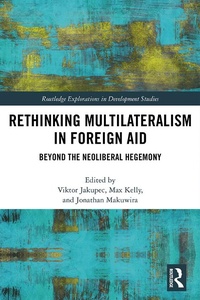
Rethinking Multilateralism in Foreign Aid
Beyond the Neoliberal Hegemony
1st Edition
Published on 23. April 2020
270 pages
978-1-000-06831-3 (ISBN)
Description

This edited book provides a contemporary, critical and thought-provoking analysis of the internal and external threats to Western multilateral development finance in the twenty-first century. It draws on the expertise of scholars with a range of backgrounds providing a critical exploration of the neoliberal multilateral development aid.
The contributions focus on how Western institutions have historically dominated development aid, and juxtapose this hegemony with the recent challenges from right-wing populist and the Beijing Consensus ideologies and practices. This book argues that the rise of right-wing populism has brought internal challenges to traditional powers within the multilateral development system. External challenges arise from the influence of China and regional development banks by providing alternatives to established Western dominated aid sources and architecture. From this vantagepoint, Rethinking Multilateralism in Foreign Aid puts forward new ideas for addressing the current global social, political and economic challenges concerning multilateral development aid.
This book will be of interest to researchers, academics and students in the field of International Development and Global Governance, decision-makers at government level as well as to those working in international aid institutions, regional and bilateral aid agencies, and non-governmental organisations.
The contributions focus on how Western institutions have historically dominated development aid, and juxtapose this hegemony with the recent challenges from right-wing populist and the Beijing Consensus ideologies and practices. This book argues that the rise of right-wing populism has brought internal challenges to traditional powers within the multilateral development system. External challenges arise from the influence of China and regional development banks by providing alternatives to established Western dominated aid sources and architecture. From this vantagepoint, Rethinking Multilateralism in Foreign Aid puts forward new ideas for addressing the current global social, political and economic challenges concerning multilateral development aid.
This book will be of interest to researchers, academics and students in the field of International Development and Global Governance, decision-makers at government level as well as to those working in international aid institutions, regional and bilateral aid agencies, and non-governmental organisations.
Reviews / Votes
"This is an excellent book. It is thoroughly discussing current challenges to the multilateral aid system and its international financial institutions. The rising multipolarity of the global order and the dawn of right wing populism in western liberal democracies have brought the long-established architecture of multilateral development financing into jeopardy. The contention between 'Washington Consensus' and 'Beijing Consensus' - and their respective institutions and narratives - is analysed by a number of knowledgeable authors." - Professor. Dr. Matthias Rompel, Honorary Professor at Giessen University and Director at the German International Cooperation Agency GIZ"A strong analytical and a timely case study in an important, but clearly under-researched IR theory field. The authors were bold enough to question many deeply rooted perceptions about how multilateralism is related to neoliberalism. The book is a major contribution to our understanding of what an efficient multilateral international assistance should mean in the XXI century." - Andrey Kortunov, Director General, Russian International Affairs Council, and President, New Eurasia Foundation
"Neoliberalism has been the archetype of development finance for the past four decades, a trajectory that is now increasingly overshadowed by the long reach of China's economic ascendancy. Jakupec, Kelly, and Makuwira have assembled a timely and vital contribution that encourages us to reconsider the multilateral foreign aid paradigm as global hegemony shifts to the Far East." - Professor Simon Springer, Head of Discipline for Geography and Environmental Studies and Director of the Centre for Urban and Regional Studies, University of Newcastle, Australia
More details
Series
Edition
1. Auflage
Language
English
Place of publication
London
United Kingdom
Publishing group
Taylor & Francis Ltd
Target group
College/higher education
Professional and scholarly
Product notice
Reflowable
Illustrations
11 Tables, black and white; 3 Line drawings, black and white; 3 Illustrations, black and white
ISBN-13
978-1-000-06831-3 (9781000068313)
Copyright in bibliographic data and cover images is held by Nielsen Book Services Limited or by the publishers or by their respective licensors: all rights reserved.
Schweitzer Classification
Other editions
Additional editions
Viktor Jakupec | Max Kelly | Jonathan Makuwira
Rethinking Multilateralism in Foreign Aid
Beyond the Neoliberal Hegemony
Book
05/2023
1st Edition
Routledge
€51.98
Shipment within 15-20 days
Viktor Jakupec | Max Kelly | Jonathan Makuwira
Rethinking Multilateralism in Foreign Aid
Beyond the Neoliberal Hegemony
Book
05/2020
1st Edition
Routledge
€206.60
Shipment within 15-20 days
Rethinking Multilateralism in Foreign Aid
Beyond the Neoliberal Hegemony
Book
05/2020
Routledge
Unfortunately, price unknown
Available (delivery time upon request)
Persons
Viktor Jakupec is a Professor at Deakin University, Australia and the University of Potsdam, Germany.
Max Kelly is an Associate Professor of International and Community Development at Deakin University, Australia.
Jonathan Makuwira is a Professor of Development Studies and the current Deputy Vice Chancellor of Malawi University of Science and Technology (MUST). He is also a Research Associate in the Department of Development Studies at Nelson Mandela University (NMU), South Africa.
Max Kelly is an Associate Professor of International and Community Development at Deakin University, Australia.
Jonathan Makuwira is a Professor of Development Studies and the current Deputy Vice Chancellor of Malawi University of Science and Technology (MUST). He is also a Research Associate in the Department of Development Studies at Nelson Mandela University (NMU), South Africa.
Content
1. Multilateralism and Development Aid: Concepts and Practices Viktor Jakupec, Max Kelly and Jonathan Makuwira 2. Multilateralism, global development: unpacking the megatrends Max Kelly and Jonathan Makuwira 3. Populism and the New World Order Michel de Percy 4. Revisiting Truman Version of Development and Eurafrica Project of Underdeveloping Africa Sabelo J. Ndlovu-Gatsheni & Busani Mpofu 5. Seventy-Five Years of Financing and Advising Development: Perspectives on Work of the Bretton Woods Institutions and Chequered Africa's Development Charles H.B. Mphande 6.The Washington Consensus and Global Civil Society: The Road Traversed Jonathan Makuwira 7. Shifts in international development aid and its impact on economic growth Maneka Jayasinghe, Saroja Selvanathan, and Eliyathamby A. Selvanathan 8. Development Banks: Washington Consensus, Beijing Consensus or Banking Consensus? Adrian Robert Bazbauers and Susan Engel 9. Rethinking Global Financial Architecture: The Case Of Brics New Development Bank Tafadzwa Chitenderu and Ronney Ncwadi 10. The ADB and AIIB: Cooperation, Competition and Contestation Kearrin Sims 11. The World Bank's Resilience Discourse: Reactive Environmental Norm Diffusion and the Crisis of Global Climate Governance Peter Ferguson 12. Challenging the hegemony of the Washington Consensus: The development potential of BRICS 'from below' Janet Cherry 13. Multilateral Foreign Aid and the shadow of Cold War II Viktor Jakupec 14. A new 'New' multilateralism, in a contemporary development context Max Kelly and John McKay 15. Competing Multilateralisms and Development Aid under Scrutiny Jonathan Makuwira, Max Kelly and Viktor Jakupec
