

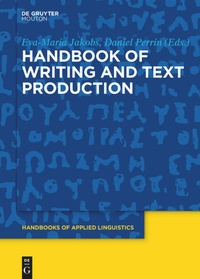
Handbook of Writing and Text Production
Description

Writing matters, and so does research into real-life writing. The shift from an industrial to an information society has increased the importance of writing and text production in education, in everyday life and in more and more professions in the fields of economics and politics, science and technology, culture and media. Through writing, we build up organizations and social networks, develop projects, inform colleagues and customers, and generate the basis for decisions. The quality of writing is decisive for social resonance and professional success. This ubiquitous real-life writing is what the present handbook is about.
The de Gruyter Handbook of Writing and Text Production brings together and systematizes state-of-the-art research. The volume contains five sections, focussing on (I) the theory and methodology of writing and text production research, as well as on problem-oriented and problem-solving approaches related to (II) authors, (III) modes and media, (IV) genres, and (V) domains of writing and text production. Throughout the 21 chapters, exemplary research projects illustrate the theoretical perspectives from globally relevant research spaces and traditions.
Both established and future scholars can benefit from the handbook's fresh approach to writing in the context of multimodal, multi-semiotic text production.
Reviews / Votes
"Das Handbuch bietet einen umfassenden und zudem - durch verständlichen Duktus und illustriert mit vielen Beispielen - sehr lesbaren Überblick über den aktuellen Diskurs zur Schreibforschung und eine Fülle an Anregungen zum Weiterlesen."Sabine Dengscherz in: www.zeitschrift-schreiben.eu/rezensionen, Mai 2014More details
Other editions
Additional editions
Persons
Content
- Intro
- Preface
- Introduction to the handbook series
- Contents
- 1 Introduction and research roadmap: Writing and text production
- Section I. Theory and methodology in text production research
- 2 Introduction: Theory and methodology in text production research
- 3 Research paradigms: Beyond product, process, and social activity
- 4 Models of writing and text production
- 5 Methodology: From speaking about writing to tracking text production
- Section II. Author perspectives
- 6 Introduction : Author perspectives in text production research
- 7 Authorship and context: Writing and text production as situated activities
- 8 Author profiles: Awareness, competence, and skills
- 9 Beyond single authors: Organizational text production as collaborative writing
- Section III. Mode and media perspectives
- 10 Introduction: Mode and media perspectives in text production research
- 11 Production modes: Writing as materializing and stimulating thoughts
- 12 Production media: Writing as using tools in media convergent environments
- 13 Beyond single modes and media: Writing as an ongoing multimodal text production
- Section IV. Genre perspectives
- 14 Introduction: Genre perspectives in text production research
- 15 Reproducing genres: Pattern-related writing
- 16 Producing genres: Pattern variation and genre development
- 17 Beyond single genres: Pattern mapping in global communication
- Section V. Domain perspectives
- 18 Introduction: Domain perspectives in text production research
- 19 Learning domains: Writing as lifelong learning
- 20 Professional domains: Writing as creation of economic value
- 21 Beyond single domains: Writing in boundary crossing
- Subject index
