

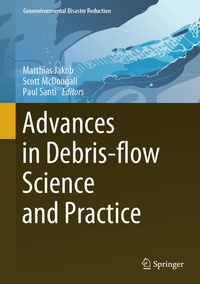
Advances in Debris-flow Science and Practice
Description

This book provides a summary of the state of the art of all facets of debris-flow science and practice and is designed to be a comprehensive technical reference for practitioners and a state-of-the-art research overview for scientists. It is richly illustrated with equations, graphs, photos, and tables. The book allows students, practitioners, and regulators to get a sense of the current state of the art in this science. Currently, there are 2 to 3 papers published every week on some aspects of debris-flow science. This creates a bewildering amount of literature that cannot be captured by a single individual. This book provides a comprehensive overview of all facets to date, including initial hazard assessments, detailed quantitative risk assessments, debris-flow warning systems, debris-flow mitigation structure designs, and failures of mitigation works, as well as new topics such as climate change effects on debris flows.
More details
Other editions
Additional editions
Persons
Matthias Jakob , Ph.D., P.Geo., Principal Geoscientist, was an internationally recognized specialist on geohazard and risk assessment and management. Sadly, Dr. Jakob passed way in 2022. He remains one of Canada's leading experts in hazard and risk assessment of landslides, especially debris floods and debris flows. He completed such assessments for several hundred creeks mostly in Canada but also in Chile, Argentina, Ecuador, Bolivia, and Austria. Dr. Jakob was involved as the lead author for the Professional Practice Guidelines of Engineers and Geoscientists British Columbia (EGBC) on Landslide Assessments in Residential Developments and Legislated Flood Assessments in a Changing Climate in BC. Dr. Jakob authored some 100 publications in the fields of applied geohazard assessments and was senior editor on a book on debris flows and debris avalanches published in 2005 that won the prestigious Burwell Award in 2009.
Scott McDougall is an associate professor of Geological Engineering in the Department of Earth, Ocean, and Atmospheric Sciences at the University of British Columbia (UBC). He completed a B.A.Sc. in Civil Engineering at the University of Toronto in 1998 and a Ph.D. in Geological Engineering at UBC in 2006. Before joining the faculty at UBC full time in 2016, he worked for 10 years as a consultant with BGC Engineering in Vancouver, where he was engaged in a wide variety of projects in the mining, energy, transportation, and municipal development sectors. His research team specializes in the development of tools and techniques for the analysis of geohazards, including landslides, landslide-generated waves, shoreline erosion, and dam breaches. He has served as the chair of the Canadian Geotechnical Society's (CGS) Geohazards Committee and was a recipient of the 2014 CGS Colloquium Award and the 2023 Thomas Roy Award.
Paul Santi is a professor of Geological Engineering at the Colorado School of Mines, wherehe has been on the faculty for over 22 years. Previously, he taught for 6 years at the Missouri University of Science and Technology and worked for 6 years as an engineering consultant in San Francisco and Denver. His recent research has focused on analysis, prediction and mitigation design for debris flows, landslide analysis, and general geologic hazard analysis. He holds a Bachelor's degree in Geology and Physics from Duke University, an M.S. in Geology from Texas A&M, and a Ph.D. in Geological Engineering from the Colorado School of Mines. He is a fellow of the Geological Society of America, he has been the chair of the Engineering Geology Division of that organization, and he has been the president of the Association of Environmental and Engineering Geologists.
