

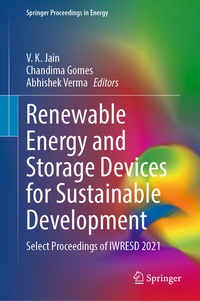
Renewable Energy and Storage Devices for Sustainable Development
Description

More details
Other editions
Additional editions
Persons
V. K. Jain completed his Ph.D. in Solid State Physics from IIT Delhi in 1970. He joined Solid State Physics Laboratory in 1972 and worked as Director Grade Scientist until 2003. He was Head of the silicon devices and Micro Electro Mechanical Systems (MEMS) division and developed many new technologies. His research on electro-luminescence in porous silicon was the ?rst international observation and was reported by Photonics Spectra, USA, and Electronics Asia. He has also developed the technology for space quality silicon solar cells. He is among those who have started the MEMS program in the country and also produced many devices. He was also associated with the National Programme on Smart Materials and MEMS technology from the beginning. He has published more than 200 papers in national and international journals, edited a few books, and has ?led more than 50 patents (including 12 granted). His research interests include solar energy, thermal heat storage system, sensors, biosensors, water puri?cation, etc. He has started two new institutes at Amity University-Amity Institute for Advanced Research and Studies (Materials and Devices) and Amity Institute of Renewable and Alternative-and working as Distinguished Scientist and Professor.
Chandima Gomes is a Full Professor of High Voltage Engineering at the University of Witwatersrand, South Africa. He has about 25 years of teaching experience. His specialization areas include high-voltage engineering, lightning and thunderstorm physics, energies, environmental sciences, and electromagnetics. He has 18 research and 10 program grants, 128 journal publications, 17 chapters, and 200 conference proceedings papers to his credit. He is Senior Adviser to the National Lightning Safety Institution, USA, and was Chief Adviser to African Centers for Lightning and Electromagnetics based in Uganda. Being an engineering consultant for several companies in Asia and Africa, he has over 20 years of international experience in designing lightning protection systems and providing solutions for electromagnetic issues.
Abhishek Verma did his Ph.D. in Electronic Science from Delhi University in 2009. He further joined the National University of Singapore, Singapore, as a postdoc in solar cells technologies. Presently, he is working as Associate Professor at Amity University, Noida. His areas of interest are organic and inorganic 3rd-generation solar cells, solar thermal nano-enhanced phase change materials, nanotechnology, Agrivoltaics, clean energy generation, quantum dots, CNT, Graphene, Si NWs, optical (UV and IR) sensors, volatile/toxic gas sensors, LPG sensors, Si nanowire technology-based sensors and devices. He has organized the many prestigious International Conferences, as Secretary. He has ?led over 20 patents (2 granted), published 5 books as an editor and published over 60 papers in refereed international journals and conferences.
Content
- Intro
- Preface
- Contents
- About the Editors
- Fine Line Printing for Solar Cells with Knotless Screens
- 1 Introduction
- 2 Experiment
- 3 Results
- 4 Conclusion
- References
- Chemical Bath Deposited CdS Along with Electrodeposited and Closed Space Sublimated CdTe for Solar Cell Fabrication
- 1 Introduction
- 2 Fabrication of CBD-CdS/ED-CdTe and CBD-CdS/CSS-CdTe Devices
- 2.1 Chemical Bath Deposition of CdS
- 2.2 Electrodeposition of CdTe
- 2.3 Closed Space Sublimation of CdTe
- 3 Experimental Elucidations
- 3.1 XRD Analysis
- 3.2 Performance of the Photovoltaic Cells
- 4 Conclusions
- References
- Reducing Land Occupancy Using Solar PV Artefact: A Study
- 1 Introduction
- 2 Simulation Study
- 3 Results and Discussion
- 4 Conclusion
- References
- Recent Advances in Hybrid Organic-Inorganic Perovskite Solar Cells with Different Halides and Their Combinations
- 1 Introduction
- 2 Efficiency Trends for Different Halides
- 2.1 Iodine Based
- 2.2 Bromine Based
- 2.3 Iodine-Chlorine Mixed Halide
- 2.4 Iodine-Bromine Mixed Halide
- 3 Conclusion
- References
- Design and Optimization of an Agrivoltaics System
- 1 Introduction
- 2 Experimental Details
- 3 Results and Discussions
- 4 Conclusions
- References
- Implementation of the Family Size Biogas Plant to Achieve a Sustainable Lifestyle: Case Study a Farm in Village 37
- 1 Introduction
- 2 What Are the Objectives of the Biogas Project?
- 3 Why Puxin Biogas Plant?
- 4 Methodology and Construction of the Plant
- 5 Part I: Construction of Puxin Biogas Digester and Gas Storage Tank
- 6 Part II: Inlet and Effluent Chambers, Gasholder Construction, and Finishing Work
- 7 Conclusions
- References
- Humidity-Enabled Graphene Based Bilayer Device for Power Generation
- 1 Introduction
- 2 Experimental Details
- 3 Results and Discussion
- 4 Conclusion
- References
- Long-Term Performance Analysis of Solar Collectors
- 1 Introduction
- 2 Utilizability
- 2.1 Flat Plate Collector
- 2.2 Evacuated Tube Collector
- 3 Flowchart for Long Term Performance Analysis
- 4 Results and Discussions
- 5 Conclusions
- References
- Mitigation of Soiling of Solar Panels by Applying Superydrophobic Aluminum Oxide Thin Film and Dry Cleaning by Electrodynamic Screen
- 1 Introduction
- 2 Experimental Details
- 3 Results and Discussions
- 3.1 Surface and Optical Properties of Transparent Superhydrophobic Alumina Coatings
- 3.2 EDS-Related Investigations: Simulation Results of Dust Removal Mechanism of EDS Film
- 4 Conclusions
- References
- Propagation of Microwaves in Magnetized Plasma and Air-Based Ternary Structure
- 1 Introduction
- 2 Theoretical Framework
- 3 Results and Discussion
- 4 Conclusion
- References
- Photocatalytic Degradation of Chlorobenzene Using Easily Recoverable Fe3O4/OMS-2 Nanocomposite
- 1 Introduction
- 2 Materials and Methods
- 2.1 Materials
- 2.2 Synthesis of Fe3O4/OMS-2nanocomposite
- 2.3 Characterizations
- 2.4 Testing of CB Photocatalytic Degradation
- 3 Results and Discussion
- 3.1 Characterization of Synthesized Fe3O4/OMS-2 Nanocomposite
- 3.2 Photocatalytic Degradation of CB
- 4 Conclusions
- References
- Efficient Removal of Crystal Violet Dye Using Fly Ash-Supported Nanoscale Zerovalent Iron Particles
- 1 Introduction
- 2 Experimental
- 2.1 Synthesis of nZVI/FA
- 2.2 Characterization
- 2.3 Crystal Violet Dye Removal
- 3 Results and Discussion
- 3.1 Characterization
- 3.2 Effect of Contact Time
- 3.3 Effect of CV Dye Concentration
- 3.4 Removal Mechanism of CV by nZVI/FA Composite Particles
- 4 Conclusion
- References
- Increased Heat Transfer Characteristics of Molten Salt-Synthesized Titania Nanoparticles Embedded in Palmitic Acid
- 1 Introduction
- 2 Experimental Details
- 3 Results and Discussion
- 4 Conclusions
- References
- Reduced Graphene Oxide-Based Metal Nanocomposites as Advanced Functional Electrode Material for Ni/Fe Rechargeable Batteries
- 1 Introduction
- 2 Methods and Material
- 2.1 Synthesis of Graphene Oxide
- 2.2 Synthesis of Metal Nanoparticles
- 2.3 Synthesis of Fe2O3/CuO/rGO Nanocomposites by Ex-Situ Method
- 3 Results and Discussion
- 4 Conclusions
- References
- Influence of Variation of Excitation Wavelength on Optical Properties of Silicon Nanowires
- 1 Introduction
- 2 Methodology
- 3 Results and Discussion
- 4 Conclusion
- References
- Invariance of Thermal Emissivity in Spray Coated ZrB2 Film
- 1 Introduction
- 2 Materials and Method
- 2.1 Coating Preparation
- 2.2 Coating Characterization
- 2.3 Radiation Property Evaluation
- 3 Results and Discussion
- 3.1 Phase Assemblage
- 3.2 Coating Morphology
- 3.3 Surface Roughness
- 3.4 Thermal Emittance
- 3.5 Invariance of Thermal Emittance
- 4 Conclusions
- References
- Role of Semiconductors in Various Renewable Energy Systems
- 1 Introduction
- 2 Types of Renewable Energy Conversion
- 3 Photovoltaic Cells
- 4 Types of Photovoltaic Cells
- 5 Emerging PV Technologies
- 6 Conclusion
- References
- Design of Photovoltaic System for DC Pumping Unit
- 1 Introduction
- 2 Location
- 3 Designing of a PV System
- 4 Results and Discussion
- 5 Conclusion
- References
- Glycerol Material's Impact on Growth of Microalgae for Sustainable Renewable Energy Production
- 1 Introduction
- 2 Materials and Methods
- 3 Results and Discussion
- 4 Conclusions
- References
- Study of Jaggery Derived Carbon Spheres for Supercapacitor Applications
- 1 Introduction
- 2 Experimental
- 3 Results and Discussion
- 3.1 X-ray Diffraction (XRD)
- 3.2 Scanning Electron Microscopy (SEM)
- 3.3 Cyclic Voltammetry (CV)
- 3.4 Galvanostatic Charge Discharge (GCD)
- 4 Conclusion
- References
- Optimum Concentration Ratio for Plastic Optical Fiber-Based Fresnel Lens Daylighting System
- 1 Introduction
- 2 Designing of Experimental Setup
- 3 Simulation Analysis
- 4 Discussion
- 5 Conclusion
- References
- Energy-Efficient Tunnel FET for Application as a Biosensor
- 1 Introduction
- 2 Device Structure
- 3 Results and Discussion
- 4 Conclusion
- References
