

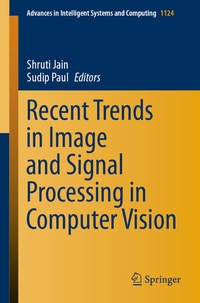
Recent Trends in Image and Signal Processing in Computer Vision
Description

This book highlights recent advances and emerging technologies that utilize computational intelligence in signal processing, computing, imaging science, artificial intelligence, and their applications. It covers all branches of artificial intelligence and machine learning that are based on computation at some level, e.g. artificial neural networks, evolutionary algorithms, fuzzy systems, and automatic medical identification systems. Exploring recent trends in research and applications, the book offers a valuable resource for professors, researchers, and engineers alike.
More details
Other editions
Additional editions
Persons
Dr. Shruti Jain
is an Associate Professor in the Department of Electronics and Communication Engineering at the Jaypee University of Information Technology, Waknaghat, H.P, India and has received her Ph.D. in Biomedical Image Processing. She has a teaching experience of around 15 years. Her research interests are Image and Signal Processing, Soft Computing, Bio-inspired Computing and Computer-Aided Design of FPGA and VLSI circuits. She has published more than 10 book chapters, 60 papers in reputed journals, and 40 papers in International conferences. She has also published five books. She is a senior member of IEEE, life member and Editor in Chief of the Biomedical Engineering Society of India and a member of IAENG. She has completed one externally funded project and one in the pipeline. She has guided 01 Ph.D. student and now has 06 registered students. She is a member of the Editorial Board of many reputed journals. She is also a reviewer of many journals and a memberof TPC of different conferences. She was awarded by Nation Builder Award in 2018-19.
Dr. Sudip Paul
has been an Assistant Professor at the Department of Biomedical Engineering, School of Technology, North-Eastern Hill University (NEHU), Shillong, India, since 2012. He holds a B.Tech. and M.Tech. degrees in Biomedical Engineering, and a Ph.D. from the Indian Institute of Technology (Banaras Hindu University), Varanasi, with a specialization in electrophysiology and brain signal analysis. He was selected as a Post-Doc Fellow under the Biotechnology Overseas Associateship for Scientists Working in the North Eastern States of India (2017-2018), supported by the Department of Biotechnology, Government of India. Dr. Sudip has published more than 90 international journal and conference papers and also filed four patents.
Recently, he has completed three book projects and is currently serving as editor for a further two. Dr. Sudip is a member of varioussocieties and professional bodies, including the APSN, ISN, IBRO, SNCI, SfN, and IEEE. He received first prize in the Sushruta Innovation Award 2011, sponsored by the Department of Science and Technology, Government of India, and numerous other awards, including the World Federation of Neurology (WFN) travelling fellowship, Young Investigator Award, and IBRO and ISN Travel Awards. Dr. Sudip has also served as an editorial board member for a variety of international journals, and has presented his research in the USA, Greece, France, South Africa, and Australia.
