

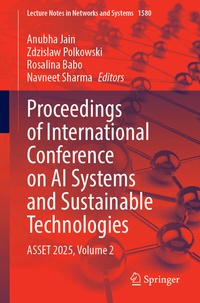
Proceedings of International Conference on AI Systems and Sustainable Technologies
Description

This book includes high-quality research papers presented at the International Conference on AI Systems and Sustainable Technologies (ASSET 2025), organized by the Department of Computer Science and Information Technology, School of CS and IT at IIS (deemed to be University), Jaipur, India, during 28-29 March 2025. It covers the state-of-the-art in AI and ML applications across diverse domains. It also discusses interdisciplinary research integrating AI with sustainable technologies in energy, agriculture, health, and climate resilience.
More details
Other editions
Additional editions
Persons
Dr. Anubha Jain, is Director of the School of Computer Science and IT at IIS (Deemed to be University), Jaipur, India, with over twenty-five years in software development, teaching, and research. She holds a Ph.D. in the field of Information Retrieval and Information Architecture. Her research interests include Soft Computing, Computational Studies, Deep Learning, and Software Engineering. She has co-authored 9 books, 12 book chapters, and published 35 papers. She is an avid speaker and resource person in many conferences and workshops. As a Green Software Champion at the Green Software Foundation, she actively promotes green technologies. She has frequently talked internationally on topics such as IoT Testing, Green IoT, and sustainable computing at QA & Test and HUSTEF conferences in Bilbao and Budapest.
Dr. Eng. Zdzislaw Polkowski is Professor at WSG University, Bydgoszcz, and Jan Wyzykowski University, Polkowice, Poland, where he also serves as Rector's Representative for International Cooperation and Erasmus+ Program. He is Adjunct Professor at Wroclaw University of Economics and other institutions in Poland, Romania, and India. Holding a Ph.D. in Computer Science and Management, he has published 159+ papers and co-edited 29 books published by Springer, IGI and CRC Press Taylor & Francis. He has delivered 85+ invited talks globally and has participated in EU-funded research projects. His interests include AI, IoT, AR, and IT in Business, IoT in Business, and Education Technology. In 2023, he was selected for a study visit at the University of Cambridge, UK.
Prof. Rosalina Babo is Coordinator Professor (Tenure) of Information Systems Department, School of Accounting and Administration of Polytechnic of Porto, Portugal. She served as Head of the department from 2000 to 2022 and was Member of the university's scientific board for 12 years. She has been Visiting Professor at several universities in different countries, namely Belgium (KU LEUVEN), Croatia (University of Split), Kosovo (University of Prishtina), and Latvia (Latvia University of Agriculture). Rosalina was one of the founders of CEOS.PP (former CEISE/STI) research center and its director for 5 years. She is active in international conference committees and reviews for journals. As a book editor, she collaborates with Elsevier, Springer, and IGI Global. Her research focuses on e-learning, e-assessment, e-business, usability, and social networks. Her main areas of research are e-learning, e-assessment, e-business, Internet applications focusing on usability and social networks.
Navneet Sharma is Associate Professor in the Department of Computer Science & IT at IIS (Deemed to be University), Jaipur, India. He has over 20 years of teaching and 14 years of research experience. His key research areas include Cloud Computing, Data Sciences, and Information Security. He has authored 6 books and published over 35 research papers in reputed journals. He holds five published patents and has supervised 6 Ph.D. scholars. He has presented papers at numerous national and international conferences and has served as a resource person, keynote speaker, and invited guest. He has received multiple awards for teaching excellence and outstanding research. He is also actively involved with various universities in research activities.
Content
The Role of AI And Machine Learning in VFX: Revolutionizing Automation and Realism.- Signal Processing and Data Enhancement in IoT-Driven Healthcare Systems Using Deep Learning.- Enhancing Satellite Telemetry Monitoring with Machine Learning: A Comprehensive Study of Anomaly Detection Techniques.- CDPS transfer to GCP a regular backup monitoring automation in cloud environment.- Arrhythmia Classification: Deep Learning and Machine Learning approach.- Hybrid Model for Enhanced Player Behavior Analysis and Grey Area Identification.- Leveraging Deep Convolutional Generative Adversarial Networks for Synthetic Devanagari Handwriting Generation.- Implementation of AI in Sustainable Investment Practices for a Greener Future.- Enhancing CAPTCHA Security with Devanagari Script Recognition Using KNN.- On the Adaptive Control of Thought- Rational (ACT-R) in AI Perspective: A study of Cognitive Architecture.- Leveraging AI for Interactive 3D Visualizations and Immersive Simulations of Sustainable Practices in Urban Planning.- Vittles Recipe Recommender: A Gourmet Food Guide with Leftovers.- Harnessing Artificial Intelligence and Machine Learning in English Language Teaching: Trends and Applications.
