

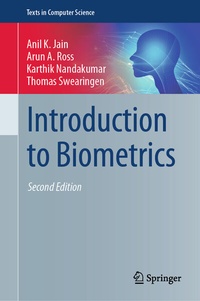
Introduction to Biometrics
Description

This textbook introduces the fundamental concepts and techniques used in biometric recognition to students, practitioners, and non-experts in the field. Specifically, the book describes key methodologies used for sensing, feature extraction, and matching of commonly used biometric modalities such as fingerprint, face, iris, and voice. In addition, it presents techniques for fusion of biometric information to meet stringent accuracy requirements, also discussing various security issues and associated remedies involved in the deployment of biometric systems. Furthermore, this second edition captures the progress made in the field of biometric recognition, with highlights including:
- Lucid explanation of core biometric concepts (e.g., individuality and persistence), which builds a strong foundation for more in-depth study and research on biometrics
- A new chapter on deep neural networks that provides a primer to recent advancements in machine learning and computer vision
- Illustrative examples of how deep neural network models have contributed to the rapid evolution of biometrics in areas such as robust feature representation and synthetic biometric data generation
- A new chapter on speaker recognition, which introduces the readers to person recognition based on the human voice characteristics
- Presentation of emerging security threats such as deepfakes and adversarial attacks and sophisticated countermeasures such as presentation attack detection and template security
While this textbook has been designed for senior undergraduate students and first-year graduate students studying a course on biometrics, it is also a useful reference guide for biometric system designers, developers, and integrators.
More details
Other editions
Additional editions
Persons
Dr. Anil K. Jain is University Distinguished Professor and Douglas E. Zongker endowed professor at Michigan State University.
Dr. Arun Ross is Martin J. Vanderploeg Endowed Professor at Michigan State University.
Dr. Karthik Nandakumar is an Associate Professor of Computer Vision at Mohamed Bin Zayed University of Artificial Intelligence (MBZUAI).
Thomas Swearingen is a Graduate Research Assistant at Michigan State University pursuing his Ph.D. in biometrics.
The authors' many publications include the Springer titles Selfie Biometrics: Advances and Challenges , Encyclopedia of Biometrics , Handbook of Face Recognition , Handbook of Fingerprint Recognition , Handbook of Biometrics , Handbook of Multibiometrics , and Biometric Systems: Technology, Design and Performance .
Content
1. Introduction.- 2. Fingerprint Recognition.- 3. Face Recognition.- 4. Iris Recognition.- 5. Additional Biometric Traits.- 6. Biometrics.
