

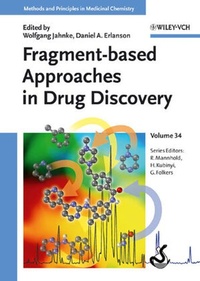
Fragment-based Approaches in Drug Discovery
1st Edition
Published on 13. December 2006
XXII, 369 pages
978-3-527-60860-7 (ISBN)
Description

This first systematic summary of the impact of fragment-based approaches on the drug development process provides essential information that was previously unavailable. Adopting a practice-oriented approach, this represents a book by professionals for professionals, tailor-made for drug developers in the pharma and biotech sector who need to keep up-to-date on the latest technologies and strategies in pharmaceutical ligand design. The book is clearly divided into three sections on ligand design, spectroscopic techniques, and screening and drug discovery, backed by numerous case studies.
More details
Other editions
Additional editions
Wolfgang Jahnke | Daniel A. Erlanson
Fragment-based Approaches in Drug Discovery
Book
08/2006
1st Edition
Wiley-VCH
€249.00
Article exhausted; check different version
Persons
Wolfgang Jahnke is a Senior Research Investigator at the Novartis Institutes for Biomedical Research in Basel, Switzerland, where he leads the Fragment-Based Screening technology platform. During his ten years at Novartis, he has received several honors, among them the appointment as Scientific Expert, and the Leading Scientist Award. Dr. Jahnke received his PhD from the TU München, working with Horst Kessler on the development and application of novel NMR methods. He subsequently carried out research with Peter Wright at the Scripps Research Institute in La Jolla.
Daniel A. Erlanson joined Sunesis Pharmaceuticals at its inception in 1998. He has been instrumental in inventing its drug-discovery technologies and using these to design leads against a variety of disease targets. Prior to Sunesis, Dr. Erlanson developed methods to conformationally constrain peptides as a post-doctoral fellow with James A. Wells at Genentech. Dr. Erlanson received his PhD in chemistry from Harvard University in the laboratory of Gregory L. Verdine, and his BA in chemistry from Carleton College, MN.
Daniel A. Erlanson joined Sunesis Pharmaceuticals at its inception in 1998. He has been instrumental in inventing its drug-discovery technologies and using these to design leads against a variety of disease targets. Prior to Sunesis, Dr. Erlanson developed methods to conformationally constrain peptides as a post-doctoral fellow with James A. Wells at Genentech. Dr. Erlanson received his PhD in chemistry from Harvard University in the laboratory of Gregory L. Verdine, and his BA in chemistry from Carleton College, MN.
Content
PART 1: CONCEPT AND THEORY
The concept of fragment-based ligand design
Multivalency in Ligand Design
Entropic consequences of linking ligands
Location of Binding Sites on Proteins by the Multiple Solvent Crystal Structure Method
PART 2: FRAGMENT LIBRARY DESIGN AND COMPUTATIONAL APPROACHES
Cheminformatics approaches to fragment-based lead discovery
Structural fragments from marketed oral drugs
Fragment docking to proteins with the multi-copy simultaneous search (MCSS) methodology
PART 3: EXPERIMENTAL TECHNIQUES
NMR - guided fragment assembly
SAR by NMR: an analysis of ptency gains realized through fragment-linking and fragment-elaboration strategies for lead generation
Pyramid: an integrated platform for fragment-based drug discovery
Fragment-based lead discovery and optimization using X-ray crystallography
Synergistic use of protein crystallography and solution-phase NMR spectroscopy in structure-based drug design: strategies and tactics
Ligand SAR using electrospray ionization mass spectrometry
Tethering
PART 4: EMERGING TECHNOLOGIES
Click chemistry for drug discovery
Dynamic combinatorial diversity in drug discovery
The concept of fragment-based ligand design
Multivalency in Ligand Design
Entropic consequences of linking ligands
Location of Binding Sites on Proteins by the Multiple Solvent Crystal Structure Method
PART 2: FRAGMENT LIBRARY DESIGN AND COMPUTATIONAL APPROACHES
Cheminformatics approaches to fragment-based lead discovery
Structural fragments from marketed oral drugs
Fragment docking to proteins with the multi-copy simultaneous search (MCSS) methodology
PART 3: EXPERIMENTAL TECHNIQUES
NMR - guided fragment assembly
SAR by NMR: an analysis of ptency gains realized through fragment-linking and fragment-elaboration strategies for lead generation
Pyramid: an integrated platform for fragment-based drug discovery
Fragment-based lead discovery and optimization using X-ray crystallography
Synergistic use of protein crystallography and solution-phase NMR spectroscopy in structure-based drug design: strategies and tactics
Ligand SAR using electrospray ionization mass spectrometry
Tethering
PART 4: EMERGING TECHNOLOGIES
Click chemistry for drug discovery
Dynamic combinatorial diversity in drug discovery
