

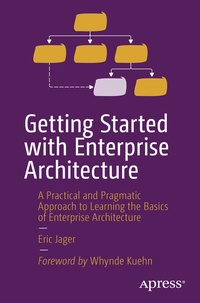
Getting Started with Enterprise Architecture
Description

Implement a basic Enterprise Architecture from start to finish using a four-stage, wheel-based approach. Aided by real-world examples, this book shows what elements are needed for the initial implementation of a fundamental Enterprise Architecture.
The book's pragmatic approach keeps existing architecture frameworks and methodologies in mind while providing instructions that are readable and applicable to all. The Enterprise Architecture Implementation Wheel builds on the methodology of existing architecture frameworks and allows you to apply the theory more pragmatically and closer to the reality that an architect encounters in daily practice.
While the main focus of the book is on the actual steps taken to design an Enterprise Architecture, other important topics include architecture origin, definition, domains, visualization, and roles. Getting Started with Enterprise Architecture is the ideal handbook for the architect who is asked to implement an Enterprise Architecture in an existing organization.
What You'll Learn
- Identify a company's needs and develop an appropriate strategy to satisfy those needs
- Implement measurable goals and objectives for a baseline architecture
- Create meaningful catalogues, diagrams, and maps to communicate the architecture to an organization
- Measure the progress of implementing the architecture
Who This Book Is For
- Novice (Enterprise and Business) architects
- Senior management
- Executives
More details
Other editions
Additional editions
Person
Eric Jager is the author of Getting Started with Enterprise Architecture and a Certified Master Architect in the field of Enterprise Architecture. He is also a certified TOGAF Enterprise Architecture Practitioner, Certified Business Architect and ArchiMate Practitioner. He is familiar with various architecture methodologies including the TOGAF Standard and the Zachman Framework.
Eric has been practicing Enterprise Architecture for over 15 years and has extensive knowledge and experience in the development and application of Enterprise Architecture. He easily leverages architecture to translate business strategy into implementation.
Eric has worked for many organizations ranging from government and consulting agencies to healthcare institutions.
Based on his years of practical experience, Eric has created a self-designed Enterprise Architecture Implementation Wheel: an approach to implementing Enterprise Architecture that can be used by both novice and experienced architects.
Eric likes to focus on the practical and pragmatic application of Enterprise Architecture and lectures on architecture at the Eindhoven University of Technology. He also writes about his experiences on his blog.
Content
Chapter 1 Introduction.- Chapter 2 Architecture origin.- Chapter 3 Architecture definition.- Chapter 4 Architecture domains.- Chapter 5 Architecture roles.- Chapter 6 Architecture visualization.- Chapter 7 Architecture positioning.- Chapter 8 Architecture implementation.- Chapter 9 Next steps.- Chapter 10 Architecture application.- Chapter 11 Closing Remarks.- Appendix A - Example Information Map.- Appendix B - Example Maturity Model.- Appendix C - Example Work Package View.
