

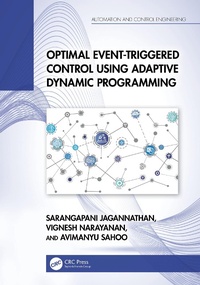
Optimal Event-Triggered Control Using Adaptive Dynamic Programming
1st Edition
Published on 21. June 2024
346 pages
978-1-040-04916-7 (ISBN)
Description

Optimal Event-triggered Control using Adaptive Dynamic Programming discusses event triggered controller design which includes optimal control and event sampling design for linear and nonlinear dynamic systems including networked control systems (NCS) when the system dynamics are both known and uncertain. The NCS are a first step to realize cyber-physical systems (CPS) or industry 4.0 vision. The authors apply several powerful modern control techniques to the design of event-triggered controllers and derive event-trigger condition and demonstrate closed-loop stability. Detailed derivations, rigorous stability proofs, computer simulation examples, and downloadable MATLAB (R) codes are included for each case.
The book begins by providing background on linear and nonlinear systems, NCS, networked imperfections, distributed systems, adaptive dynamic programming and optimal control, stability theory, and optimal adaptive event-triggered controller design in continuous-time and discrete-time for linear, nonlinear and distributed systems. It lays the foundation for reinforcement learning-based optimal adaptive controller use for infinite horizons. The text then:
Introduces event triggered control of linear and nonlinear systems, describing the design of adaptive controllers for them
Presents neural network-based optimal adaptive control and game theoretic formulation of linear and nonlinear systems enclosed by a communication network
Addresses the stochastic optimal control of linear and nonlinear NCS by using neuro dynamic programming
Explores optimal adaptive design for nonlinear two-player zero-sum games under communication constraints to solve optimal policy and event trigger condition
Treats an event-sampled distributed linear and nonlinear systems to minimize transmission of state and control signals within the feedback loop via the communication network
Covers several examples along the way and provides applications of event triggered control of robot manipulators, UAV and distributed joint optimal network scheduling and control design for wireless NCS/CPS in order to realize industry 4.0 vision
An ideal textbook for senior undergraduate students, graduate students, university researchers, and practicing engineers, Optimal Event Triggered Control Design using Adaptive Dynamic Programming instills a solid understanding of neural network-based optimal controllers under event-sampling and how to build them so as to attain CPS or Industry 4.0 vision.
The book begins by providing background on linear and nonlinear systems, NCS, networked imperfections, distributed systems, adaptive dynamic programming and optimal control, stability theory, and optimal adaptive event-triggered controller design in continuous-time and discrete-time for linear, nonlinear and distributed systems. It lays the foundation for reinforcement learning-based optimal adaptive controller use for infinite horizons. The text then:
Introduces event triggered control of linear and nonlinear systems, describing the design of adaptive controllers for them
Presents neural network-based optimal adaptive control and game theoretic formulation of linear and nonlinear systems enclosed by a communication network
Addresses the stochastic optimal control of linear and nonlinear NCS by using neuro dynamic programming
Explores optimal adaptive design for nonlinear two-player zero-sum games under communication constraints to solve optimal policy and event trigger condition
Treats an event-sampled distributed linear and nonlinear systems to minimize transmission of state and control signals within the feedback loop via the communication network
Covers several examples along the way and provides applications of event triggered control of robot manipulators, UAV and distributed joint optimal network scheduling and control design for wireless NCS/CPS in order to realize industry 4.0 vision
An ideal textbook for senior undergraduate students, graduate students, university researchers, and practicing engineers, Optimal Event Triggered Control Design using Adaptive Dynamic Programming instills a solid understanding of neural network-based optimal controllers under event-sampling and how to build them so as to attain CPS or Industry 4.0 vision.
More details
Series
Edition
1. Auflage
Language
English
Place of publication
London
United Kingdom
Publishing group
Taylor & Francis Ltd
Target group
College/higher education
Illustrations
33 Tables, black and white; 98 Line drawings, black and white; 98 Illustrations, black and white
ISBN-13
978-1-040-04916-7 (9781040049167)
Copyright in bibliographic data and cover images is held by Nielsen Book Services Limited or by the publishers or by their respective licensors: all rights reserved.
Schweitzer Classification
Other editions
Additional editions
Sarangapani Jagannathan | Vignesh Narayanan | Avimanyu Sahoo
Optimal Event-Triggered Control Using Adaptive Dynamic Programming
Book
05/2026
1st Edition
CRC Press
€66.00
Shipment within 10-20 days
Sarangapani Jagannathan | Vignesh Narayanan | Avimanyu Sahoo
Optimal Event-Triggered Control Using Adaptive Dynamic Programming
Book
06/2024
1st Edition
CRC Press
€139.30
Shipment within 10-20 days
Persons
Dr. Sarangapani Jagannathan is a Curator's Distinguished Professor and Rutledge-Emerson chair of Electrical and Computer Engineering at the Missouri University of Science and Technology (former University of Missouri-Rolla). He has a joint Professor appointment in the Department of Computer Science. He served as a Director for the NSF Industry/University Cooperative Research Center on Intelligent Maintenance Systems for 13 years. His research interests include learning, adaptation and control, secure human-cyber-physical systems, prognostics, and autonomous systems/robotics. Prior to his Missouri S&T appointment, he served as a faculty at University of Texas at San Antonio and as a staff engineer at Caterpillar, Peoria.
He has coauthored over 500 refereed IEEE Transaction/journal and conference articles, written 18 book chapters, authored/co-edited 6 books, received 21 US patents and one patent defense publication. He delivered around 30 plenary and keynote talks in various international conferences and supervised to graduation 33 doctoral and 31 M.S thesis students. He was a co-editor for the IET book series on control from 2010 until 2013 and served on many editorial boards including IEEE Systems, Man and Cybernetics, and has been on organizing committees of several IEEE Conferences. He is currently an associate editor for IEEE Transactions on Neural Networks and Learning Systems and others.
He received many awards including the 2020 Best Associate Editor Award, 2018 IEEE CSS Transition to Practice Award, 2007 Boeing Pride Achievement Award, 2001 Caterpillar Research Excellence Award, 2021 University of Missouri Presidential Award for sustained career excellence, 2001 University of Texas Presidential Award for early career excellence, and 2000 NSF Career Award. He also received several faculty excellence and teaching excellence and commendation awards. As part of his NSF I/UCRC, he transitioned many technologies and software products to industrial entities saving millions of dollars. He is a Fellow of the IEEE, National Academy of Inventors, and Institute of Measurement and Control, UK, Institution of Engineering and Technology (IET), UK and Asia-Pacific Artificial Intelligence Association.
Dr. Vignesh Narayanan is an Assistant Professor in the AI institute and the Department of Computer Science and Engineering at University of South Carolina (USC), Columbia. He is also affiliated with the Carolina Autism and Neurodevelopment research center at USC. His research interests include dynamical systems and networks, artificial intelligence, data science, learning theory, and computational neuroscience.
He received his B.Tech. Electrical and electronics engineering and M. Tech. Electrical engineering degrees from SASTRA University, Thanjavur, and the National Institute of Technology, Kurukshetra, India, respectively, in 2012 and 2014, and his Ph.D. degree from Missouri University of Science and Technology, Rolla, MO in 2017. He was a post-doctoral research associate at Washington University in St. Louis, before joining the AI institute of USC.
Avimanyu Sahoo received his Ph.D. in Electrical Engineering from Missouri University of Science and Technology, Rolla, MO, USA, in 2015 and a Master of Technology (MTech) from the Indian Institute of Technology (BHU), Varanasi, India, in 2011. He is currently an Assistant Professor in the Electrical and Computer Engineering Department at the University of Alabama in Huntsville (UAH), AL. Before joining UAH, Dr. Sahoo was an Associate Professor in the Division of Engineering Technology at Oklahoma State University, Stillwater, OK.
Dr. Sahoo's research interests include learning-based control and its applications in lithium-ion battery pack modeling, diagnostics, prognostics, cyber-physical systems (CPS), and electric machinery health monitoring. Currently, his research focuses on developing intelligent battery management systems (BMS) for lithium-ion battery packs used onboard electric vehicles, computation, and communication-efficient distributed intelligent control schemes for cyber-physical systems using approximate dynamic programming, reinforcement learning, and distributed adaptive state estimation. He has published over 45 journal and conference articles, including IEEE Transactions on Neural Networks and Learning Systems, Cybernetics, and Industrial Electronics. He is also an Associate Editor in IEEE Transactions on Neural Networks and Learning Systems and Frontiers in Control Engineering: Nonlinear Control.
He has coauthored over 500 refereed IEEE Transaction/journal and conference articles, written 18 book chapters, authored/co-edited 6 books, received 21 US patents and one patent defense publication. He delivered around 30 plenary and keynote talks in various international conferences and supervised to graduation 33 doctoral and 31 M.S thesis students. He was a co-editor for the IET book series on control from 2010 until 2013 and served on many editorial boards including IEEE Systems, Man and Cybernetics, and has been on organizing committees of several IEEE Conferences. He is currently an associate editor for IEEE Transactions on Neural Networks and Learning Systems and others.
He received many awards including the 2020 Best Associate Editor Award, 2018 IEEE CSS Transition to Practice Award, 2007 Boeing Pride Achievement Award, 2001 Caterpillar Research Excellence Award, 2021 University of Missouri Presidential Award for sustained career excellence, 2001 University of Texas Presidential Award for early career excellence, and 2000 NSF Career Award. He also received several faculty excellence and teaching excellence and commendation awards. As part of his NSF I/UCRC, he transitioned many technologies and software products to industrial entities saving millions of dollars. He is a Fellow of the IEEE, National Academy of Inventors, and Institute of Measurement and Control, UK, Institution of Engineering and Technology (IET), UK and Asia-Pacific Artificial Intelligence Association.
Dr. Vignesh Narayanan is an Assistant Professor in the AI institute and the Department of Computer Science and Engineering at University of South Carolina (USC), Columbia. He is also affiliated with the Carolina Autism and Neurodevelopment research center at USC. His research interests include dynamical systems and networks, artificial intelligence, data science, learning theory, and computational neuroscience.
He received his B.Tech. Electrical and electronics engineering and M. Tech. Electrical engineering degrees from SASTRA University, Thanjavur, and the National Institute of Technology, Kurukshetra, India, respectively, in 2012 and 2014, and his Ph.D. degree from Missouri University of Science and Technology, Rolla, MO in 2017. He was a post-doctoral research associate at Washington University in St. Louis, before joining the AI institute of USC.
Avimanyu Sahoo received his Ph.D. in Electrical Engineering from Missouri University of Science and Technology, Rolla, MO, USA, in 2015 and a Master of Technology (MTech) from the Indian Institute of Technology (BHU), Varanasi, India, in 2011. He is currently an Assistant Professor in the Electrical and Computer Engineering Department at the University of Alabama in Huntsville (UAH), AL. Before joining UAH, Dr. Sahoo was an Associate Professor in the Division of Engineering Technology at Oklahoma State University, Stillwater, OK.
Dr. Sahoo's research interests include learning-based control and its applications in lithium-ion battery pack modeling, diagnostics, prognostics, cyber-physical systems (CPS), and electric machinery health monitoring. Currently, his research focuses on developing intelligent battery management systems (BMS) for lithium-ion battery packs used onboard electric vehicles, computation, and communication-efficient distributed intelligent control schemes for cyber-physical systems using approximate dynamic programming, reinforcement learning, and distributed adaptive state estimation. He has published over 45 journal and conference articles, including IEEE Transactions on Neural Networks and Learning Systems, Cybernetics, and Industrial Electronics. He is also an Associate Editor in IEEE Transactions on Neural Networks and Learning Systems and Frontiers in Control Engineering: Nonlinear Control.
Content
1. Background and Introduction to Event-triggered Control 2. Adaptive Dynamic Programming and Optimal Control 3 Linear Discrete-time and Networked Control Systems 4. Nonlinear Continuous-time Systems 5. Co-optimization of Event-triggered Sampling and Control 6. Large-scale Linear Interconnected Systems 7. Large-scale Nonlinear Interconnected Systems 8. Exploration and Hybrid Learning for Nonlinear Interconnected Systems 9. Event-Triggered Control Applications
