

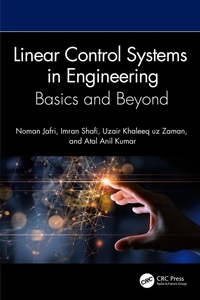
Linear Control Systems in Engineering
Basics and Beyond
Published on 9. September 2025
325 pages
978-1-040-40958-9 (ISBN)
Description

This textbook examines classical and modern control strategies toward systems' best performance, especially concerning design and operations. It simplifies control theory concepts through related mathematics and examples of real-life systems worldwide.
Linear Control Systems in Engineering: Basics and Beyond covers the fundamental principles of control systems and advanced topics providing a comprehensive resource for readers at different levels of ability. It is written in an infographic language as much as possible, making complex concepts in control systems accessible to a broad audience, including students and professionals. The textbook includes many examples and practical exercises to reinforce learning and demonstrate how control systems work in various engineering domains. The textbook focuses on both the conventional and contemporary control systems technologies and trends, such as digital control, automation, and robust control. It also highlights analysis, stability, and optimization techniques for control systems in a sole source.
The textbook is written for both undergraduate and graduate courses dealing with the subjects of electrical, mechanical, mechatronics, chemical, and aerospace engineering. It will take the reader from basic concepts and applications to advanced topics, and the book will be the sole source to reach knowledge and explore future possibilities related to control design techniques, methodologies, and operations from basic to beyond.
A solutions manual and PowerPoint slides are available for qualified textbook adoption.
Linear Control Systems in Engineering: Basics and Beyond covers the fundamental principles of control systems and advanced topics providing a comprehensive resource for readers at different levels of ability. It is written in an infographic language as much as possible, making complex concepts in control systems accessible to a broad audience, including students and professionals. The textbook includes many examples and practical exercises to reinforce learning and demonstrate how control systems work in various engineering domains. The textbook focuses on both the conventional and contemporary control systems technologies and trends, such as digital control, automation, and robust control. It also highlights analysis, stability, and optimization techniques for control systems in a sole source.
The textbook is written for both undergraduate and graduate courses dealing with the subjects of electrical, mechanical, mechatronics, chemical, and aerospace engineering. It will take the reader from basic concepts and applications to advanced topics, and the book will be the sole source to reach knowledge and explore future possibilities related to control design techniques, methodologies, and operations from basic to beyond.
A solutions manual and PowerPoint slides are available for qualified textbook adoption.
More details
Language
English
Place of publication
London
United Kingdom
Publishing group
Taylor & Francis Ltd
Target group
College/higher education
Illustrations
15 Tables, black and white; 169 Line drawings, black and white; 1 Halftones, black and white; 170 Illustrations, black and white
File size
13,53 MB
ISBN-13
978-1-040-40958-9 (9781040409589)
Copyright in bibliographic data and cover images is held by Nielsen Book Services Limited or by the publishers or by their respective licensors: all rights reserved.
Schweitzer Classification
Other editions
Additional editions
Noman Jafri | Imran Shafi | Uzair Khaleeq uz Zaman
Linear Control Systems in Engineering
Basics and Beyond
Book
09/2025
1st Edition
CRC Press
€133.00
Shipment within 10-20 days
Persons
Dr. Noman Jafri is a distinguished academic and engineering professional, currently serving as the dean of engineering at Abasyn University in Pakistan. His academic journey has been marked by a commitment to excellence and a passion for engineering innovation. He obtained his master's and PhD in electrical engineering in 1967 from the University of Ottawa in Canada. With his extensive educational background and expertise, Dr. Jafri has made significant contributions to the field of engineering. He has not only been a diligent educator but has also played a pivotal role in shaping the curriculum and research initiatives. Under his leadership, the engineering department has thrived and grown, attracting aspiring engineers from all over Pakistan.
Dr. Imran Shafi is a distinguished Pakistani computer engineer and researcher, known for his pioneering contributions to time-frequency analysis, particularly through the integration of neural networks to enhance signal processing techniques. His research focuses on improving time-frequency distributions (TFDs) for the analysis of nonstationary signals, addressing key challenges such as blurring and cross-term interference that commonly hinder the accuracy of traditional methods. By developing innovative approaches that utilize neural networks, Dr. Shafi has significantly advanced the resolution and energy concentration of TFDs, enabling more precise representation of instantaneous signal frequencies. With over 120 research publications to his name and a substantial citation count, his work has made a lasting impact in the fields of signal processing and computational intelligence, earning recognition within the global academic community.
Dr. Uzair Khaleeq uz Zaman is a highly accomplished academic and globally engaged educator, holding a PhD in industrial engineering from Arts et Metiers ParisTech, France, with over ten years of experience in university teaching, curriculum development, and applied research. Currently serving as associate professor and head of the Mechanical Engineering Department at NUST, Pakistan, he is recognized for his expertise in smart manufacturing, industry 4.0, and digital transformation. Dr. Uzair's international teaching footprint spans France, China, and Luxembourg, where he has delivered lectures and workshops at leading institutions. As a published author, keynote speaker, and subject matter expert, his work focuses on industrial automation, additive manufacturing, and smart manufacturing systems. Moreover, with a strong commitment to bridging academia and industry, he has successfully led industry-funded research projects and consultancy assignments in areas such as manufacturing optimization, warehouse automation using AGVs, and process planning. Beyond his technical expertise, Dr. Uzair is a strong advocate for global academic collaboration and student-centered, outcome-based learning, ensuring that his teaching and research contribute meaningfully to both academic excellence and real-world industrial innovation.
Dr. Atal Anil Kumar is currently working as a professor at the Laboratory of Design, Fabrication, and Control (LCFC), Universite de Lorraine as the chair of Robotics for Sustainable and Agile Industry. He has a bachelor's degree in mechatronics and an Erasmus master's in advanced robotics (with scholarship) from France and Italy. He has been awarded a research internship grant by the Indian Institute of Technology, Bombay (IIT-B), for performing research during his bachelor's degree. Before joining as professor, Dr. Atal worked as a research scientist in the Department of Engineering at the University of Luxembourg. Dr. Atal has also worked as an R&D engineer in the automotive and steel manufacturing industries to gain significant hands-on experience to apply his theoretical knowledge. His research interests include nonlinear control, collaborative robots, robot kinematics and dynamics, and human-robot interaction.
Dr. Imran Shafi is a distinguished Pakistani computer engineer and researcher, known for his pioneering contributions to time-frequency analysis, particularly through the integration of neural networks to enhance signal processing techniques. His research focuses on improving time-frequency distributions (TFDs) for the analysis of nonstationary signals, addressing key challenges such as blurring and cross-term interference that commonly hinder the accuracy of traditional methods. By developing innovative approaches that utilize neural networks, Dr. Shafi has significantly advanced the resolution and energy concentration of TFDs, enabling more precise representation of instantaneous signal frequencies. With over 120 research publications to his name and a substantial citation count, his work has made a lasting impact in the fields of signal processing and computational intelligence, earning recognition within the global academic community.
Dr. Uzair Khaleeq uz Zaman is a highly accomplished academic and globally engaged educator, holding a PhD in industrial engineering from Arts et Metiers ParisTech, France, with over ten years of experience in university teaching, curriculum development, and applied research. Currently serving as associate professor and head of the Mechanical Engineering Department at NUST, Pakistan, he is recognized for his expertise in smart manufacturing, industry 4.0, and digital transformation. Dr. Uzair's international teaching footprint spans France, China, and Luxembourg, where he has delivered lectures and workshops at leading institutions. As a published author, keynote speaker, and subject matter expert, his work focuses on industrial automation, additive manufacturing, and smart manufacturing systems. Moreover, with a strong commitment to bridging academia and industry, he has successfully led industry-funded research projects and consultancy assignments in areas such as manufacturing optimization, warehouse automation using AGVs, and process planning. Beyond his technical expertise, Dr. Uzair is a strong advocate for global academic collaboration and student-centered, outcome-based learning, ensuring that his teaching and research contribute meaningfully to both academic excellence and real-world industrial innovation.
Dr. Atal Anil Kumar is currently working as a professor at the Laboratory of Design, Fabrication, and Control (LCFC), Universite de Lorraine as the chair of Robotics for Sustainable and Agile Industry. He has a bachelor's degree in mechatronics and an Erasmus master's in advanced robotics (with scholarship) from France and Italy. He has been awarded a research internship grant by the Indian Institute of Technology, Bombay (IIT-B), for performing research during his bachelor's degree. Before joining as professor, Dr. Atal worked as a research scientist in the Department of Engineering at the University of Luxembourg. Dr. Atal has also worked as an R&D engineer in the automotive and steel manufacturing industries to gain significant hands-on experience to apply his theoretical knowledge. His research interests include nonlinear control, collaborative robots, robot kinematics and dynamics, and human-robot interaction.
Content
1. Linear Control System. 2. Laplace Transform. 3. Modeling of Control System-Transfer Function Approach. 4. Modeling of Control Systems - Signal Flow Graph Approach. 5. System Types and Steady-State Error Description. 6. Time Response Analysis. 7. Stability of Linear Systems. 8. Control System Analysis and Design by Root Locus Analysis. 9. Frequency Domain Analysis of Control Systems. 10. State Variable Method for Analysis of Control Systems. 11. Modern Methods for Analysis of Control Systems.
