

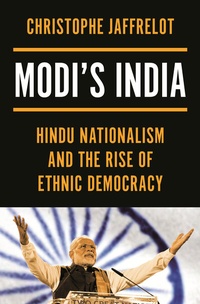
Modi's India
Hindu Nationalism and the Rise of Ethnic Democracy
1st Edition
Published on 1. October 2021
656 pages
978-0-691-22309-4 (ISBN)
Description

A riveting account of how a popularly elected leader has steered the world's largest democracy toward authoritarianism and intolerance
Over the past two decades, thanks to Narendra Modi, Hindu nationalism has been coupled with a form of national-populism that has ensured its success at the polls, first in Gujarat and then in India at large. Modi managed to seduce a substantial number of citizens by promising them development and polarizing the electorate along ethno-religious lines. Both facets of this national-populism found expression in a highly personalized political style as Modi related directly to the voters through all kinds of channels of communication in order to saturate the public space.
Drawing on original interviews conducted across India, Christophe Jaffrelot shows how Modi's government has moved India toward a new form of democracy, an ethnic democracy that equates the majoritarian community with the nation and relegates Muslims and Christians to second-class citizens who are harassed by vigilante groups. He discusses how the promotion of Hindu nationalism has resulted in attacks against secularists, intellectuals, universities, and NGOs. Jaffrelot explains how the political system of India has acquired authoritarian features for other reasons, too. Eager to govern not only in New Delhi, but also in the states, the government has centralized power at the expense of federalism and undermined institutions that were part of the checks and balances, including India's Supreme Court.
Modi's India is a sobering account of how a once-vibrant democracy can go wrong when a government backed by popular consent suppresses dissent while growing increasingly intolerant of ethnic and religious minorities.
Over the past two decades, thanks to Narendra Modi, Hindu nationalism has been coupled with a form of national-populism that has ensured its success at the polls, first in Gujarat and then in India at large. Modi managed to seduce a substantial number of citizens by promising them development and polarizing the electorate along ethno-religious lines. Both facets of this national-populism found expression in a highly personalized political style as Modi related directly to the voters through all kinds of channels of communication in order to saturate the public space.
Drawing on original interviews conducted across India, Christophe Jaffrelot shows how Modi's government has moved India toward a new form of democracy, an ethnic democracy that equates the majoritarian community with the nation and relegates Muslims and Christians to second-class citizens who are harassed by vigilante groups. He discusses how the promotion of Hindu nationalism has resulted in attacks against secularists, intellectuals, universities, and NGOs. Jaffrelot explains how the political system of India has acquired authoritarian features for other reasons, too. Eager to govern not only in New Delhi, but also in the states, the government has centralized power at the expense of federalism and undermined institutions that were part of the checks and balances, including India's Supreme Court.
Modi's India is a sobering account of how a once-vibrant democracy can go wrong when a government backed by popular consent suppresses dissent while growing increasingly intolerant of ethnic and religious minorities.
More details
Language
English
Place of publication
Princeton, NJ
United States
Publishing group
De Gruyter
Target group
Professional and scholarly
Edition type
Digital original
Product notice
Reflowable
Illustrations
21 tables/graphs; 1 map; 1 figure
ISBN-13
978-0-691-22309-4 (9780691223094)
Schweitzer Classification
Other editions
Additional editions
Book
08/2021
Princeton University Press
€37.14
Shipment within 10-20 days
Persons
Christophe Jaffrelot is director of research at CERI-Sciences Po/CNRS in Paris, professor of Indian politics and sociology at King's College London, and a nonresident scholar at the Carnegie Endowment for International Peace. His books include The Pakistan Paradox: Instability and Resilience and Hindu Nationalism: A Reader (Princeton). He lives in Le Chesnay, France. Twitter @jaffrelotc
Content
- Cover
- Contents
- Acknowledgments
- Abbreviations
- Map of India
- Introduction: The Three Ages of India's Democracy
- Part I. The Hindu Nationalist Power Quest: Hindutva and Populism
- 1. Hindu Nationalism: A Different Idea of India
- Hindutva: What It Means to Be a Hindu
- Sangh Parivar and Politics
- The Social Profile of Hindu Nationalism
- 2. Modi in Gujarat: The Making of a National-Populist Hero
- A Pure Product of the RSS
- "The Emperor of Hindu Hearts"
- Moditva: Personalization of Power and Heroization
- A Charismatic Leader Sealing the Fate of the Moderation Thesis
- 3. Modi's Rise to Power, or How to Exploit Hope, Fear, and Anger
- The Political Orchestration of the Hindu Sense of Vulnerability
- The Rise of the Bajrang Dal and the Plebeianization of Hindu Nationalism
- A New Social Profile: The Sangh Parivar and Its "Angry Young Men"
- The 2014 Election Campaign
- 4. Welfare or Well-Being?
- Antipoverty Policies or Politics of Dignity?
- Villagers as Losers
- Diluting Reservations
- Modi, Champion of the Elite
- Conclusion to Part I
- Part II. The World's Largest de Facto Ethnic Democracy
- 5. Hindu Majoritarianism against Secularism
- Hinduizing the Public Space
- The Crusade against "Liberals"
- 6. Targeting Minorities
- Anti-Christian Xenophobia
- Recurrent Mobilizations against Muslims
- 7. A De Facto Hindu Rashtra: Indian-Style Vigilantism
- The Bajrang Dal, the Sangh Parivar's Armed Wing
- Vigilantes and State Administrations
- The Rise of a Parallel State: Law and Order as Moral Order
- Digital Vigilantism and Physical Violence against "Sickularists"
- Conclusion to Part II
- Part III. The Indian Version of Competitive Authoritarianism
- 8. Deinstitutionalizing India
- Who's Afraid of the Lokpal?
- The Slow Death of the Right to Information
- The Vain Resistance of the Central Bureau of Investigation
- The National Investigation Agency and the CBI: From "Caged Parrots" to Watchdogs on a Leash
- The Supreme Court, from Resistance to Surrender
- What Fourth Estate?
- 9. Toward "Electoral Authoritarianism": The 2019 Elections
- Chowkidar Modi
- A Well-Oiled Election Machine
- Caste Politics and Its Paradoxes
- An Uneven Electoral Playing Ground
- Modi's BJP: The Elitist Hegemon
- 10. The Making of an Authoritarian Vigilante State
- Fighting Political Opponents by Other Means-in and out of Parliament
- The Making of a Majoritarian State Fighting Dissent
- Policemen as Vigilantes and "Urban Naxals" as Political Prisoners
- 11. Indian Muslims: From Social Marginalization to Institutional Exclusion and Judicial Obliteration
- Invisible in the Republic: Long-Standing but Aggravated Institutional Marginality
- Muslims in Dealings with the Police and the Courts
- Judicial Majoritarianism: Preparing the Ground for a Ram Temple in Ayodhya
- Conclusion
- Notes
- Select Bibliography
- Index
