

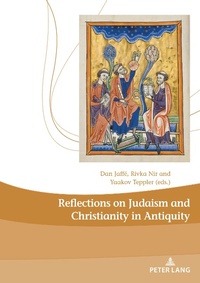
Reflections on Judaism and Christianity in Antiquity
Description

This book written by Israeli scholars reflects the centrality of 'the Parting of the Ways', an issue of focal concern to the question where and when came into being the boundary line separating between Judaism and Christianity. It is reflective of the diversity within the research community in Israel, much like in the field of research worldwide.
More details
Other editions
Additional editions
Persons
Dan Jaffé is Senior Lecturer of Jewish History at Bar-Ilan University and chief editor of the series Judaïsme ancien et christianisme primitif published by Cerf Edition in Paris. He has published many studies on Rabbinic Judaism, Early Christianity and Jewish historiography on the historical Jesus. His recent books are Les identités en formation. Rabbis, hérésies, premiers chrétiens (2018) and Juifs et chrétiens aux premiers siècles. Identités, dialogues et dissidences (2019).
Rivka Nir is researcher and a teacher of Jewish History in the Second Temple Period and Early Christianity at The Open University of Israel. Her publications include The Destruction of Jerusalem and the Idea of Redemption in the Syriac Apocalypse of Baruch (2003), Joseph and Aseneth. A Christian Book (2012) and The First Christian Believer, In Search of John the Baptist (2019).
Yaakov Teppler is Lecturer of Jewish Studies in Late Antiquity and Early Middle Ages, former Head of the History Department and now Dean of Students at Beit Berl College, Israel. He is author of Birkat Haminim, Jews and Christians in Conflict in the Ancient World (2007) and a number of published studies on Rabbinic Judaism and Christianity.
Content
List of Contributors - About the Editors - Preface - Introduction - Rivka Nir: The 'Christian' Message of John the Baptist in the Synoptic Gospels - David (Dmitry) Kopeliovich: The New Jeremiah in the New Testament: Concerning Some Narrative Strategies in Luke - Serge Ruzer: Moses and Jesus as Bearers of God's Logos in the Prologue of John and the Question of John's Christology - Summary of a Lecture by Daniel. R. Schwartz: Would the Christian Paul Consider Himself a Jew? - Jonathan Bourgel: Th e Fiscus Judaicus: A Touchstone of Jewish (- Christian) Identity? - Dan Jaffé: Extra Ecclesiam nulla Salus! Birkat ha- minim Reconsidered - Text and Context - Yael Wilfand: 'Like Snake Venom'? The Rabbis and Christian Charity -Menachem Ben Shalom: Rabbi Hanina ben Dosa and his Hasidic Image in Light of Talmudic Tradition (Yerushalmi v. Bavli) - Yaakov Teppler: The Trial of Rabbi Eliezer ben Hyrcanus and the Parting of the Ways - Barak S. Cohen: Dating Anti- Christian Sources in the Babylonian Talmud - Ben Zion Rosenfeld and Arie Levene: The Christian Community in Syria (110- 180 CE): The Creation of 'Syrian Christianity' - Eyal Regev: Were the Early Christians Sectarians? Searching for Sectarianism in the New Testament.
