

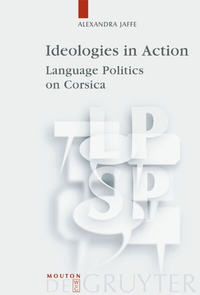
Ideologies in Action
Description

In Corsica, spelling contests, road signs, bilingual education bills and Corsican language newscasts leave language planners and ordinary speakers deeply divided over how to define what "counts" as Corsican and how it is connected with cultural identity. In Ideologies in Action Alexandra Jaffe explores the complex interrelationship between linguistic ideologies and practices on the French island of Corsica. This detailed exploration of the ideological and political underpinnings of three decades of language planning raises fundamental questions about what it means to "save" a minority language, and the way in which specific cultural, political and ideological contexts shape the "successes" and "failures" of linguistic engineering efforts.
Jaffe's ethnography focuses both on the way dominant language ideologies are inscribed in the everyday experience of ordinary people, as well as how they shape the evolving strategies of language planners trying to revitalize the Corsican language. While Jaffe's analysis demonstrates the pervasive influence of dominant language ideologies on minority language speakers and language planners, she also draws on case studies from everyday discourse, educational practice and public and mediatized debates over language issues to develop an ethnographically-grounded perspective on levels of resistance. In the final part of the book she explores the emergence (and the limits) of "radical" genres of resistance found in forms of Corsican language activism and in examples of codeswitching and language mixing in bilingual radio practice.
This book contributes to a growing literature on language ideology, and will be of interest to anthropologists, political scientists and linguists interested in the practical and theoretical dimensions of language contact, minority language literacy, bilingual education, and language shift.
More details
Other editions
Additional editions


Content
- Intro
- Acknowledgments
- 1 Introduction
- 1. Introduction
- 2. The ethnographic process: methods and relationships
- 2.1. Village life
- 2.2. Language planners
- 3. Language in Corsican society: central, complex and contested
- 3.1. Vignette 1: In two language classes
- 3.2. Vignette 2: The politics of orthographic identity
- 3.3. Vignette 3: One nationalist's struggle: language in the politics of identity vs. language in everyday life
- 4. Metadiscourse, language and political economy
- 4.1. Language and political economy
- 5. Diglossia
- 6. Resistance
- 6.1. A typology of different kinds of resistance
- 7. Radical models of resistance: challenging dominant assumptions
- 2 Social space and place: models of identity
- 1. Geography: social and linguistic space
- 2. The village
- 2.1. Vignette 1. Pierrette
- 2.2. Vignette 2: Paul
- 2.3. Vignette 3: Jean
- 2.4. Vignette 4: Michel Mallory
- 2.5. Vignette 5: Henri, and others
- 2.6. Summary: language and the village
- 3. History, social relations and identity
- 3.1. Outside rule
- 3.2. Kinship and "the clan"
- 4. The diaspora
- 4.1. The "unbroken cord": inalienable identity
- 4.2. Ambiguous status and ambivalent reactions
- 5. Corsican nationalism
- 6. Conclusions
- 3 Language shift and diglossia: ideology, history and contemporary practice
- 1. Corsican and Italian: a classic diglossic relationship
- 1.2. Corsican and Italian verbs
- 1.3. Articles and endings
- 1.4. Vocabulary
- 1.5. Pronunciation
- 1.6. Summary
- 1.7. Diglossia with Italian vs. diglossia with French
- 2. French linguistic politics
- 2.1. Language and nation
- 2.2. The role of the schools
- 2.3. Language and cultural integration
- 2.4. The military: national service and the mother tongue
- 3. Sociolinguistic effects of French language domination
- 3.1. Prestige and insecurity
- 3.2. Language shift: compartmentalization of language use by age
- 3.3. Domains of practice: inner and outer sphere
- 3.4. Gender
- 4. Codeswitching and language mixing
- 4.1. Conscious language choices and an "alternative market"
- 4.2. Heterogenous practices
- 5. Contact-induced varieties
- 5.1. Le Français régionale de Corse
- 5.2. Francorse
- 5.3. Gallicized Corsican
- 6. Conclusion
- 4 Language Activism Part I
- 1. Introduction
- 2. Language and nation: biological versus strategic essentialism
- 3. Overview of language activism and language legislation
- 3.1. The seventies
- 3.2. The eighties
- 3.3. The nineties
- 4. Major themes and debates in Corsican language activism
- 4.1. Differentiation from Italian: pragmatics and ideology
- 4.2. Language unity: the drive for elaboration
- 4.3. The boundary with French: the "purists" vs. the "sociolinguists"
- 4.4. Critical grammar as synthesis
- 5. Conclusions
- 5 Language Activism Part 2
- 1. Introduction
- 1.1. Background for the debates: the early eighties
- 1.2. Sources of data and survey results
- 2. Support for mandatory Corsican
- 2.1. The primordial link
- 2.2. Acknowledging language shift: a sense of urgency
- 2.3. The pragmatic effects of symbolic action: legitimacy and language attitudes
- 2.4. Summary
- 3. The argument against mandatory Corsican: "choice" and oppositional value
- 3.1. "Choice" and language hierarchy
- 3.2. "Choice" as the cornerstone of language value
- 3.3. The discourse of "choice": Corsican identity and the rejection of that which is imposed
- 3.4. Choice and the mother tongue
- 4. Lingua Matria
- 5. Coofficiality
- 6. From diglossia to polynomy
- 7. Conclusions
- Chapter 6 Language learning: its social evaluation and meaning
- 1. Reactions to a foreign learner: boundaries and community
- 1.1. The underestimation of competence
- 1.2. The exaggeration of competence
- 2. Social drama: learners as performers
- 3. Myths of acquisition: more boundary maintenance
- 4. The Corsican learner: problems of identity
- 4.1. The problem of the "prise de parole": inauthenticating error
- 4.2. Learner's Corsican
- 5. Pedagogical strategies
- 5.1. A sociolinguistic approach to variation and authenticity
- 5.2. Sociolinguistic choices
- 5.3. Limits to "choice": linguistic judgments in the classroom
- 6. A return to the problems of linguistic and cultural boundaries
- 7. Conclusions
- 7 Cracks in the public performance of Corsican literacy: the Second Annual Corsican Spelling Contest
- 1. The meaning of orthography
- 1.1. The role of writing in minority language promotion
- 1.2. Internal coherence: Corsican as an autonomous code
- 2. The symbolic meanings of the Spelling Contest
- 2.1. The cracks in the mirror
- 2.2. The role of writing
- 2.3. Language and social hierarchy: the question of elitism
- 2.4. "They" have an academy: the question of linguistic authority
- 2.5. Language standards and linguistic alienation
- 2.6. Regional diversity vs. a standard orthography
- 3. Conclusions
- 8 Moving language off center stage: media and performance
- 1. Radio: Radio Corse Frequenza Mora
- 1.1. Contests and standards: A Ghjustra Paesana and l'Accademia di i Stralampati
- 1.2. Language alternation and language mixing on the radio
- 2. Corsican reimagined: reference to Italian and other languages
- 2.1. Italy on the radio
- 3. Theater and storytelling
- 4. The newspaper
- 5. Some persistent "old" politics of representation at play in the media
- 5.1. Sociolinguistic responsibility vs. professional ideals
- 5.2. Popular purism: reactions to codeswitching and neologisms
- 4. Conclusions
- 9 Conclusion
- 1. Responding to dominance: stances and consequences
- 2. Applying dominant models of language to minority contexts
- 3. Lived experience and the persuasive power of dominant discourses
- 4. Problems of legitimation
- 4.1. The absence of an Academy
- 4.2. A short literary history
- 4.3. Linguistic value and identity as local and oppositional
- 4.4. Lack of a strong base of oral practice
- 4.5. The politicization of language and language choices
- 4.6. No social or economic coercion
- 5. The production of authoritative discourses
- 6. The role of ethnography in the comparative project
- Notes
- References
- Name index
- Subject index
