

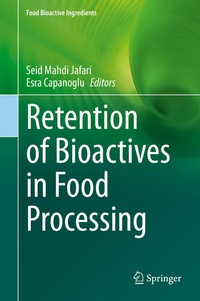
Retention of Bioactives in Food Processing
Description

Bioactive compounds in food, known for their positive health effects, can be lost during handling after harvest, processing and storage. While most foods are exposed to processing to increase shelf life and edibility and to ensure microbial safety, conventional processing methods may have disadvantages, such as decreasing the nutritional quality of foods, long processing times, high temperature and high energy uses. For these reasons, novel non-thermal food processing technologies (including HPP, ultrasound) and novel thermal food processing technologies (including microwave/Ohmic heating) have become widespread.
This book provides a critical evaluation of the effects of conventional, novel non-thermal, and thermal food processing techniques on the retention and bioaccessibility of bioactive compounds in food materials. Within these three categories, many different processing methods are included: fermentation/germination, drying, extrusion, and modified atmosphere packaging, as well as novel technologies, such as microwave heating, ultrasound, high pressure processing, ozonation, and membrane separation processes.
More details
Other editions
Additional editions
Persons
Prof. Seid Mahdi Jafari received his PhD in Food Process Engineering from the University of Queensland (Australia), in 2006. Now, he is a full-time Prof. of GUASNR (Iran), part-time Prof. in UVigo (Spain), and adjunct Prof. in SINANO (China). He has published > 350 papers in International Journals (h-index=64 in Scopus) and 80 book chapters/36 books with Elsevier, Springer, and Taylor & Francis. Selected achievements:
- one of the top 1% world scientists by Thomson Reuters (2015)
- one of the top national researchers by the Iranian Ministry of Science, Research, and Technology (2017)
- one of the world's highly cited researchers by Clarivate Analytics (Web of Science), in 2018, 2019 and 2020
- a top reviewer in the field of agricultural and biological sciences by Publons (2018 and 2019).
Content
Section 1: Introduction to bioactive compounds and food processes.- 1. An overview of food bioactive compounds and their health-promoting features.- 2. Different food processing technologies; a general background.- Section 2: Influence of conventional processes on food bioactive compounds.- 3. Postharvest Handling and Preparation of Foods for Processing.- 4. Thermal Treatments.- 5. Frying, baking and cooking.- 6. Chilling, Freezing and Thawing.- 7. Drying.- 8. Evaporation.- 9. Canning.- 10. Juice Processing.- 11. Extrusion.- 12. Fermentation and Germination.- 13. Extraction processes (SFE).- 14. Modified atmosphere packaging.- Section 3: Influence of novel thermal processes on food bioactive compounds.- 15. Microwave Heating.- 16. Ohmic Heating.- 17. Infrared Heating.-18. Radiofrequency and dielectric heating.- Section 4: Influence of novel non-thermal processes on food bioactive compounds.- 19. Irradiation.- 20. High Pressure Processing.- 21. Pulsed electric field (PEF), Pulsed X-Ray and Pulsed UV Processes.- 22. Ultrasound Treatments.- 23. Membrane separation processes.- 24. Ozonation, and plasma processing.- 25. Nano-based food processes.
